
On this page
Ask a founder what they will make if the company sells for $45 million, and most will multiply the price by their ownership. Own 40% of a $45 million company, take home $18 million. It is a reasonable guess, and it is almost always wrong.
The price a buyer pays is only where the math starts. Debt comes off the top, then deal costs, and what is left flows through the cap table in an order set by each share class's terms. Preferred shareholders are usually paid back before common sees a dollar, sometimes more than once. The result is that two people who own the same percentage of a company can walk away from the same exit with very different amounts.
That order of payment is called the liquidation waterfall, and as of this week you can model it directly in Ledger. This post walks through how a waterfall works, with real numbers, and then shows where it lives in the product.
The headline price is not your payout
Three things stand between the price in a press release and what reaches shareholders.
- Debt repaid at close. Venture debt, bank loans, and other obligations are settled first. A buyer paying $45 million for a company with $3 million of debt is really buying the equity for $42 million.
- Transaction costs. Bankers, lawyers, and accountants are paid out of the proceeds. A few percent of the deal is common.
- The share classes themselves. What remains, the net proceeds, is split according to each class's rights, not simply by ownership percentage.
The first two are subtraction. The third is where the surprises live.
The terms that decide who gets what
Every preferred share class carries a small set of economic terms, written into the company's articles or certificate of incorporation. They are negotiated once, at the financing, and then mostly forgotten until an exit makes them matter.
- Seniority. The order in which classes are paid. A senior class collects its full preference before a junior class receives anything. Classes can also rank equally (pari passu) and share pro rata.
- Original issue price. What investors paid per share. The preference is calculated from it.
- Preference multiple. How many times the original issue price the class is owed back before common. 1x is standard; 2x or 3x shows up in harder markets.
- Participation. Whether the class, after collecting its preference, also shares in what is left alongside common. Non-participating preferred must choose: take the preference, or convert to common and take its ownership share. Participating preferred gets both.
- Participation cap. A limit on how much participating preferred can collect in total, usually expressed as a multiple of what it invested. Above the cap, converting to common can become the better choice.
- Dividend accrual. Where a class has cumulative dividends, the unpaid amount builds up over time and is added to the preference at exit.
None of these are exotic. But they interact, and the interactions are what make a waterfall hard to reason about in your head.
A worked example
Take a company with 10 million shares on a fully diluted basis, split across three classes:
| Class | Shares | Ownership | Invested | Terms |
|---|---|---|---|---|
| Series A Preferred | 2,000,000 | 20% | $10M at $5.00 | Senior, 1x, participating, capped at 3x ($30M) |
| Series Seed Preferred | 1,000,000 | 10% | $1M at $1.00 | Junior to A, 1x, non-participating |
| Common | 7,000,000 | 70% | Founders and employees |
The company has raised $11 million in total. Now run four exits, each stated as net proceeds after debt and costs. (The $40 million case is our $45 million headline price, less $3 million of debt and $2 million of deal costs.)
| Net proceeds | Series A | Series Seed | Common | Common per share |
|---|---|---|---|---|
| $10M | $10.0M (100%) | $0 | $0 | $0.00 |
| $40M | $16.0M (40%) | $3.0M (7.5%) | $21.0M (52.5%) | $3.00 |
| $120M | $30.0M (25%) | $11.25M (9.4%) | $78.75M (65.6%) | $11.25 |
| $200M | $40.0M (20%) | $20.0M (10%) | $140.0M (70%) | $20.00 |
Walk through each row and the terms come to life.
At $10 million, the Series A is senior and owed $10 million back. It takes all of it. The seed investors, the founders, and every employee with shares receive nothing, even though together they own 80% of the company. This is not a corner case: selling for less than the total raised is one of the most common exits there is.
At $40 million, the Series A takes its $10 million first. The remaining $30 million is shared across all 10 million shares at $3.00 each, and because the Series A participates, it takes another $6 million on top of its preference, for $16 million in total. The seed investors run the same test the product does: keep a $1 million preference, or convert to common and take $3 million. They convert. Common, which owns 70% of the company, receives 52.5% of the proceeds, at $3.00 a share. The Series A paid $5.00 a share and is getting $8.00 back.
At $120 million, the Series A's preference plus participation would come to $32 million, but its cap is $30 million, so it stops there. The $2 million it gives up flows to everyone else. Common's share climbs back toward its ownership.
At $200 million, the Series A is better off abandoning its preference altogether. Converted to common, its 20% is worth $40 million, well above the $30 million cap. Every class now receives exactly its ownership percentage, and the preferences stop mattering.
When converting beats the preference
That last row points to the most useful number in any waterfall: the exit value above which a preferred class is better off converting to common.
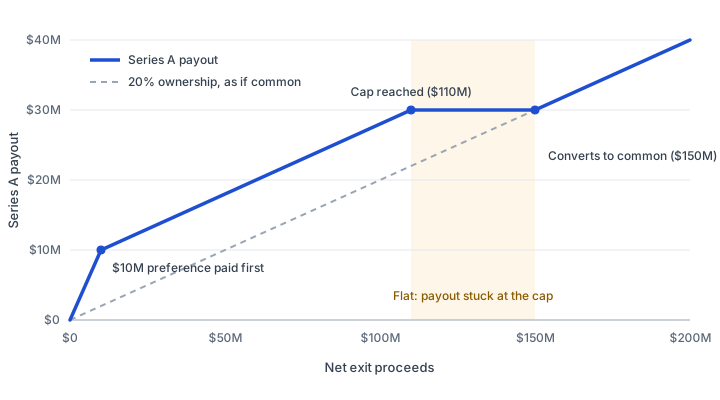
For our Series A, two points matter. Its payout hits the $30 million cap at a $110 million exit. Converting only pays more once 20% of the proceeds exceeds $30 million, which happens at $150 million. In between is a flat stretch where a $40 million increase in the sale price does not move the Series A's payout by a dollar.
That flat stretch changes incentives in a negotiation. An investor sitting in it has little reason to push for a higher price, while common shareholders gain from every extra dollar. The seed class has its own, much lower crossover: it converts at any exit above $20 million. Knowing where each class sits on its own curve tells you who wants what at the table, before anyone says it out loud.
Options, SAFEs, and the questions spreadsheets skip
Our example kept to issued shares. Real cap tables have more moving parts, and each needs a decision before the numbers mean anything.
- Unexercised options. Do vested, in-the-money options count as if exercised, adding shares to common and exercise money to the pot? Are unvested options accelerated, cancelled, or assumed by the buyer? Each choice changes the per-share figure for common.
- Outstanding SAFEs. A SAFE that has not converted by the time of an exit usually has its own rule, typically the greater of its purchase amount back or what it would receive as converted shares. Its position relative to preferred and common depends on its terms.
- A round that has not happened yet. Founders modeling a future exit often want to see it after the next financing, with the new class's preference stacked on top. That is a different cap table from today's.
This is where waterfall spreadsheets tend to break. The formulas are built once, around the cap table as it looked at the time, and every new class, conversion, or grant needs someone to rewire them correctly.
Modeling it in Ledger
The exit waterfall lives in the Scenarios tab of the cap table. Enter an exit value, any debt repaid at close, and transaction costs, and Ledger works through each share class in order of seniority, applying preference multiples, participation, caps, and accrued dividends, and shows what each class and each holder receives.
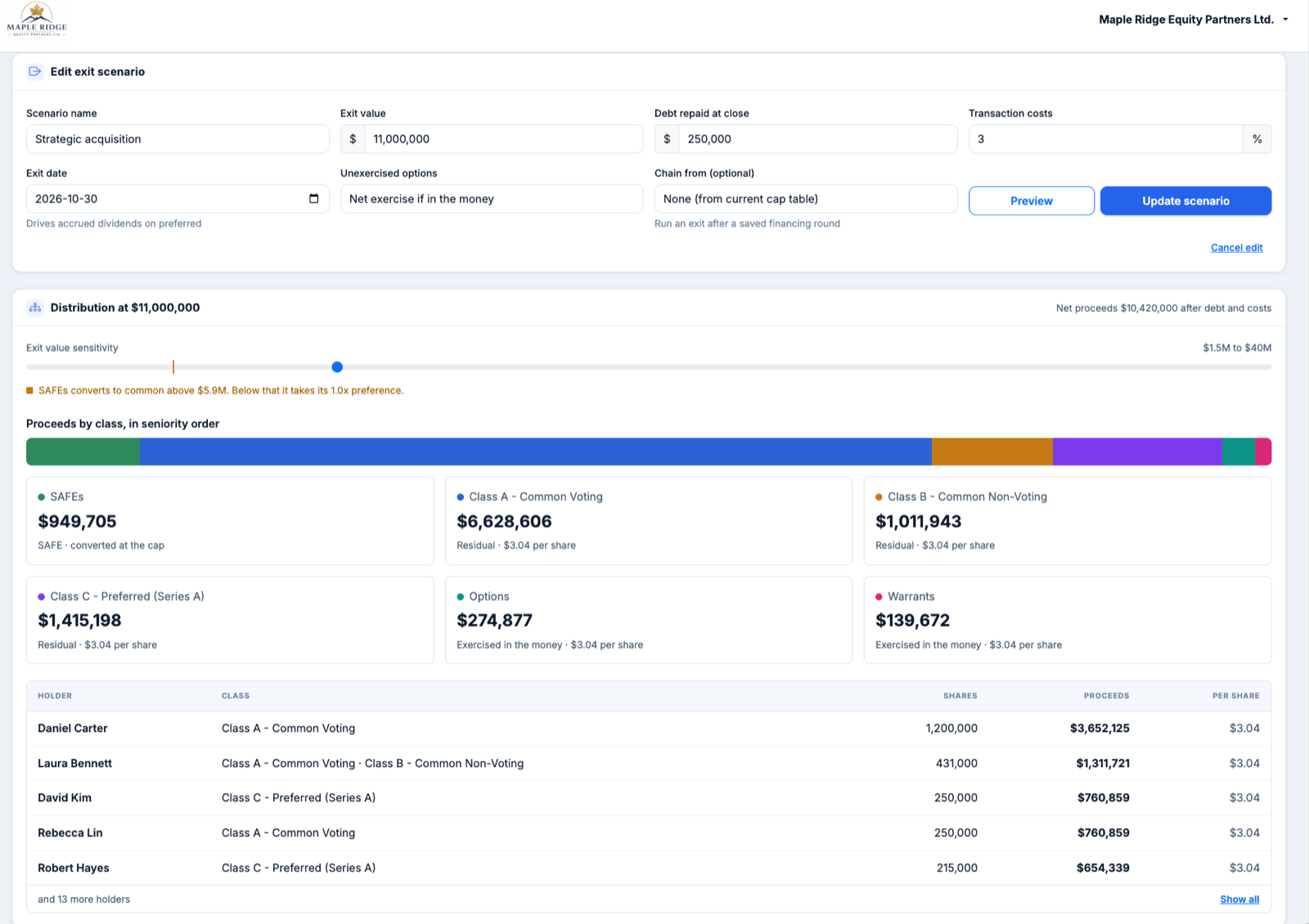
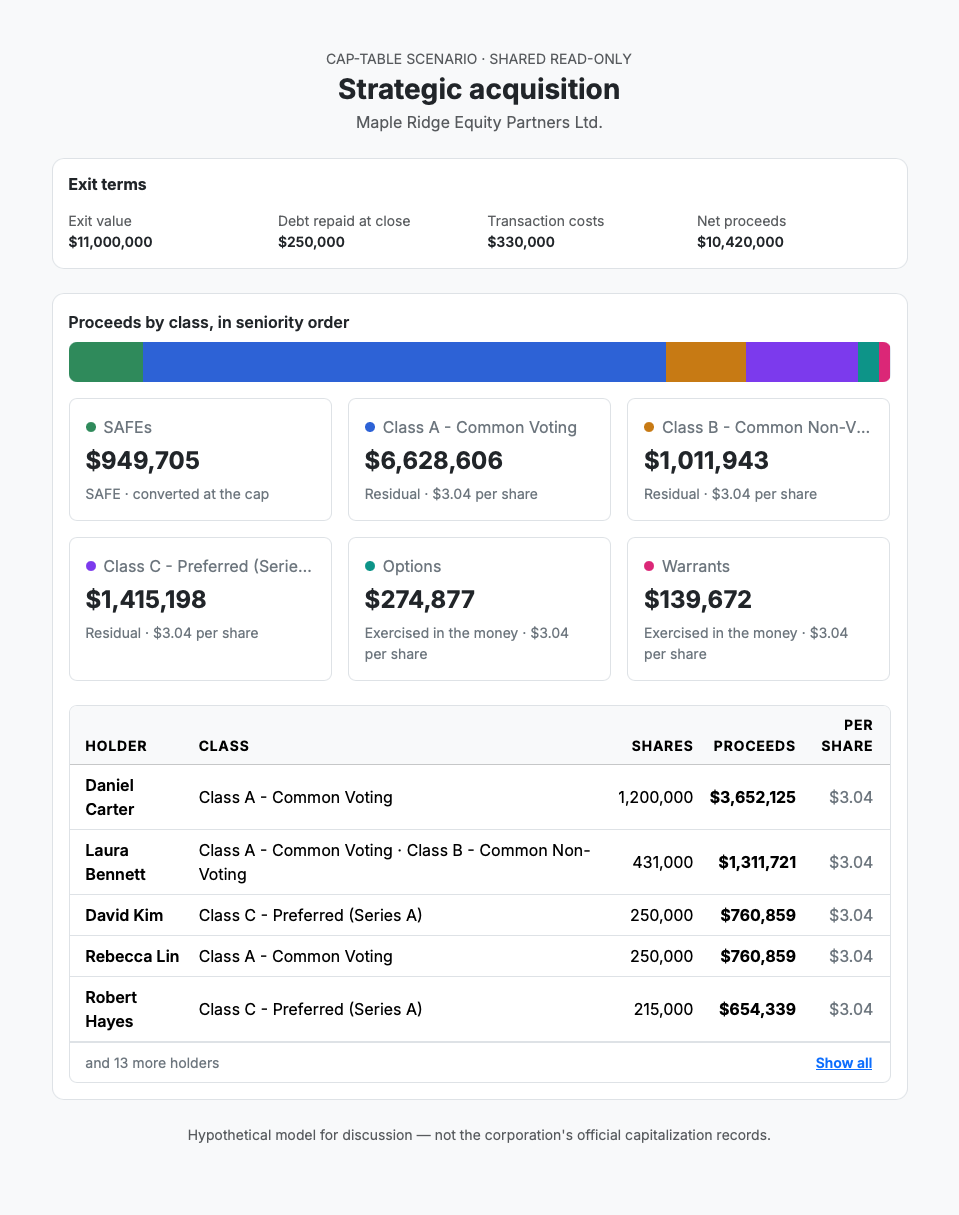
You choose how unexercised options are treated, see how outstanding SAFEs convert, and run the exit on the current cap table or after a financing round you have already saved as a scenario. A sensitivity scale lets you slide the exit value across a range and watch each class's share move, with a marker at the point where a class is better off giving up its preference and converting to common, and a note spelling out what it takes on either side. Scenarios can be saved, edited, and shared through a read-only link, so a board member or counsel can review the same numbers.
The waterfall is only as good as the terms it reads, so share classes in Ledger now carry their full economic terms: Common or Preferred, seniority, original issue price, preference multiple, participation, and dividend accrual, alongside votes per share and rights and restrictions. Guided setup asks whether each new class is Common or Preferred, and if a preferred class is missing its preference multiple or original issue price, Ledger flags it on the corporation's Overview with a link to fix it. The model uses the terms your records actually hold, not a second copy of them in a spreadsheet.
One note on scope: a waterfall model is a planning tool. The rights that actually govern an exit are the ones in your articles, your shareholder agreements, and the deal documents, and your counsel should confirm them before anyone relies on the numbers.
The bottom line
An exit is the one moment when every term negotiated across every round is applied at once. Founders who model it early know what a given offer is worth to them, where each investor's incentives sit, and which terms are worth pushing back on in the next round. Those who don't tend to find out at closing.
Read more about the terms behind the model in our glossary entries on liquidation preference and preferred stock, see both updates in the changelog, and run your own exit in Octelligence Ledger.