How to issue share certificates in Minnesota
A share certificate is the corporation's representation that a shareholder holds the shares the certificate names. Under Minnesota Statutes Chapter 302A, the procedure follows the universal pattern with the jurisdictional specifics noted below.
| Statute | Minnesota Statutes Chapter 302A |
|---|---|
| Short citation | MN Stat. Ch. 302A |
| Relevant sections | state corporation statute (certificate provisions) |
| Registry | Minnesota Secretary of State |
- The certificate is evidence; the register is the record
- Certificates are numbered sequentially, with no skips and no reuse
- Required fields: corporation name, share class, share count, certificate number, date, holder name, officer signatures
- Uncertificated form is permitted in most jurisdictions and operationally simpler at scale
- Cancelled certificates are retained, not discarded
In Minnesota
In Minnesota, the procedure to issue share certificates operates under Minnesota Statutes Chapter 302A. The substantive steps mirror the universal pattern, with the applicable provisions found in state corporation statute (certificate provisions). The Minnesota Secretary of State is the primary public-record destination for any filings flowing from the procedure. Diligence counsel will reconcile the corporation's internal records against the public record at Minnesota Secretary of State as part of the standard review.
Steps
Confirm the authorizing resolution
A certificate is issued only pursuant to an authorizing resolution. The resolution identifies the shareholder, the class, the share count, and the consideration. Without a resolution, the certificate cannot be issued. The resolution and the certificate share the same date (the issuance date) or the certificate's effective date is the date specified in the resolution. See the board resolution procedure.Decide certificated or uncertificated
Most modern corporation statutes permit shares to be uncertificated, with the register entry alone serving as the record of ownership. DGCL § 158 permits uncertificated stock; CBCA s. 49 permits uncertificated securities; Companies Act 2006 permits CREST-eligible uncertificated holdings. Uncertificated form eliminates the physical-document overhead, reduces cancellation friction on transfers, and is operationally simpler. Some shareholders (particularly individual founders and small-corporation shareholders) still prefer a physical certificate. Either is acceptable.Assign the next sequential certificate number
Certificate numbers are sequential, starting from 1 at incorporation. Each issuance takes the next number. Skipped numbers, reused numbers, and out-of-order numbering all read as poor record-keeping in diligence. The corporation tracks the next available number in the register or in a separate sequence log. For an uncertificated record, the same sequential numbering is applied.Populate the required fields
Every certificate must include: the full legal name of the corporation, the jurisdiction of incorporation, the class and series of shares, the number of shares represented (in figures and words), the certificate number, the date of issuance, the name of the registered holder, and any restrictions on transfer (legends required by the shareholders' agreement, securities laws, or other agreements). The certificate is then signed by the officers permitted to sign under the bylaws.Apply transfer restriction legends
Where the shares are subject to transfer restrictions (under the shareholders' agreement, securities laws, or other agreements), the certificate bears restriction legends. Common legends: "The securities represented by this certificate have not been registered under the Securities Act of 1933 and may not be transferred except in accordance with..." for US private-placement issuances; "The securities represented by this certificate are subject to the terms of a Shareholders' Agreement dated..." for issuances subject to a shareholders' agreement. The legend is on the face of the certificate, in legible type.Sign and seal
The certificate is signed by the officers permitted to sign under the bylaws. Typical practice: the president and the secretary (or two officers with comparable authority) sign. The corporate seal (if the bylaws require it) is applied. Modern practice in many jurisdictions has dispensed with the seal as a requirement, but the bylaws may still mandate its use. Electronic signature is permitted under modern statutes.Update the register and deliver the certificate
The register entry is made on the issuance date, recording the certificate number, holder, class, count, consideration, and date. The certificate is delivered to the holder (physical delivery, mailed, or held by counsel on the holder's behalf). For uncertificated shares, the register entry is the delivery; a notice of issuance is sent to the holder confirming the entry. The shareholder's acknowledgement of receipt may be requested but is not always required.File the certificate copy and supporting documents
A copy of the issued certificate (or the uncertificated issuance record), the executed subscription agreement, the proof of consideration received, and the authorizing resolution all go into the minute book together. Original cancelled certificates from prior holders (on transfers) are also retained in the minute book. The certificate copy is the document a diligence team will inspect to reconcile against the register entry.
Common mistakes
- Certificate issued without an authorizing resolution. A certificate is generated and delivered to a shareholder but no board resolution authorizes it. The issuance is unauthorized and the certificate may be voidable.
- Certificate number conflicts with a prior cancelled certificate. Cancelled certificate 14 is on file. A new issuance is given the number 14. Years later, the conflict surfaces in reconciliation and the chain of issuance is unclear.
- Transfer restriction legend missing. The shares are subject to a shareholders' agreement, but the certificate has no legend referencing the agreement. A subsequent transferee may take the shares free of the agreement's restrictions.
- Certificate face says one thing, register says another. The certificate is for 100 shares but the register entry shows 1,000. The clerical error is unrecoverable without going back to the authorizing resolution and reissuing the certificate.
- Certificate verification impossible by third parties. A bank or counterparty wants to verify a certificate's authenticity. The corporation has no mechanism to confirm: no QR-verified link, no central registry, no transfer agent. The verification request stalls.
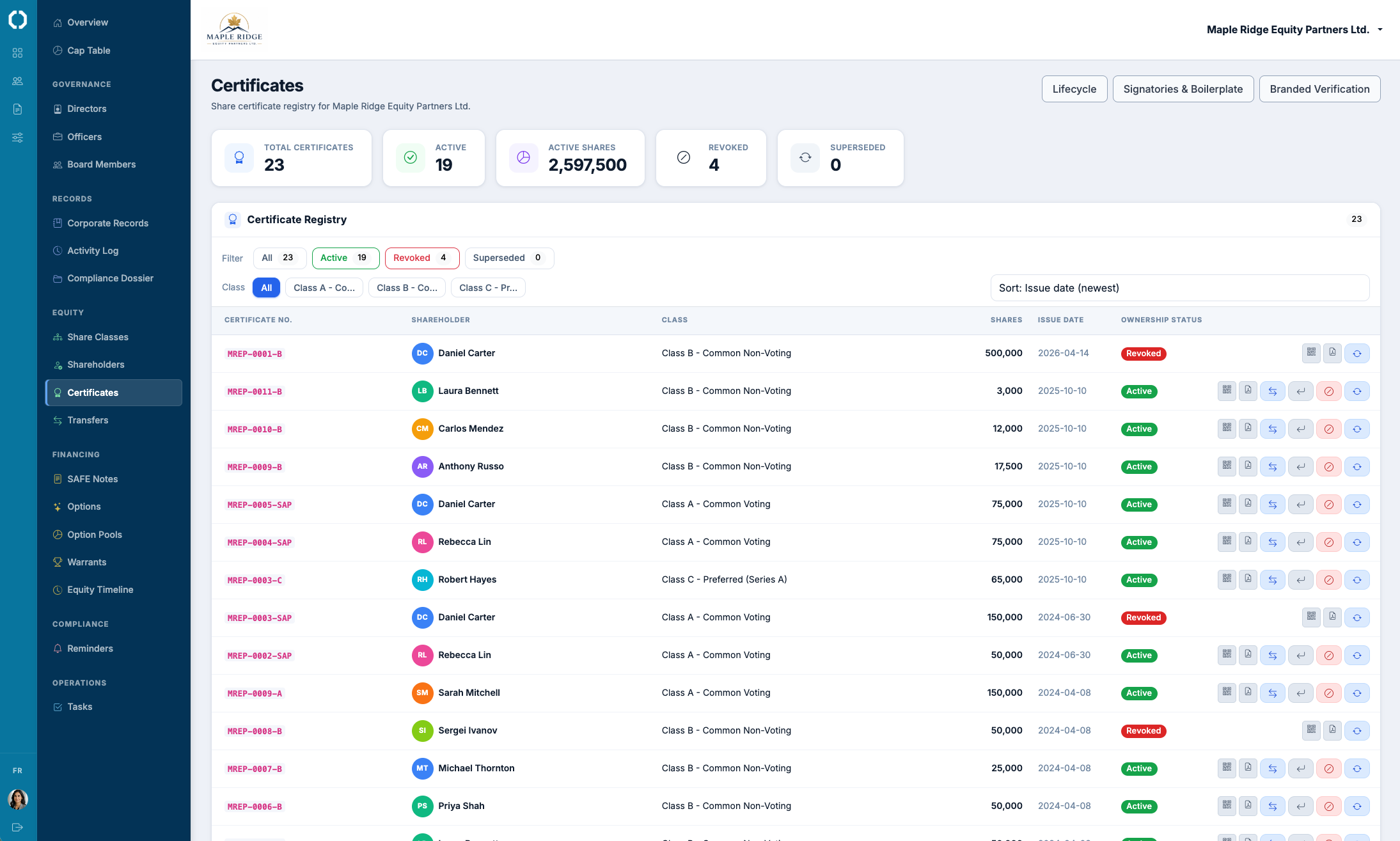
Octelligence issues share certificates with sequential numbering, the required fields populated from the issuance details, transfer-restriction legends applied where required, and a QR-verified public link that confirms the certificate's status against the register in real time. Bank verification, diligence counsel verification, and counterparty verification all work without phone calls.
See Share CertificatesCommon questions
Sequential numbering, mandatory fields populated, transfer-restriction legends applied, and a verifiable QR link to the register entry.