How to pass a board resolution in Virginia
Most board decisions in private corporations are documented as written resolutions rather than minuted meetings. Under Virginia Stock Corporation Act, the procedure follows the universal pattern with the jurisdictional specifics noted below.
| Statute | Virginia Stock Corporation Act |
|---|---|
| Short citation | VSCA |
| Relevant sections | state corporation statute (written consent and conflicts provisions) |
| Registry | Virginia State Corporation Commission |
- Written consent of all directors substitutes for a meeting in most jurisdictions
- Conflicts of interest must be disclosed and the conflicted director typically abstains
- The resolution should identify what is authorized, in language a stranger could parse two years later
- Resolutions are dated on the date of the last signature or the effective date stated in the resolution itself
- Resolutions go into the minute book chronologically, with the underlying documents (subscription agreements, share transfer forms, etc.) attached
In Virginia
In Virginia, the procedure to pass a board resolution operates under Virginia Stock Corporation Act. The substantive steps mirror the universal pattern, with the applicable provisions found in state corporation statute (written consent and conflicts provisions). The Virginia State Corporation Commission is the primary public-record destination for any filings flowing from the procedure. Diligence counsel will reconcile the corporation's internal records against the public record at Virginia State Corporation Commission as part of the standard review.
Steps
Draft the resolution
The resolution begins with recitals (the context: what is being decided and why) and proceeds to the operative clauses ("NOW THEREFORE, BE IT RESOLVED, that..."). Each operative clause states one action: approving a share issuance, appointing an officer, ratifying a contract, declaring a dividend. The resolution identifies any documents being approved by reference (the subscription agreement attached as Schedule A, the employment agreement attached as Schedule B, etc.). Plain English over Latin; specificity over generality.Disclose conflicts of interest
Any director with a material interest in the subject matter of the resolution must disclose the interest before the resolution is considered. The disclosure is recorded in the resolution itself ("The director [name] disclosed an interest in the transaction by reason of [description]") or in a separate written declaration. The conflicted director typically abstains from voting, though the statute and the bylaws control whether abstention is required or merely permitted.Choose the method: meeting or written consent
Two paths exist. A board meeting (in person, by telephone, or by video) considers the resolution, votes, and the minutes record the outcome. Written consent of all directors (or the required majority where the statute permits a less-than-unanimous standard, like DGCL § 141(f)) substitutes for a meeting. Written consent is faster for routine matters but requires every director to sign; meetings allow majority decisions. Most private corporations default to written consent for routine matters and meetings for material ones.Circulate for signature (written consent path)
The resolution is circulated to all directors for signature. Electronic signature is permitted in every modern jurisdiction (US Uniform Electronic Transactions Act, Canada's PIPEDA, UK Electronic Communications Act). The resolution is effective on the date of the last director's signature, or on the effective date stated in the resolution if it's prospective. If a director refuses to sign, the meeting path must be used.Hold the meeting and minute the decision (meeting path)
If a meeting is held, notice is given to all directors as required by the bylaws (typically 24-72 hours, with shorter notice permitted by waiver). Quorum requirements (typically a majority of directors) must be met. The resolution is moved, seconded, debated as appropriate, and voted on. Minutes record the resolution as passed, the vote count (or unanimity), and any abstentions or dissents. The minutes are signed by the chair and the secretary.File the resolution in the minute book
The executed resolution (or the minutes of the meeting, plus the resolution as an exhibit) goes into the minute book in chronological order. Any documents approved by the resolution (subscription agreements, share transfer forms, employment agreements, leases) are filed as schedules to the resolution or in a parallel section of the minute book with cross-references. The minute book is the authoritative record of board action.Implement the action authorized
The resolution authorizes; the action follows. A resolution approving a share issuance is followed by the actual issuance (register entry, certificate issuance, cap-table update). A resolution appointing an officer is followed by the officer's signed acceptance and any necessary employment documentation. The resolution alone is not the action; it is the authorization for the action. The action must follow to give the resolution effect.
Common mistakes
- Resolution drafted retroactively. The action is taken (shares issued, officer appointed, contract signed) and the resolution is drafted later to paper over the absence of authorization. Diligence counsel reads the date inconsistency as poor governance.
- Conflict not disclosed. A director with a material interest votes on the resolution without disclosing the interest. The transaction may be voidable on a shareholder challenge, and the director may face liability.
- One director not asked to sign. On a unanimous written consent path, one director is overlooked or assumed to be unreachable. The resolution is invalid until that director signs. The transaction proceeds and the gap surfaces in diligence.
- Resolution authorizes generically. The resolution says "the Corporation may issue shares as the officers determine" without identifying the issuance specifically. This is too generic to evidence the specific decision. Each material action should be authorized by a specific resolution.
- Resolution exists but the action wasn't taken. The board authorized something that never happened. The minute book shows the authorization but the operational evidence (register entry, signed agreement, etc.) is missing.
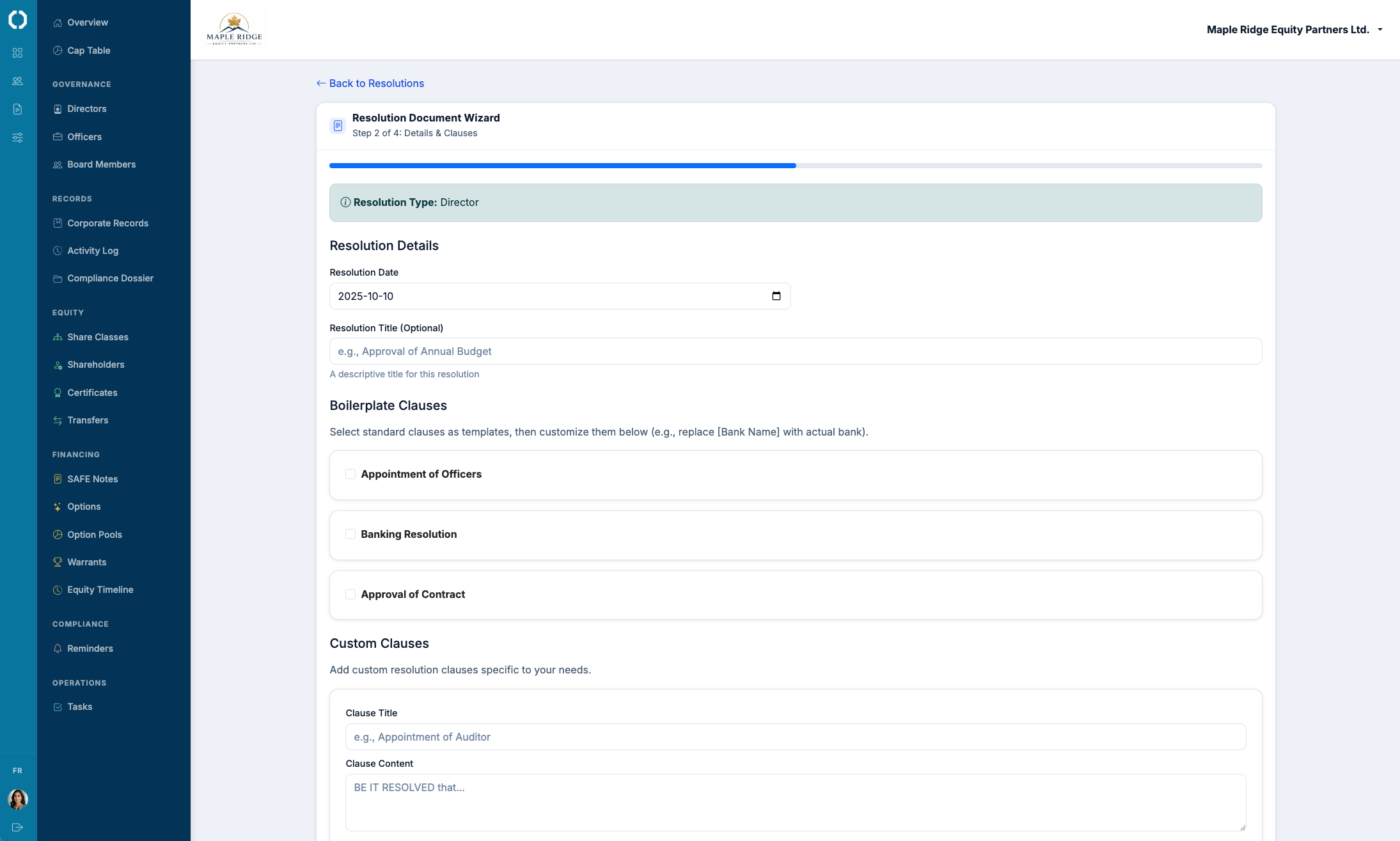
Octelligence's resolution workflow starts from the action being authorized (a share issuance, a director appointment, a contract approval), drafts the resolution with the right recitals and operative clauses, circulates for electronic signature with conflict-disclosure tracking, and files the executed resolution in the minute book. The action and its authorization stay in lockstep.
See Digital Corporate RecordsCommon questions
Resolutions drafted, signed electronically, conflict disclosures captured, and filed in the minute book before the action proceeds.