How to prepare for due diligence in Quebec
Due diligence is a fact-finding exercise run by counsel for an investor, an acquirer, or a lender. Under Loi sur les sociétés par actions du Québec, the procedure follows the universal pattern with the jurisdictional specifics noted below.
| Statute | Loi sur les sociétés par actions du Québec |
|---|---|
| Short citation | LSAQ / QBCA |
| Relevant sections | s. 35 (inspection of records) |
| Registry | Registraire des entreprises du Québec |
- Reconcile the share register to issued certificates: every certificate has an entry, every entry has a certificate
- Surface every authorizing resolution: option grants, share issuances, director appointments, material contracts
- Verify annual filings are current: corporate registry, beneficial-ownership filings, tax
- Check the cap table ties to the register on the current date
- Address transfer-restriction compliance: every transfer must have flowed through the corporation's process
- Pre-clear any anticipated questions with counsel before the data room opens
In Quebec
Quebec diligence has the additional layer of provincial filings with the Registraire des entreprises du Québec, separate from federal CRA filings. The annual updating declaration is the principal public touchpoint. Quebec's separate provincial corporate tax (CO-17) means diligence counsel verifies two layers of tax compliance.
Steps
Reconcile the share register to issued certificates
Pull every issued certificate (or uncertificated record). For each, confirm the register has a corresponding entry at the same date with the same class, count, and holder name. For each register entry, confirm a certificate exists. Discrepancies are investigated by tracing back to the authorizing resolution. Cancelled certificates should still be retained (stapled into the minute book or stored), and the cancellation date should match the register. Reconciliation is most painful when handled at the start of diligence; running it as ongoing practice avoids the cascade. See the share register maintenance procedure.Surface every authorizing resolution
Every share issuance, share transfer, option grant, officer appointment, director appointment, material contract, and amendment to the articles or bylaws should be authorized by a resolution in the minute book. Walk the cap table backward: for every entry, is there an authorizing resolution? For every option grant, is there a board resolution approving the grant on the grant date with the strike price? For every director on the corporate registry, is there a resolution recording the appointment? Missing resolutions are the most common diligence failure point.Verify annual filings are current
Pull the corporate registry record for the corporation. Confirm the annual return (or annual report, confirmation statement, etc.) is filed for every year of the corporation's existence. Confirm the registered directors on the registry match the internal register. Confirm the beneficial-ownership filings (ISC under CBCA/OBCA, PSC under UK, FinCEN BOI under US) are current. Any missed filings should be remedied immediately; delays at the corporate registry can take weeks to clear.Reconcile the cap table to the register
Generate the cap table on the current date. Confirm that issued shares match the register total. Confirm that outstanding options, warrants, SAFEs, and convertible notes are all reflected. Confirm fully-diluted percentages tie to the underlying instruments. The cap table should be reproducible from the register and the convertible-instrument schedule on any date. If the cap table can't be regenerated from the underlying records, the diligence counsel's first question will surface the gap.Verify transfer-restriction compliance
For every share transfer in the corporation's history, confirm that the transfer-restriction provisions in the bylaws and shareholders' agreement were satisfied. Right-of-first-refusal offered (or waived in writing). Board approval obtained where required. Permitted-transferee exemptions properly applied. The diligence team will read the shareholders' agreement and check the most recent material transfers; an unfollowed restriction is treated as a potential breach of contract that may require unwinding.Confirm IP and assignment of pre-formation work
For every founder and early employee, confirm an assignment of pre-formation intellectual property to the corporation. For every contractor or consultant who contributed material work, confirm a written work-for-hire or assignment agreement. Pre-formation IP that isn't assigned is the single most common reason early-stage financings stall in diligence. Fix it before the diligence team finds it.Pre-clear anticipated questions with counsel
Walk the records with the corporation's counsel before opening the data room. Counsel will identify the issues a diligence team will flag: a missing resolution, an unclear consideration record, a transfer that didn't flow through the corporation's process, a beneficial-ownership filing that's out of date. Each issue has a remediation: a ratifying resolution, a written acknowledgement, a corrective filing. Remediation is far easier when done before the diligence team asks; remediation in response to a diligence finding looks reactive and reduces leverage.
Common mistakes
- Diligence prep started after the term sheet. The corporation waits until the LOI or term sheet is signed before reconciling records. Diligence runs in parallel with the negotiation, and any record gap reduces the corporation's leverage on remaining commercial terms. Prep should start before the financing process opens.
- Cap table maintained outside the system of record. The cap table lives in a spreadsheet that no one can fully reconcile to the register. Diligence counsel's first question ("can you confirm the cap table on the current date matches the register?") surfaces the gap.
- Missing 83(b) elections. Founder issuances were made years earlier but the 83(b) election filings can't be located. The IRS service center can confirm filing in some cases, but the absence of a contemporaneous copy in the minute book is the failure point.
- Resolutions ratified retroactively in response to diligence. Diligence surfaces missing resolutions; the corporation drafts ratifying resolutions dated current and circulates them. The pattern is visible in diligence and reads as poor governance, even though ratification is legally effective.
- Beneficial-ownership filings out of date. The ISC, PSC, or FinCEN BOI report wasn't updated when ownership changed. The corporation is technically out of compliance and the filing must be brought current before closing.
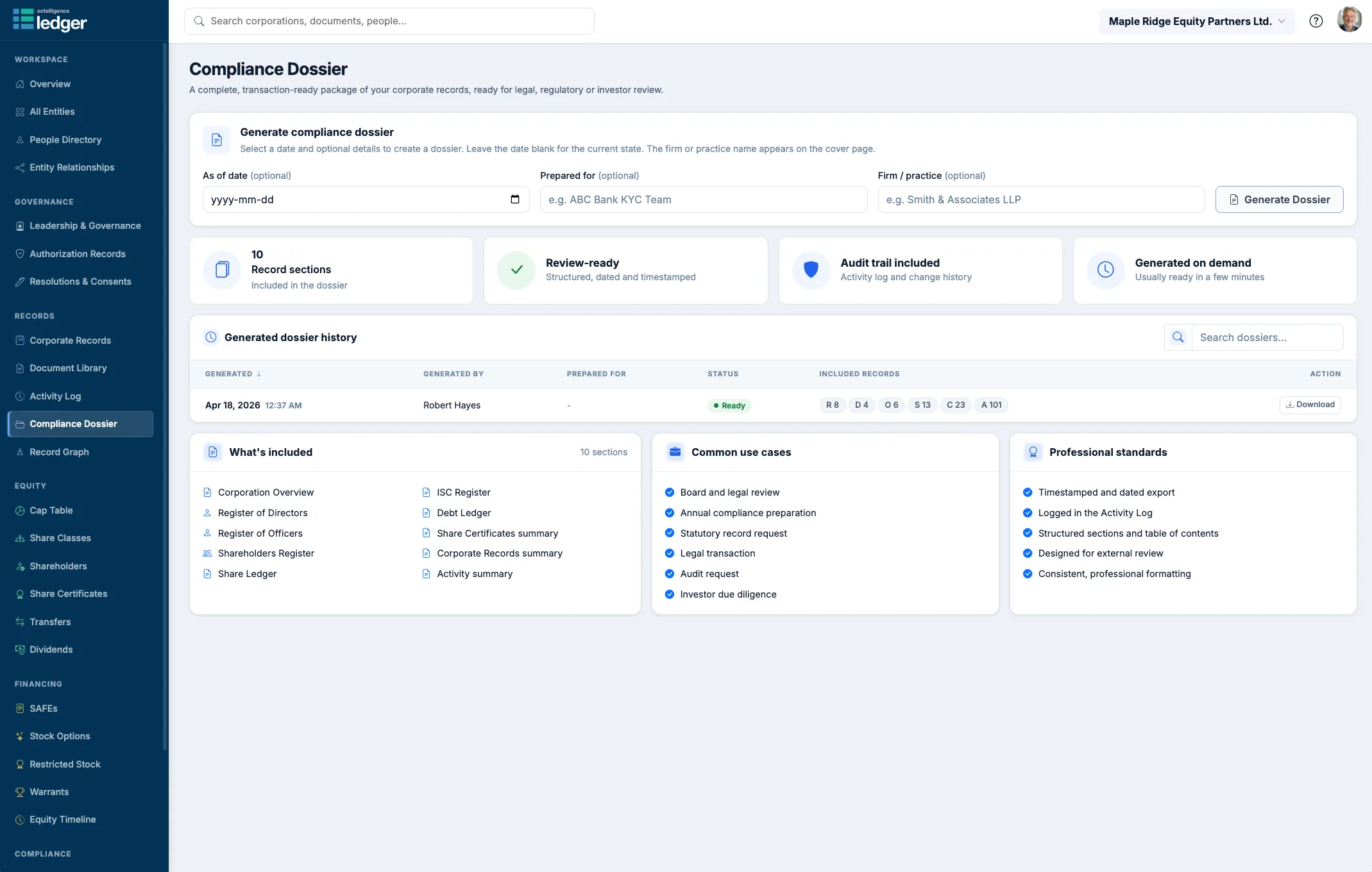
Octelligence keeps the records reconciled as the corporation operates: register matches certificates, cap table builds from the register, resolutions tie to the actions they authorize, and annual filings are tracked to deadlines. When diligence arrives, the bundle is already there.
See Digital Corporate RecordsCommon questions
Reconciled records, complete authorizing resolutions, current filings, and a cap table that ties to the register every day.