How to issue founder shares in Georgia
Founder shares are issued at the formation of the corporation or shortly after, when the value of the corporation is still close to zero. Under Official Code of Georgia Annotated Title 14, the procedure follows the universal pattern with the jurisdictional specifics noted below.
| Statute | Official Code of Georgia Annotated Title 14 |
|---|---|
| Short citation | OCGA Title 14 |
| Relevant sections | state corporation statute + IRC § 83 (US federal tax) |
| Registry | Georgia Secretary of State |
- Founder shares are issued, not granted as options. Options are a different instrument entirely
- Vesting is governed by the restricted-stock purchase agreement, not the share certificate
- In the US, the 83(b) election must be filed within 30 days of issuance to fix tax basis at the (near-zero) fair value
- In Canada, the equivalent planning uses the lifetime capital-gains exemption and the qualified small business corporation rules
- Founder issuance should be done before any external financing fixes a higher valuation
In Georgia
In Georgia, the procedure to issue founder shares operates under Official Code of Georgia Annotated Title 14. The substantive steps mirror the universal pattern, with the applicable provisions found in state corporation statute + IRC § 83 (US federal tax). The Georgia Secretary of State is the primary public-record destination for any filings flowing from the procedure. Diligence counsel will reconcile the corporation's internal records against the public record at Georgia Secretary of State as part of the standard review.
Steps
Decide the founder cap structure
Before any issuance, the founding team decides how the cap table will split among them, how many shares will be reserved for the option pool, and whether any shares will be held back for advisors or near-term hires. The total issuance at formation typically uses 6-8 million shares (US convention) or 1-2 million shares (Canadian convention), with the founder allocation set as a percentage of that total. The allocation decision is permanent in practice; reallocating founder shares later is feasible but expensive.Pass the authorizing resolution
The board (often the founders themselves as initial directors) passes a resolution authorizing the issuance of founder shares. The resolution identifies each founder by name, the class and number of shares, the consideration (usually nominal, like $0.0001 per share times the share count), and the vesting schedule. The resolution also approves the form of restricted-stock purchase agreement.Execute the restricted-stock purchase agreement
Each founder signs a restricted-stock purchase agreement (RSPA, sometimes called a founder stock purchase agreement). The RSPA records the consideration paid, the vesting schedule (typically four years with a one-year cliff), the corporation's right to repurchase unvested shares at the original price if the founder leaves, and the assignment of any pre-formation intellectual property. Founder shares are issued outright, but unvested shares are subject to repurchase, which is the mechanical equivalent of vesting.Pay the consideration
Each founder pays the consideration recited in the RSPA. The payment is usually small in absolute terms (cents to a few dollars), but it must actually clear; a missing payment record is one of the most commonly-cited diligence failures for founder issuances. Cleared cheque, wire confirmation, or a contemporaneous written acknowledgement of cash received are all acceptable, but a contemporaneous record must exist.File the 83(b) election (US founders)
In the US, founders who receive shares subject to vesting can elect under IRC § 83(b) to be taxed on the value of the shares at issuance (which is near-zero) rather than as the shares vest. Without the election, vesting events become taxable income at the then-fair-market value, which is the source of the founder tax disaster that every US startup advisor warns about. The election must be filed with the IRS within 30 days of issuance, with no extensions permitted. A copy is delivered to the corporation; the founder keeps the original mailing certificate. See the 83(b) election glossary term for the full mechanics.Update the share register and issue certificates
The share register records each founder issuance: name, share count, certificate number, consideration, and issuance date. The certificates are issued in the founder's name, marked with the RSPA restriction legend if the bylaws or RSPA require it. Some corporations issue certificates only after vesting cliffs are met; this is operationally simpler but legally identical to issuing at the start with vesting-subject-to-repurchase.File everything in the minute book
The authorizing resolution, each RSPA, proof of consideration paid, copies of any 83(b) elections, the share certificates, and the updated register all go into the minute book. The 83(b) election copy is particularly important: the IRS retains the original, and reconstructing whether an election was filed years later is the source of expensive disputes.
Common mistakes
- Missed 83(b) election. The 30-day window passes without the election being filed. This is the single most expensive founder mistake in the US; once missed, vesting events become taxable income at the then-fair-market value, which compounds rapidly as the corporation grows.
- Consideration never paid. The RSPA recites a payment that was never made. Years later, in diligence, the absence of a cleared cheque or transfer record creates a question of whether the shares were validly issued at all.
- Vesting schedule in the certificate, not the RSPA. The certificate face references vesting but no separate written agreement exists. The vesting terms are then unenforceable in practice; the RSPA is where the corporation's repurchase right lives.
- Founder issuance after external financing. Founders try to issue themselves shares at near-zero value after a priced round at a higher valuation. The IRS treats the spread as compensation income. Founder issuance must happen at formation, or soon after, while the fair market value is still demonstrably near zero.
- IP assignment missing. The RSPA assigns the founder's pre-formation IP to the corporation, but the assignment language is missing or incomplete. Diligence counsel will refuse to close a financing if pre-formation IP isn't cleanly assigned.
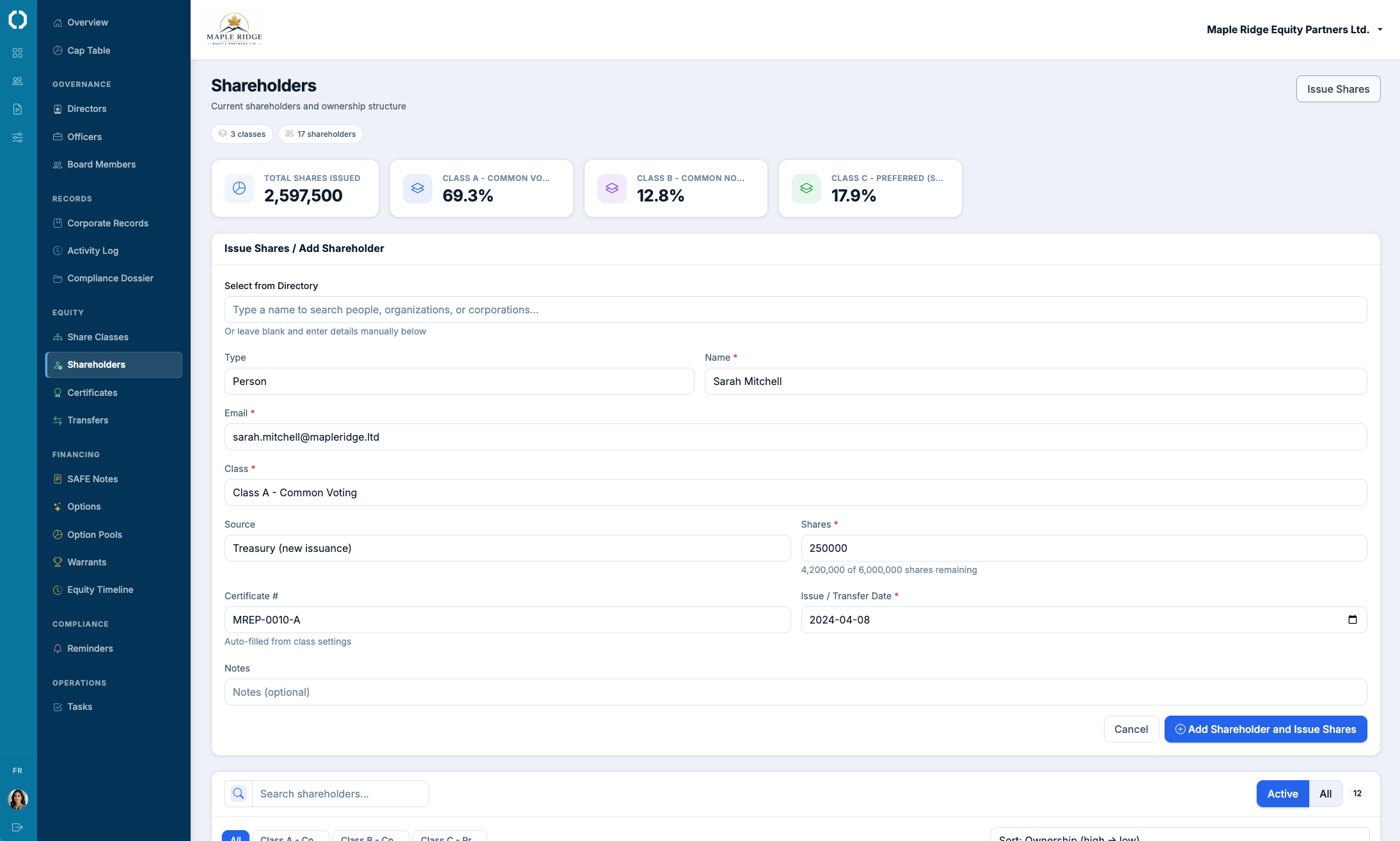
Octelligence handles the founder-issuance bundle: the authorizing resolution, the restricted-stock purchase agreement template (US or Canadian, with vesting), the consideration record, the certificate, the register entry, and (for US founders) the 83(b) election copy in the minute book. The diligence reconstruction problem disappears.
See Digital Corporate RecordsCommon questions
Structured RSPAs, the 83(b) election copy filed where it belongs, vesting tracked in the register, and a minute book that survives any diligence review.