Stock ledger requirements in Georgia (GBCC)
What a Georgia corporation must know about stock ledger requirements under Georgia Business Corporation Code, O.C.G.A. § 14-2-101 et seq.: statute citations, mechanics, and inspection rights.
| O.C.G.A. § 14-2-1601 | Records of shareholders |
|---|---|
| O.C.G.A. § 14-2-1602 | Inspection rights |
| O.C.G.A. § 14-2-625 | Stock ledger as source of ownership |
| O.C.G.A. § 14-2-1631 | Court enforcement |
- Records each shareholder's name, address, number and class of shares, and date acquired
- Maintained at the principal office; electronic form permitted
- Inspection rights granted to shareholders under state-specific 'proper purpose' standards (Delaware vs MBCA states differ)
- Transfers, issuances, and cancellations recorded chronologically
- Legal source of truth on ownership; the cap table is the operational analytical view
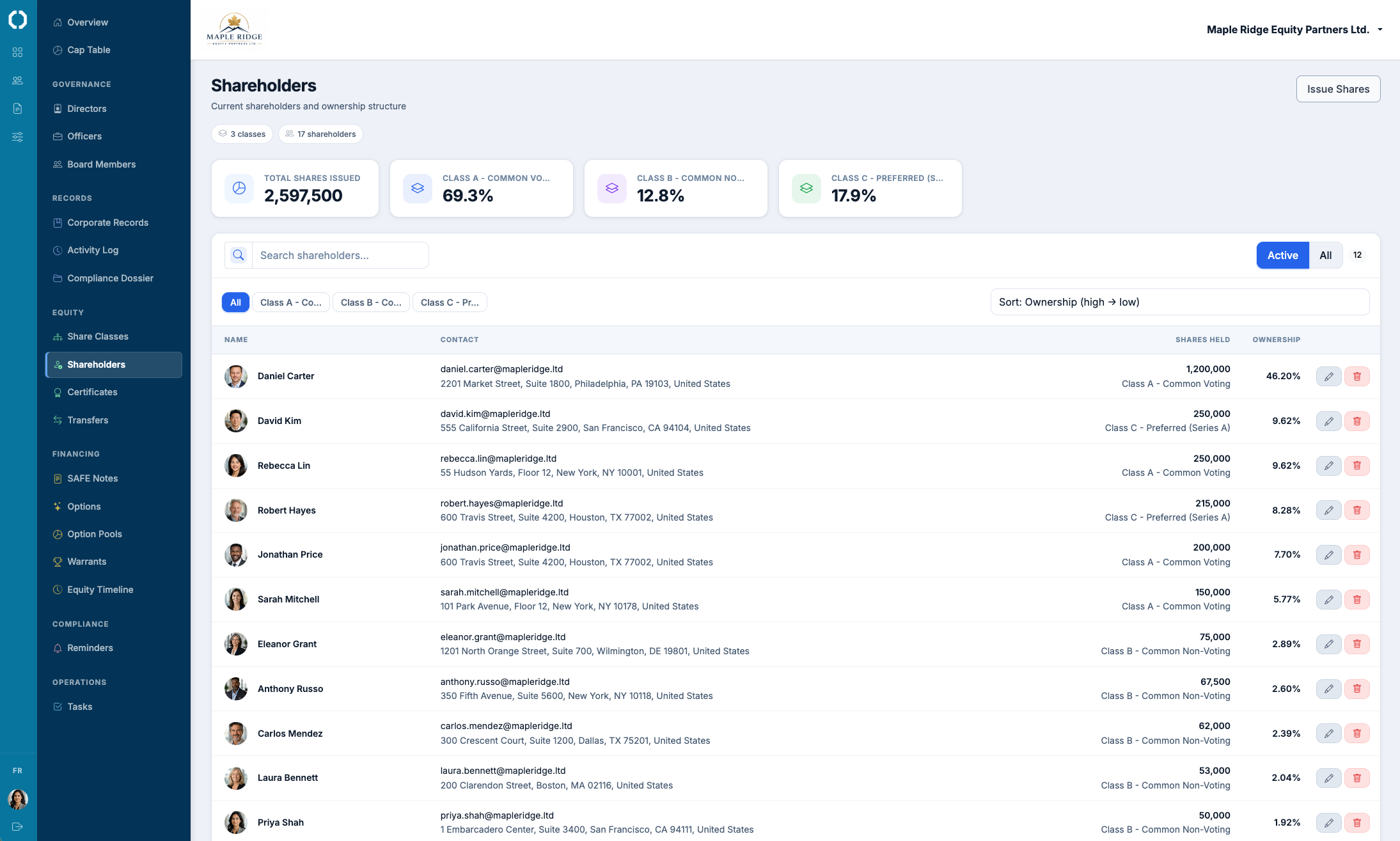
What the GBCC requires
O.C.G.A. § 14-2-1601 requires every Georgia corporation to maintain records of shareholders. Closely modeled on the MBCA.
- Shareholder name and address
- Number and class of shares held
- Date each shareholder became a holder
- Certificate numbers and dates
- Complete transfer history (cedent, transferee, dates, certificates cancelled and issued)
Difference from the cap table
The stock ledger is the statutory document — the legal source of truth on ownership. The cap table is the operational analytical view that models current and fully-diluted ownership. When they diverge, it is almost always the cap table that has drifted.
Inspection rights
Shareholders have a statutory right to inspect the stock ledger. State-specific standards vary: Delaware's DGCL § 220 is broadly permissive; MBCA-state versions require a 'proper purpose'; Nevada limits inspection to shareholders holding 15% or more. Most states require free extracts and reasonable copy fees.
In Octelligence, every issuance, transfer, and cancellation updates both the statutory stock ledger and the cap table simultaneously. You cannot have one without the other, which eliminates drift between them.
See Digital Corporate RecordsIssuances, transfers, cancellations recorded in real time. Cap table synchronized.