Share register and stock ledger requirements across 41 jurisdictions
The share register (Canada, UK) and stock ledger (US) are the corporation's official list of who owns what. They are the source of truth for ownership, voting rights, and inspection. What must be in the register, where it is kept, and who can see it, each jurisdiction prescribes its own rules.
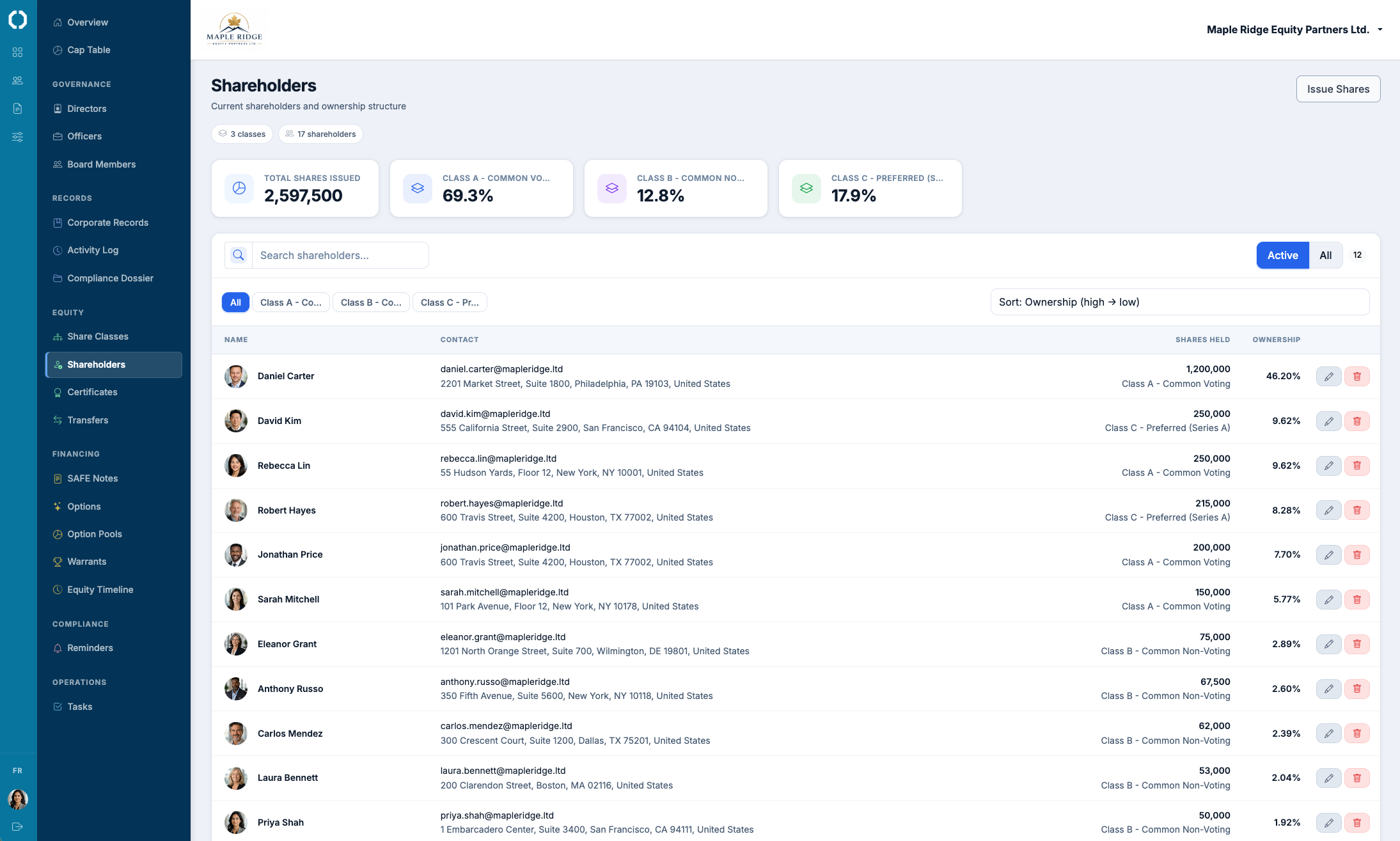
The single source of truth for share ownership
Of all the records a corporation must maintain, the share register (or stock ledger, in US parlance) is the most important. The certificates can be lost. The minutes can be reconstructed. The articles can be re-issued. The share register is the only document that authoritatively answers: who owns the corporation? When a certificate and the register disagree, the register controls, in every jurisdiction we cover.
What the register must contain, where it is kept, how often it is updated, and who can inspect it varies across jurisdictions. The differences are small in the abstract but operationally significant. A corporation maintaining a register under DGCL § 219 is doing something different from one maintaining it under CBCA s. 50 or UK CA 2006 s. 113. This page surveys those differences across 41 jurisdictions and the statutes that govern them.
Choose your jurisdiction
Each guide covers what to maintain, where to keep it, who can inspect, and what happens if you don't.
Canada (Federal / CBCA)
CBCA View requirements CanadaOntario
OBCA View requirements CanadaBritish Columbia
BCBCA View requirements CanadaAlberta
ABCA View requirements CanadaQuebec
QBCA View requirements CanadaManitoba
MCA View requirements CanadaNew Brunswick
NBBCA View requirements CanadaNewfoundland and Labrador
NLCA View requirements CanadaNova Scotia
NSCA View requirements CanadaPrince Edward Island
PEIBCA View requirements CanadaSaskatchewan
SBCA View requirements United StatesDelaware
DGCL View requirements United StatesCalifornia
Cal. Corp. Code View requirements United StatesNew York
NY BCL View requirements United StatesTexas
TBOC View requirements United StatesFlorida
FBCA View requirements United StatesNevada
NRS Ch. 78 View requirements United StatesWashington
WA BCA View requirements United StatesMassachusetts
M.G.L. c. 156D View requirements United StatesWyoming
WBCA View requirements United StatesColorado
C.R.S. Title 7 View requirements United StatesUtah
URBCA View requirements United StatesIllinois
805 ILCS 5/ View requirements United StatesNew Jersey
NJBCA View requirements United StatesGeorgia
GBCC View requirements United StatesNorth Carolina
NCBCA View requirements United StatesVirginia
VSCA View requirements United StatesArizona
A.R.S. Title 10 View requirements United StatesTennessee
TBCA-TN View requirements United StatesMinnesota
Minn. Stat. § 302A View requirements United StatesOregon
ORS Ch. 60 View requirements United StatesMichigan
MICA View requirements United StatesOhio
OGCL View requirements United StatesPennsylvania
PBCL View requirements United StatesConnecticut
C.G.S. § 33-600 View requirements United StatesMaryland
MGCL View requirements United StatesIndiana
IBCL View requirements United StatesWisconsin
Wis. Stat. Ch. 180 View requirements United StatesMissouri
RSMo Ch. 351 View requirements United StatesSouth Carolina
SCBCA View requirements United KingdomUnited Kingdom
CA 2006 View requirementsCompare requirements across jurisdictions
The same artifact, different rules.
| Jurisdiction | Governing statute | Required content | Inspection rights | Location requirement |
|---|---|---|---|---|
| Canada (Federal / CBCA) | CBCA s. 50 | Holders, shares, certificate numbers, dates | Shareholders + creditors (no proper-purpose threshold) | Registered office or designated Canadian location |
| Ontario | OBCA s. 141 | Holders alphabetized, shares, certs, dates | Shareholders + beneficial owners + creditors | Registered office |
| British Columbia | BCBCA s. 111 | Holders, shares, certs, dates, restrictions | Shareholders + creditors at records office | Records office in BC |
| Alberta | ABCA s. 50 | Holders, shares, certs, dates | Shareholders + creditors | Registered office or designated Alberta location |
| Quebec | QBCA art. 224-225 | Holders, shares, certs, dates, restrictions | Shareholders during business hours | Head office in Quebec |
| Delaware | DGCL § 219 | Stockholders, shares, dates, certificate numbers | Stockholders with proper purpose (§ 220) | No specific location (any form under § 224) |
| California | Cal. Corp. Code § 1500, § 1600 | Shareholders, shares, dates | Shareholders (no proper-purpose requirement) | Principal office in California |
| New York | NY BCL § 624 | Shareholders, shares, dates | 6-month or 5% threshold; proper purpose | Any location, by or on behalf of the corporation |
| Texas | TBOC § 21.157, § 21.218 | Shareholders, shares, dates | 6-month or 5% + proper purpose | Any location |
| Florida | FBCA § 607.1601 | Shareholders, shares, dates | Tier 1: basic records freely; Tier 2: proper purpose | Principal office |
| Nevada | NRS 78.105, 78.257 | Stockholders, shares, dates | 15% threshold OR written authorization | Registered office in Nevada |
| Washington | RCW 23B.16.010 | Shareholders, shares, dates | Tier 1: basic records; Tier 2: proper purpose | Any location |
| Massachusetts | M.G.L. c. 156D § 16.01 | Shareholders, shares, dates | Tier 1: basic; Tier 2: proper purpose; 5% rule for lists | Any location |
| United Kingdom | CA 2006 s. 113 | Members, shares, dates, amount paid | Public on application with proper purpose | Registered office or SAIL |
How registers drift, and why it matters
The most common failure mode in private corporations is not that the register is wrong from inception. It's that the register starts correct, then drifts away from reality across years of share transfers, option exercises, and corporate actions that get documented in emails and PDFs but never make it back to the register.
The gap typically shows up at the worst possible moment: a Series A diligence team requests the register and finds it doesn't match the cap table the corporation has been showing to investors. Or a court orders production in a § 220 or s. 21 inspection demand and the register turns out to be a year out of date. Reconstructing ownership history after the fact is expensive and forensically uncertain. Keeping the register current as transfers happen is the only reliable approach.
Octelligence keeps the share register as the single source of truth. Every share issuance, transfer, redemption, and conversion flows through one workflow, with the share certificate and cap table generated from the register, never maintained alongside it. The activity log records every change. Across 41 jurisdictions, the same structure adapts to local statutory requirements.
See Digital Corporate RecordsFrequently asked
The same artifact under different names. 'Share register' is the Canadian and UK term; 'stock ledger' is the US term. Both refer to the corporation's official list of shareholders, the shares held by each, and the dates of acquisition and disposition. The legal substance is identical.
The shareholder's name and address, the number and class of shares held, the certificate numbers if certificates are issued, the date of acquisition, and the date of any disposition. Specific requirements vary by jurisdiction, the jurisdiction guides below detail each one, but this core information is universal.
Most jurisdictions require the register to be kept at the corporation's registered office or another designated location within the jurisdiction. The UK requires it at the registered office or a SAIL (single alternative inspection location). The US generally permits the register to be kept anywhere by or on behalf of the corporation.
Shareholders, in every jurisdiction. Creditors, in most. The general public, in some narrower cases (the UK register of members under s. 116 is open to public inspection on application). Inspection rules vary; see the jurisdiction guides for jurisdiction-specific access rights.
Live register, share certificates tied to register entries, cap table built from the register itself.