Securities register requirements for a federal Canadian (CBCA) corporation
The CBCA calls the share register the 'securities register' under s. 50. The register must list all issued securities, the holders, the certificate numbers, and the dates. It is kept at the registered office or a designated Canadian location.
| CBCA s. 50 | Securities register |
|---|---|
| CBCA s. 21 | Right of access to records |
| CBCA s. 21.1 | ISC register (individuals with significant control) |
| CBCA s. 20 | Corporate records (where register lives) |
| CBCA s. 49 | Share certificates (cross-reference to register) |
- Section 50 requires the corporation to maintain a securities register at the registered office or designated Canadian location
- Register must show: name and address of each holder, number and class of securities held, certificate numbers, dates of issuance and transfer
- Shareholders, creditors, and their personal representatives may inspect under s. 21
- ISC register under s. 21.1 is a separate register identifying individuals with significant control (25%+)
- Securities register can be kept in electronic form; cancellation and reissuance recorded with dates
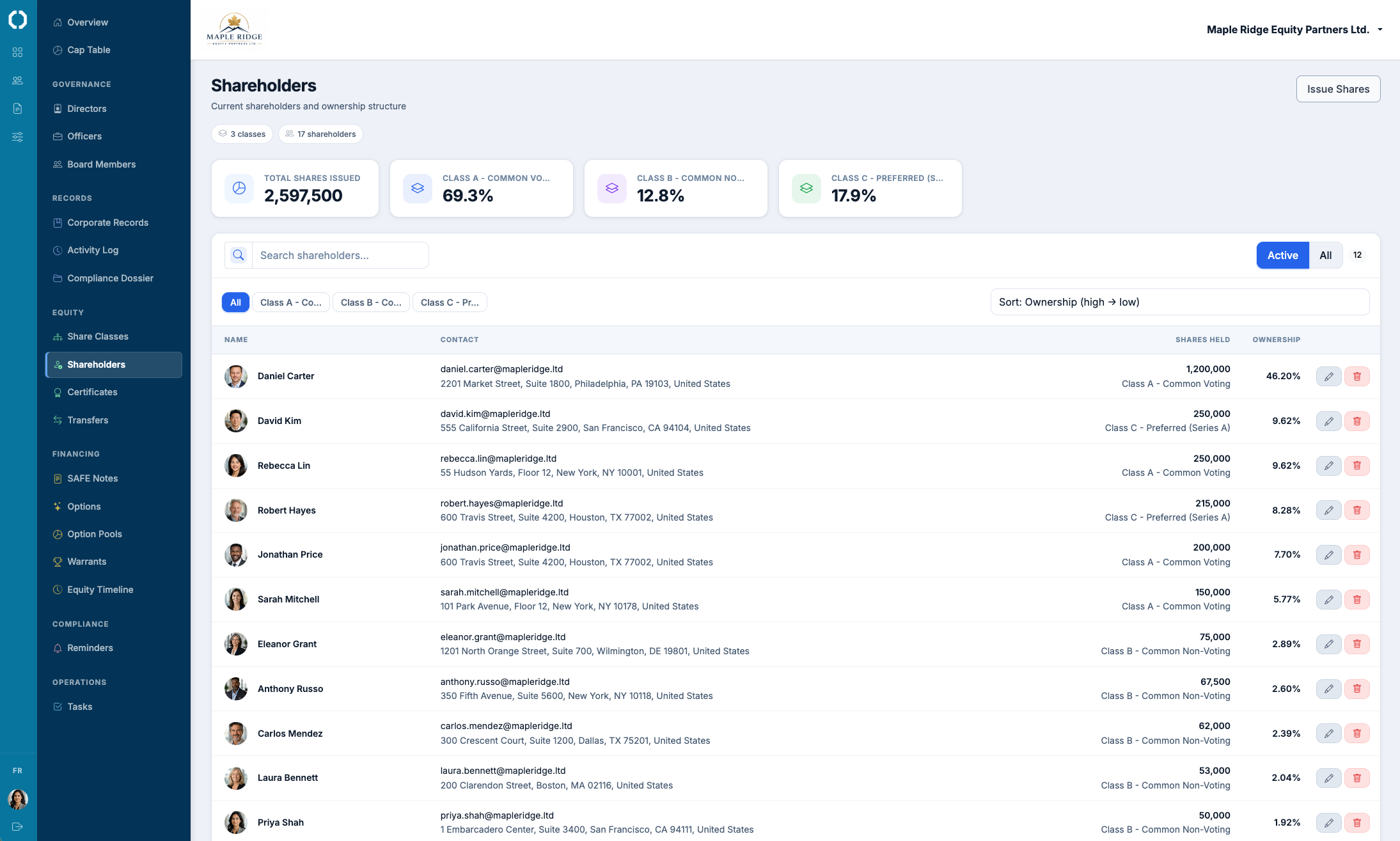
CBCA s. 50 securities register
Section 50 of the CBCA requires every federal Canadian corporation to maintain a securities register containing:
- The name and address of every holder of every security issued by the corporation
- The number and class of securities held by each holder
- The date and number of the certificate issued for the security, where the corporation issues certificated shares
- The date and particulars of any transfer of the security
- The date and particulars of any cancellation or surrender of the security
The register may be kept at the registered office or at another place in Canada designated by the directors. It may be kept in electronic form provided the information can be reproduced on demand. The register is a continuous record, each transfer creates a new entry without overwriting the prior one, so the complete history of ownership remains visible.
Inspection under CBCA s. 21
Shareholders, creditors, and their personal representatives have the right to inspect the securities register under s. 21. The inspection occurs during the corporation's usual business hours, free of charge. The inspector may take extracts and obtain copies on payment of a reasonable fee.
Unlike US Delaware (DGCL § 220), the CBCA does not require the inspector to demonstrate a 'proper purpose'. The status of shareholder or creditor is sufficient. This is a broader inspection right than in most US jurisdictions and one of the practical differences between Canadian and US corporate practice.
ISC register: separate from the securities register
The ISC register under s. 21.1 (introduced in 2019) is a separate register identifying individuals with significant control of the corporation, typically natural persons holding 25% or more of voting rights or shares, directly or indirectly, or otherwise controlling the corporation. The ISC register lives alongside the securities register but contains different information and has different access rules.
The ISC register is maintained internally and is also filed with Corporations Canada. The filings have limited public access (regulators, law enforcement, certain investigators) but are not openly searchable. The two registers, securities under s. 50 and ISC under s. 21.1, should be reconciled regularly to ensure the ISC information accurately reflects who actually owns or controls the corporation.
Common reconciliation issues
The most common failure pattern: a CBCA corporation issues shares correctly into the securities register, but transfers and cancellations get documented in lawyers' files and never make it back to the register. After several years of transfers, the register doesn't match the actual ownership. The cap table the corporation maintains in a spreadsheet diverges from the statutory register.
When this gap surfaces, in financing, in diligence, in a regulatory inquiry, reconstruction is more expensive than maintenance. Counsel must trace each transfer back through the documents, verify each cancellation, and update the register retroactively. Where the gap is years old, some entries may be impossible to reconstruct.
Octelligence keeps the share register up to date as issuances, transfers, and conversions happen. Certificates and cap tables are generated from the register, not maintained alongside it. The activity log records every change.
See Digital Corporate RecordsLive register, share certificates tied to register entries, cap table built from the register itself.