Central securities register for a British Columbia (BCBCA) corporation
BC corporations maintain a 'central securities register' under BCBCA s. 111, kept at the records office. The BC term is distinctive but the function tracks the CBCA. BC also maintains a transparency register under s. 119.1.
| BCBCA s. 111 | Central securities register |
|---|---|
| BCBCA s. 113 | Form of central securities register |
| BCBCA s. 46 | Inspection rights at records office |
| BCBCA s. 119.1 | Transparency register |
| BCBCA s. 42 | Records office |
- BC uses 'central securities register' under s. 111, distinctive term, same function as share register
- Kept at the records office (BC-specific concept), must be in BC
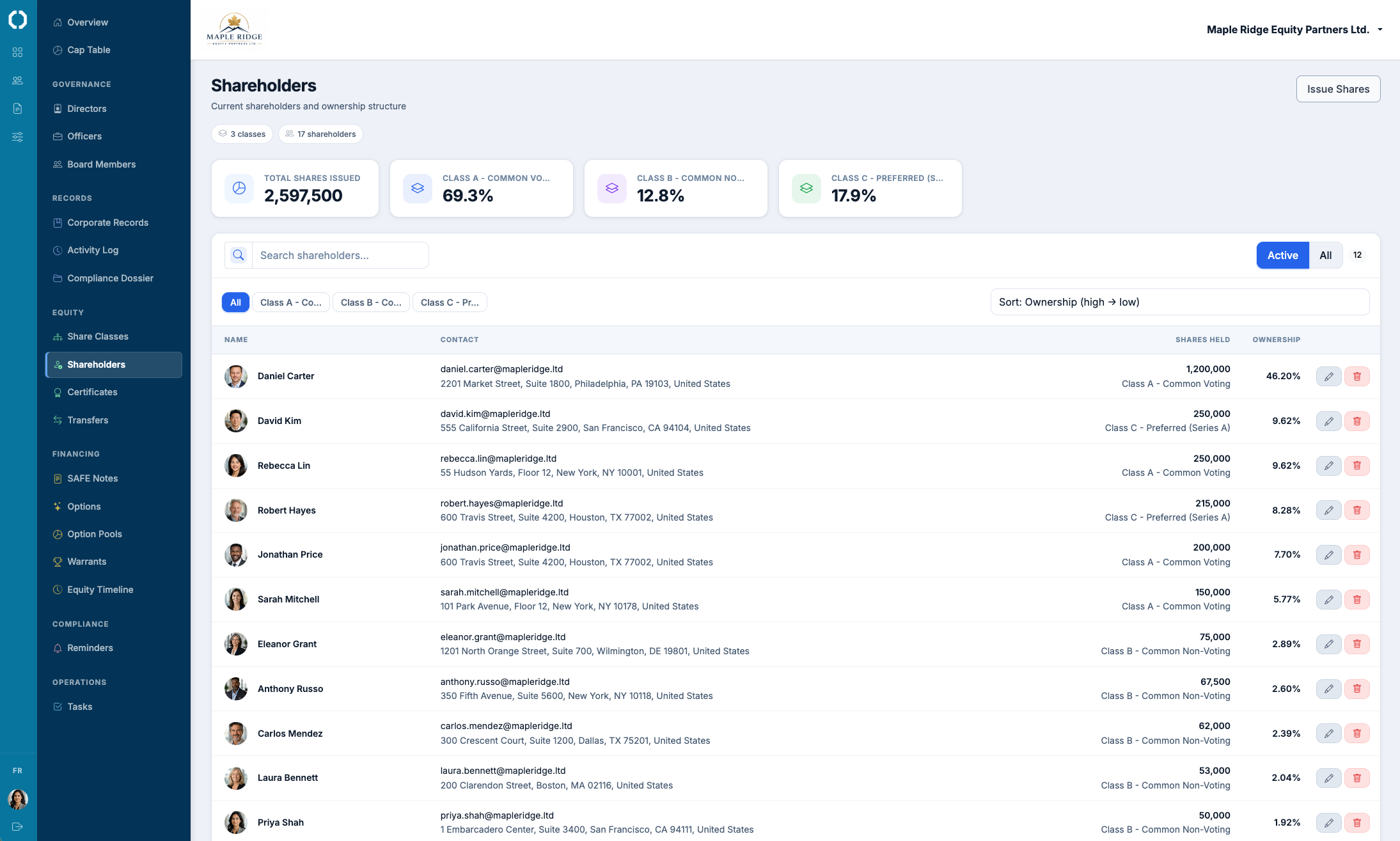
- Required content: holder name and address, number and class of shares, certificate numbers, dates
- Shareholders may inspect at records office during business hours under s. 46
- BC's transparency register under s. 119.1 (introduced 2020) is a separate, complementary register
BC's records office requirement
The central securities register must be kept at the corporation's records office, a BC-specific concept distinct from the registered office. The records office can be the same address as the registered office, or a different BC address. Many BC corporations use their corporate counsel's office as the records office, allowing the register to be professionally maintained.
The records office must be open for inspection during business hours, for at least two consecutive hours per business day under s. 46.
Central securities register content (s. 111)
The central securities register must show:
- The name and last known address of each registered shareholder
- The number, class, and series (where applicable) of shares held by each shareholder
- The date each share was issued, transferred, or cancelled
- The certificate number of each share certificate issued (where the corporation issues paper or digital certificates rather than uncertificated shares)
- Any restriction on transfer attaching to the shares
Inspection under s. 46
Shareholders of a BC corporation may inspect the central securities register at the records office during business hours. The inspection occurs at the records office (not the registered office, where they may differ). Shareholders may take extracts free of charge and obtain copies on payment of a reasonable fee.
Where a shareholder requests information not in the standard records, for example, a list of shareholders for use in soliciting proxies, the corporation may require an affidavit attesting to the purpose for which the list will be used. This is similar to the OBCA s. 145 mechanism.
BC transparency register
Section 119.1 of the BCBCA (introduced 2020) requires private BC corporations to maintain a transparency register identifying 'significant individuals', natural persons with significant control over the corporation, defined similarly to ISC under the CBCA. The transparency register is maintained at the records office and made available to law enforcement, tax authorities, and certain regulators on request.
The transparency register and the central securities register are separate documents but should reconcile: the people with 25%+ holdings shown on the securities register should appear on the transparency register (or be traceable through intermediate entities to natural persons on the transparency register).
Octelligence keeps the share register up to date as issuances, transfers, and conversions happen. Certificates and cap tables are generated from the register, not maintained alongside it. The activity log records every change.
See Digital Corporate RecordsLive register, share certificates tied to register entries, cap table built from the register itself.