Stock ledger and shareholder list for a California corporation
California requires a stock register and shareholder list, with broad inspection rights under Cal. Corp. Code §§ 1600-1602. California's inspection regime does not require demonstrating proper purpose, broader than Delaware's § 220.
| Cal. Corp. Code § 1500 | Books and records, including stock register |
|---|---|
| Cal. Corp. Code § 1600 | Shareholder list and inspection rights |
| Cal. Corp. Code § 1601 | Inspection of books and records |
| Cal. Corp. Code § 1602 | Records to be kept |
| Cal. Corp. Code § 1603 | Penalties for refusal of inspection |
- California requires a 'stock register' as part of the corporation's books and records under § 1500
- Section 1600 grants broader inspection rights than Delaware, no proper-purpose threshold required
- Required content: shareholder name and address, class and number of shares, dates of acquisition and transfer
- Shareholders may inspect at the principal office in California during business hours with 5 days' written notice
- Refusal of valid inspection demand can result in court order and attorney's fees (§ 1603)
California's books and records framework
California Corporations Code § 1500 requires every corporation to keep 'adequate and correct books and records of account', minutes of proceedings, and a stock register or other record of shareholders. The stock register specifically must show:
- The names and addresses of all shareholders
- The number and class of shares held by each
- The dates of acquisition and disposition
- The certificate numbers (where certificated)
Section 1602 requires these records to be kept at the principal office in California, California is more prescriptive about location than Delaware (which allows records anywhere) but similar to most Canadian provinces.
Inspection without proper purpose (§ 1600-1601)
California § 1601 grants shareholders the right to inspect the books and records of the corporation, including the stock register, on at least five business days' written demand. Unlike Delaware (DGCL § 220), California does not require the shareholder to demonstrate a 'proper purpose'. The shareholder's status as a shareholder is sufficient.
This is a significant practical difference. California shareholders can obtain the stock register and other records on a relatively low procedural threshold; Delaware stockholders may face refusal of demands the corporation considers improper, requiring a Court of Chancery proceeding to enforce. California's approach is closer to the Canadian and UK rules.
Shareholder list (§ 1600)
In addition to the stock register, California § 1600 specifically addresses the shareholder list. Any shareholder may inspect the list during the corporation's usual business hours at the principal office. The shareholder list must show the names, addresses, and shareholdings of all shareholders.
The shareholder list provisions are particularly relevant in the context of proxy contests and shareholder activism. California's broad access regime makes it easier for activist shareholders to obtain contact information for fellow shareholders than Delaware does.
Refusal of inspection (§ 1603)
Where the corporation refuses a valid inspection demand under §§ 1600-1601, the shareholder may petition the superior court for an order compelling production. The court may award attorney's fees and impose other remedies. Refusal of a valid inspection without legitimate basis exposes officers and directors to personal liability for fees and damages.
California courts have generally been firm in enforcing the broad inspection regime, particularly in disputes between minority and majority shareholders or in proxy-contest contexts.
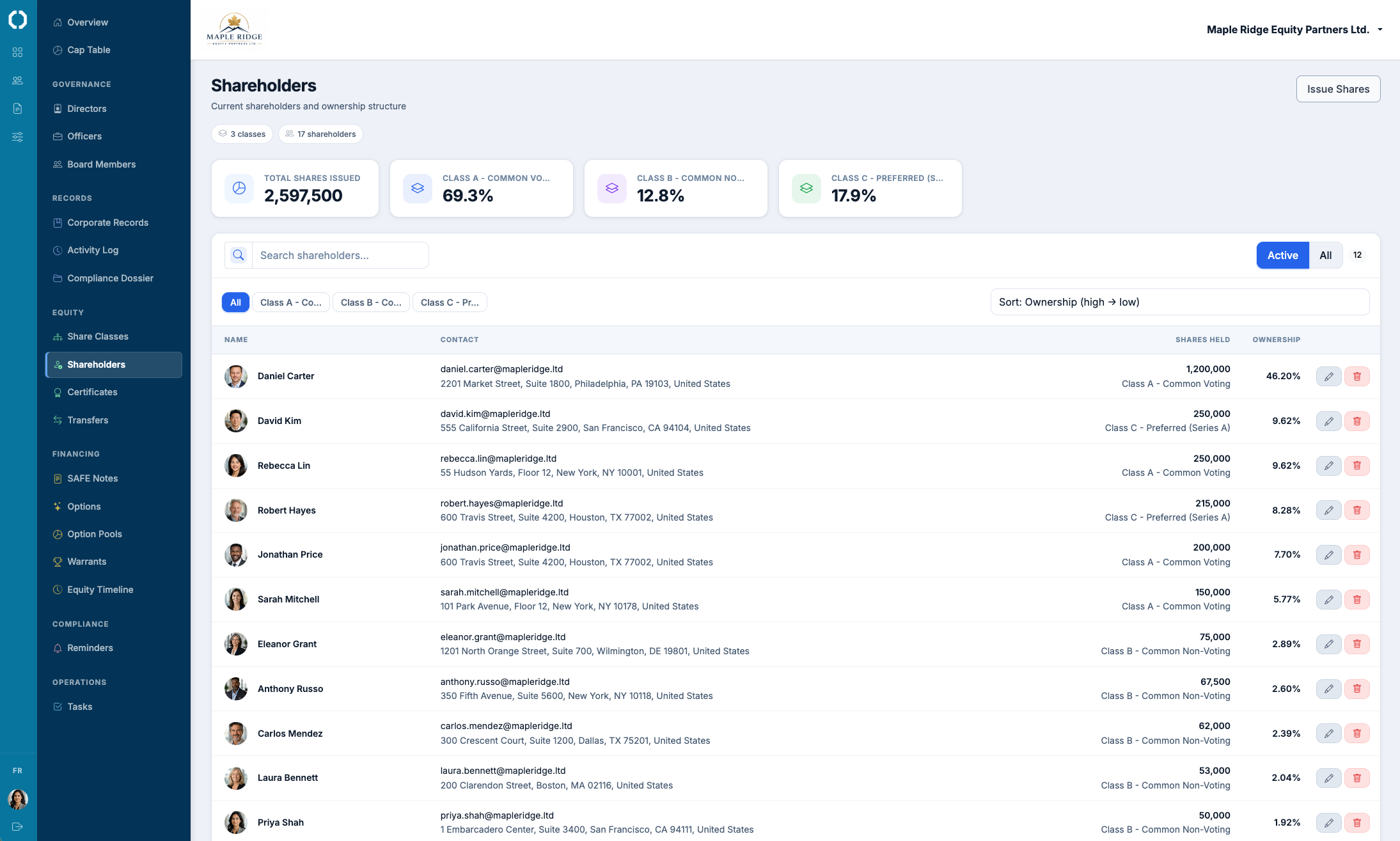
Octelligence keeps the share register up to date as issuances, transfers, and conversions happen. Certificates and cap tables are generated from the register, not maintained alongside it. The activity log records every change.
See Digital Corporate RecordsLive register, share certificates tied to register entries, cap table built from the register itself.