Stock ledger requirements for a Delaware corporation
DGCL § 219 requires every Delaware corporation to maintain a stock ledger. Unlike many other jurisdictions, Delaware does not require the ledger to be kept at a specific location. The stock ledger is the controlling record where it conflicts with a stock certificate.
| DGCL § 219 | List of stockholders entitled to vote; penalty for refusal to produce; stock ledger |
|---|---|
| DGCL § 220 | Inspection of books and records |
| DGCL § 224 | Form of records (paper or electronic) |
| DGCL § 213 | Fixing of date for determination of stockholders of record |
| DGCL § 218 | Voting trusts and other voting agreements |
- DGCL § 219 requires a stock ledger to be maintained at the corporation's principal place of business or registered agent
- Stock ledger is the controlling record where it conflicts with a stock certificate
- Section 219 also requires preparation of a stockholder list for each meeting, available for inspection 10 days before
- Inspection of the stock ledger under § 220 requires a 'proper purpose', stricter than Canadian or UK regimes
- Section 224 permits records in any form (paper, electronic, distributed ledger) provided they can be converted to written form
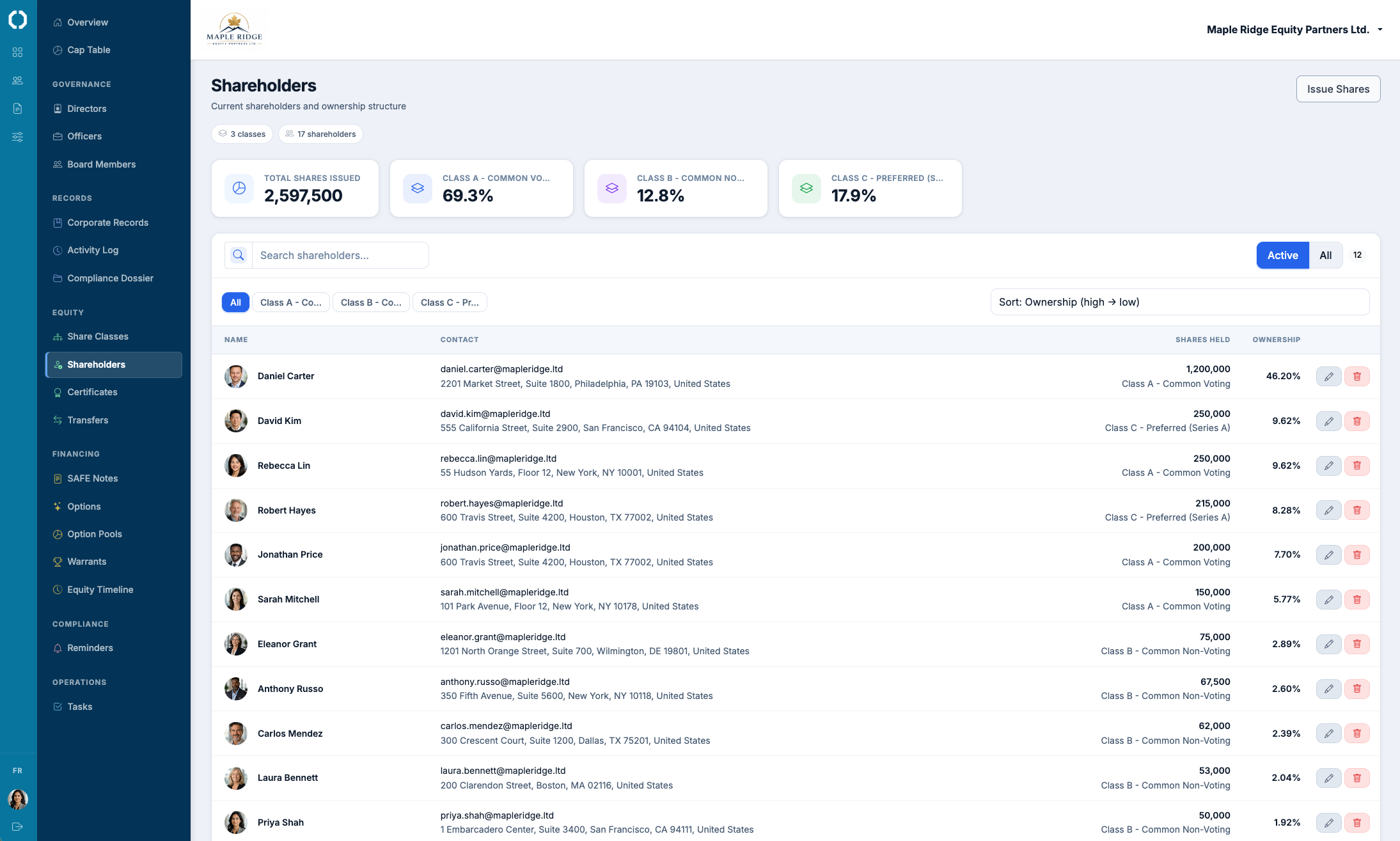
DGCL § 219 stock ledger
Section 219 of the DGCL requires every Delaware corporation to maintain a stock ledger. The stock ledger is the authoritative record of:
- The names and addresses of all stockholders
- The number and class of shares held by each
- The dates of issuance and transfer
- The certificate numbers (for certificated stock) or appropriate notations (for uncertificated)
Section 219 expressly states that the stock ledger is the controlling record of stockholder ownership. Where a stock certificate and the stock ledger disagree, the ledger controls. This is consistent with all other jurisdictions we cover.
Stockholder list for meetings
In addition to the permanent stock ledger, § 219 requires the corporation to prepare a stockholder list for each meeting at least 10 days before the meeting. The list must contain the same information as the ledger and must be available for inspection by any stockholder during ordinary business hours at the corporation's principal place of business (or, alternatively, on a reasonably accessible electronic network) for the 10 days before the meeting.
At the meeting itself, the list must be available for inspection by any stockholder. Failure to produce a proper stockholder list is grounds for adjournment of the meeting at any stockholder's request.
DGCL § 220 inspection rights
Inspection of the stock ledger (and other books and records) under § 220 requires the requesting stockholder to demonstrate a 'proper purpose', a purpose reasonably related to the stockholder's interest as a stockholder. Recognized proper purposes include:
- Investigating alleged waste or mismanagement
- Valuing the stockholder's investment
- Communicating with other stockholders about corporate affairs
- Evaluating possible derivative litigation
The corporation may refuse a demand it believes lacks proper purpose; the stockholder may then seek a Court of Chancery order compelling production. The proper-purpose requirement is stricter than the CBCA's open-access rule or the UK CA 2006 s. 116 register-of-members access. It is one of the practical differences between Delaware and Canadian or UK corporate practice.
Section 224, form of records
Section 224 expressly permits the corporation's records (including the stock ledger) to be maintained in any form, paper, electronic, or even distributed ledger technology, provided the records can be converted to clearly legible paper form within a reasonable time. The 2017 amendments to § 224 specifically contemplated blockchain-based stock ledgers, though adoption has been limited.
The Delaware approach to record form is the most permissive among the US states we cover. The flexibility supports modern digital recordkeeping for Delaware corporations operating from anywhere in the world.
Octelligence keeps the share register up to date as issuances, transfers, and conversions happen. Certificates and cap tables are generated from the register, not maintained alongside it. The activity log records every change.
See Digital Corporate RecordsLive register, share certificates tied to register entries, cap table built from the register itself.