Stock register for a Texas corporation
TBOC § 21.157 requires Texas corporations to maintain a stock register. Inspection rights under § 21.218 follow the 6-month/5% threshold model, similar to New York. Texas does not require a specific location for the register.
| TBOC § 21.157 | Maintaining record of shareholders |
|---|---|
| TBOC § 21.218 | Examination of records by shareholders |
| TBOC § 3.151 | Books and records, general |
| TBOC § 21.219 | Court order to allow examination |
| TBOC § 21.222 | Penalty for failure to allow examination |
- TBOC § 21.157 requires every Texas corporation to maintain a record of shareholders showing name, address, number and class of shares
- Section 21.218 grants inspection rights to shareholders meeting the 6-month or 5% threshold, with proper purpose
- Records may be kept anywhere; no statutory location requirement
- Court order under § 21.219 available where corporation refuses valid demand
- Section 21.222 imposes penalties (10% of value of shares, capped) for wrongful refusal
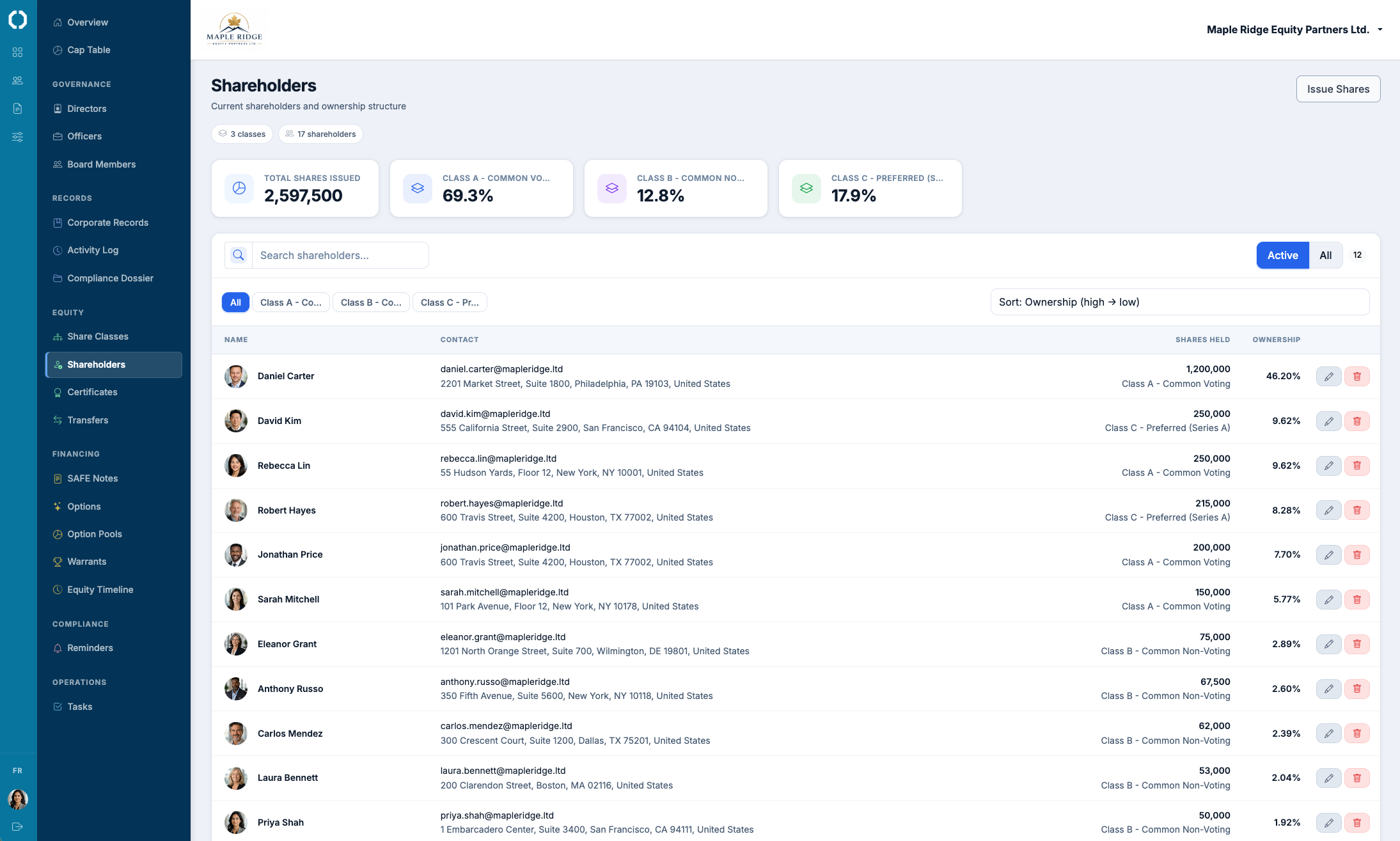
TBOC § 21.157 stock register
Section 21.157 of the Texas Business Organizations Code requires every Texas corporation to maintain a record of its shareholders. The record must contain:
- The name and address of each shareholder
- The number, class, and series (if any) of shares held by each shareholder
- The date the shareholder became the owner of the shares
The record may be maintained in any form that can be reproduced in clearly legible written form within a reasonable time. Texas does not require the record to be kept at any specific location, similar to Delaware and New York. Records may be kept anywhere in or out of Texas.
Inspection threshold and proper purpose
TBOC § 21.218 imposes a two-prong test for inspection rights:
- The shareholder must have held shares for at least six months immediately before the demand, OR hold at least 5% of all outstanding shares, AND
- The shareholder must make a written demand stating a proper purpose related to the shareholder's interest as a shareholder
This combines the New York 6-month/5% threshold with the Delaware proper-purpose requirement, Texas is stricter than either New York or Delaware alone. Both conditions must be met before the shareholder may compel inspection of the corporation's books and records.
Court order and penalties
Where the corporation refuses a valid inspection demand, the shareholder may seek a court order under § 21.219. The court will examine whether the threshold requirements and proper purpose are met; if so, the court will compel production.
Section 21.222 imposes a statutory penalty on the corporation for wrongful refusal: 10% of the value of the shares owned by the demanding shareholder, capped at the lesser of $10,000 or the value of the books and records demanded. The penalty is in addition to court costs and attorney's fees. This makes wrongful refusal an expensive miscalculation by the corporation.
Records during meetings
In addition to the standing stock register, Texas requires the corporation to prepare a list of shareholders entitled to vote at any meeting, available for inspection during the meeting and during the period before. Section 21.353 governs action by written consent of directors; § 21.358 governs shareholder written consents and the related records obligations.
Octelligence keeps the share register up to date as issuances, transfers, and conversions happen. Certificates and cap tables are generated from the register, not maintained alongside it. The activity log records every change.
See Digital Corporate RecordsLive register, share certificates tied to register entries, cap table built from the register itself.