Stock ledger for a Nevada corporation
NRS 78.105 requires Nevada corporations to maintain a stock ledger at the registered office. Nevada's inspection rights are narrower than other major US jurisdictions, only 15%+ holders or those with written authorization may inspect.
| NRS 78.105 | Records to be kept at registered office; stock ledger |
|---|---|
| NRS 78.107 | Stock ledger or register of stockholders |
| NRS 78.257 | Inspection rights |
| NRS 78.265 | List of stockholders for meetings |
| NRS 78.235 | Stock certificates and uncertificated stock |
- NRS 78.105 requires the stock ledger to be kept at the registered office in Nevada
- Section 78.107 specifies content: stockholder names, addresses, number and class of shares, dates
- Inspection rights under NRS 78.257 limited to 15%+ holders or written authorization from 15%+ of stockholders
- Section 78.265 requires a stockholder list for meetings, available for inspection 10 days before
- Nevada permits uncertificated stock; ledger entries replace certificate references for uncertificated shares
NRS 78.105, registered office requirement
Section 78.105 of the Nevada Revised Statutes requires every Nevada corporation to keep a stock ledger (and certain other records) at its registered office in Nevada. This is a more prescriptive location requirement than Delaware or Texas, both of which allow records to be kept anywhere. Most Nevada corporations operate from outside the state and use a commercial registered agent service whose office houses the statutory records.
The stock ledger may be kept in physical or electronic form provided it can be reproduced in legible written form on demand.
Content under NRS 78.107
The stock ledger must contain:
- The names and addresses of all stockholders
- The number of shares held by each, with the class and series if applicable
- The dates of issuance and transfer of each share
- Certificate numbers (where certificated) or appropriate notations for uncertificated shares
The ledger is the authoritative record of stockholder ownership. Where the ledger and a stock certificate disagree, the ledger controls.
Narrow inspection rights (NRS 78.257)
Nevada's stockholder inspection rights are notably narrower than other US jurisdictions. Under NRS 78.257, a stockholder seeking to inspect the corporation's books of account or other records must:
- Hold at least 15% of all issued and outstanding stock of the corporation, OR
- Have written authorization from at least 15% of the issued and outstanding stock
The 15% threshold is significantly higher than:
- New York's 6-month/5% threshold (BCL § 624)
- Texas's 6-month/5% threshold combined with proper purpose (TBOC § 21.218)
- Delaware's proper-purpose requirement with no threshold (DGCL § 220)
- California's no-threshold approach (Cal. Corp. Code § 1601)
The 15% threshold effectively limits inspection to substantial holders. This is one of the features that makes Nevada attractive to closely-held businesses and asset-protection structures: minority stockholders cannot easily demand information about the corporation.
Stockholder list for meetings (NRS 78.265)
Despite the narrow general inspection right, NRS 78.265 requires a stockholder list to be prepared and available for inspection 10 days before every meeting. The list is open to any stockholder regardless of holding percentage, the 15% threshold under NRS 78.257 does not apply to the meeting list. This ensures every stockholder has access to the basic information needed to participate in the meeting and to communicate with fellow stockholders before voting.
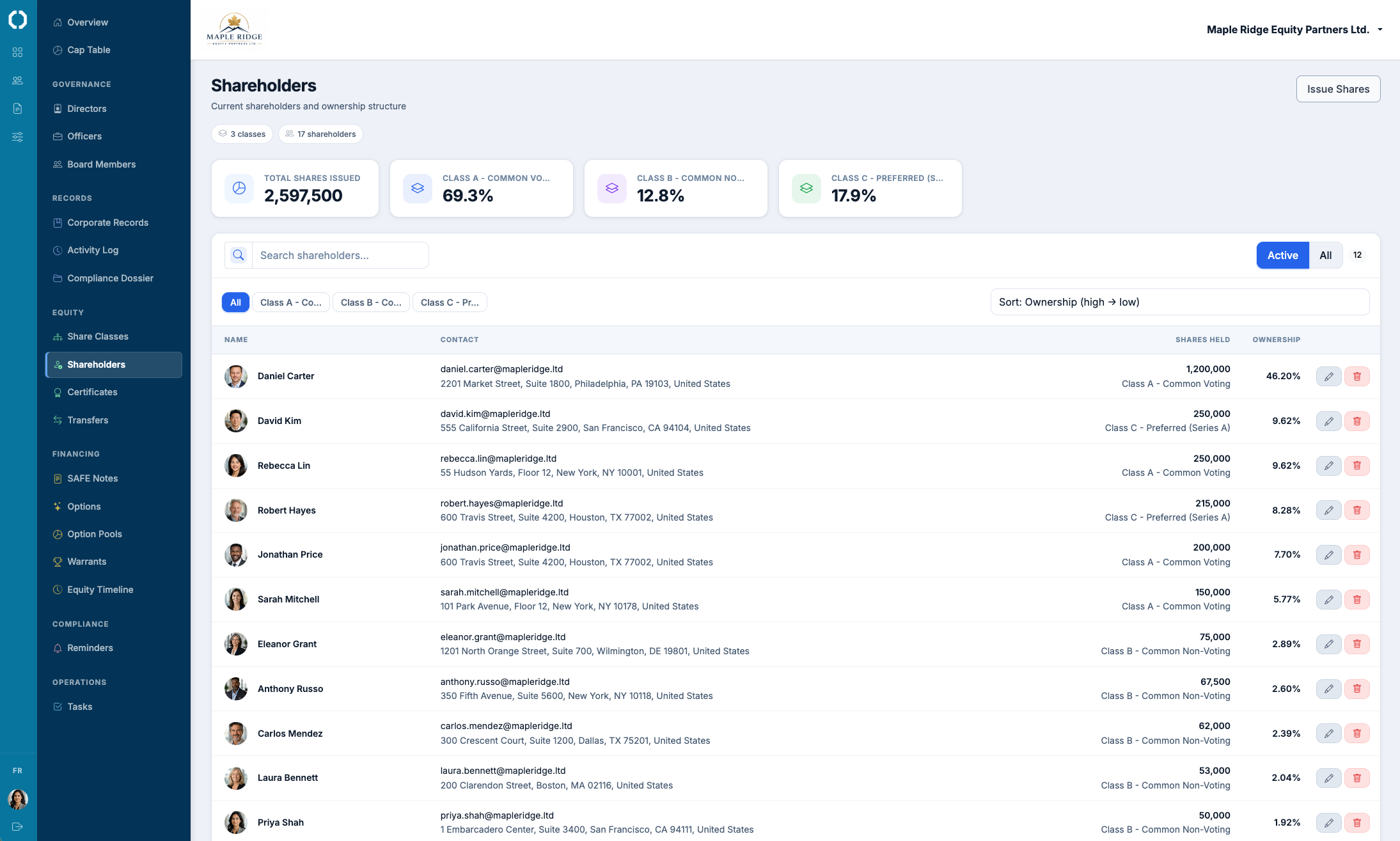
Octelligence keeps the share register up to date as issuances, transfers, and conversions happen. Certificates and cap tables are generated from the register, not maintained alongside it. The activity log records every change.
See Digital Corporate RecordsLive register, share certificates tied to register entries, cap table built from the register itself.