Share register requirements in Nova Scotia (NSCA)
What a Nova Scotia corporation must know about share register requirements under Companies Act, RSNS 1989, c. 81 (NSCA): statute citations, mechanics, and inspection rights.
| Register of members | NS equivalent of share register |
|---|---|
| Companies Act | Governs members' register |
| Inspection | Members can inspect at registered office |
| Annual return | Confirms register contents |
- Records each shareholder's name, address, number and class of shares, date acquired
- Maintained at the registered office; electronic form permitted
- Inspection rights granted to shareholders and creditors
- Transfers, issuances, and cancellations recorded chronologically
- Legal source of truth on ownership; cap table is the operational view
What the NSCA requires
In the NS Companies Act tradition, the equivalent of a share register is the 'register of members', maintained by the corporation under its Articles of Association and the Companies Act.
UK Companies Act tradition in Nova Scotia
Nova Scotia's Companies Act, RSNS 1989, c. 81, descends from the UK Companies Act tradition rather than the CBCA model. The Memorandum of Association establishes the corporation and its objects; the Articles of Association govern internal procedures and shareholder rights. This is a meaningful departure from the CBCA-tradition provinces, where Articles of Incorporation and Bylaws play different roles.
Practical implications
For corporate records management, the practical implications are mostly procedural: the corporation's Articles of Association play a larger role in defining what is required and how it is documented. Counsel familiar with NS practice should be consulted on jurisdiction-specific points. The general principles (records must be maintained, members have inspection rights, annual filings are required) remain similar to other Canadian jurisdictions.
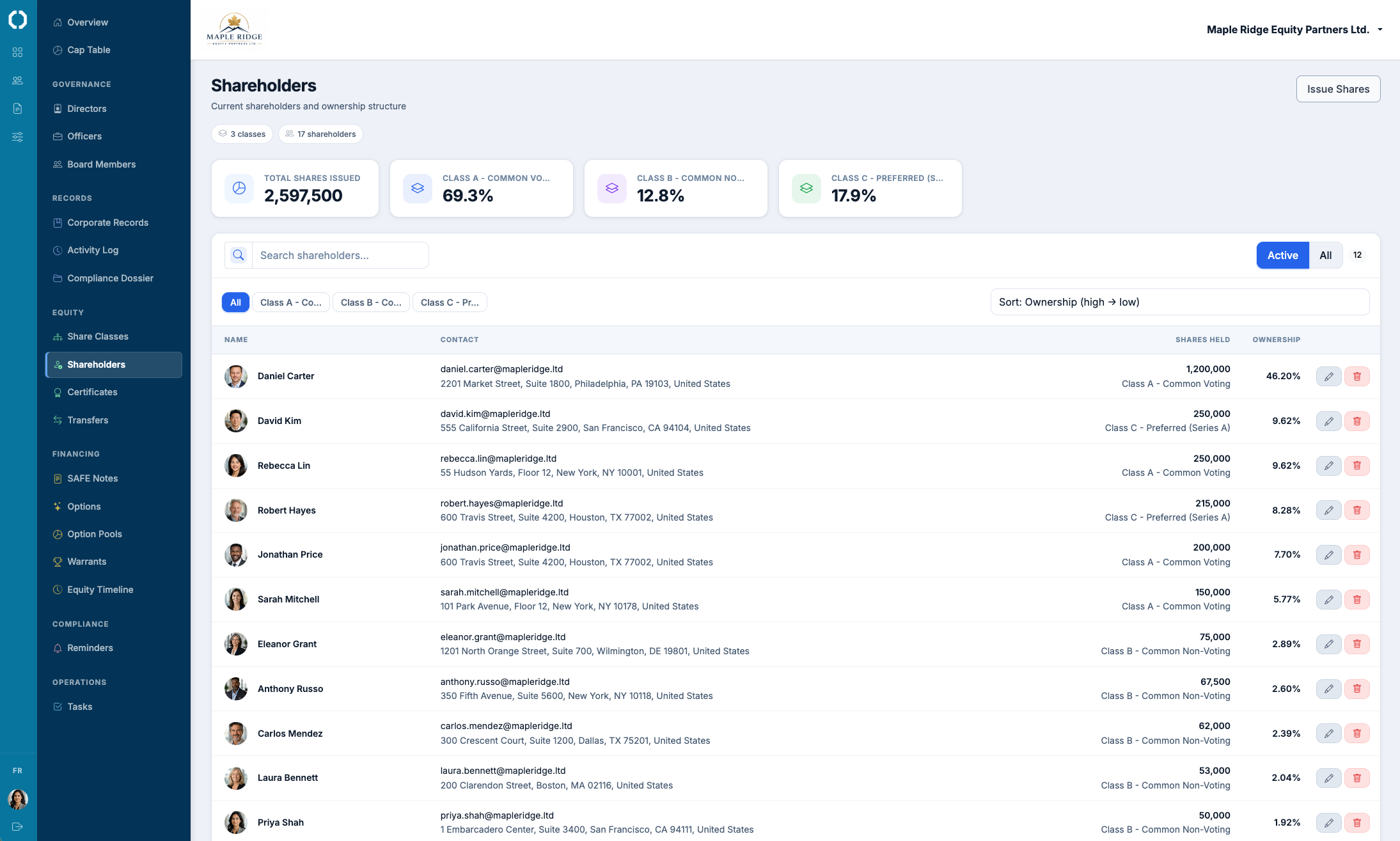
In Octelligence, every issuance, transfer, and cancellation updates both the statutory register and the cap table simultaneously. You cannot have one without the other, which eliminates drift between them.
See Digital Corporate RecordsIssuances, transfers, cancellations recorded in real time. Cap table synchronized.