Annual report requirements in Ohio (OGCL)
Ohio is the only US state that does NOT require an annual report for most for-profit corporations under O.R.C. Ch. 1701. Ohio corporations instead pay the Commercial Activity Tax (CAT) on revenues over $150,000 to the Department of Taxation, with no separate corporate registry filing.
| O.R.C. Ch. 1701 | Ohio General Corporation Law |
|---|---|
| Annual report required | No (for most for-profit corporations) |
| Filing authority | Ohio Department of Taxation (for CAT tax) |
| Filing | Commercial Activity Tax (CAT) return for corporations with revenue > $150,000 |
| Statement of Continued Existence | Required only for nonprofits under O.R.C. § 1702.59 (every 5 years) |
| Late consequences | Loss of CAT registration; potential dissolution for sustained non-compliance |
| Reinstatement | By curing all defaults |
- Ohio does NOT require annual reports for most for-profit corporations, the only US state with this distinction
- For-profit Ohio corporations file Commercial Activity Tax (CAT) returns with the Department of Taxation
- Statement of Continued Existence is required for nonprofits only under O.R.C. § 1702.59 (every 5 years)
- Ohio's regime trades the routine annual report for a revenue-based tax filing
- Corporations with Ohio revenue under $150,000 have minimal ongoing state filings
Ohio's distinctive 'no annual report' regime
Ohio is the only US state that does not require a routine annual report for most for-profit corporations. Under O.R.C. Ch. 1701, for-profit corporations are not required to file an annual statement, periodic report, or biennial statement with the Secretary of State or any other agency. This is a long-standing feature of Ohio corporate law, predating the Model Business Corporation Act, and it reflects Ohio's historical preference for tax-based rather than registration-based corporate compliance.
The Commercial Activity Tax (CAT)
Instead of an annual report, Ohio corporations with annual Ohio-sourced gross receipts over $150,000 file Commercial Activity Tax (CAT) returns with the Ohio Department of Taxation. The CAT is a privilege tax on gross receipts, structured as a flat $150 minimum plus a percentage of receipts above the threshold. CAT returns are filed quarterly for most filers, with annual filing available for smaller corporations.
Statement of Continued Existence (nonprofits only)
Ohio nonprofit corporations under O.R.C. Ch. 1702 do have a periodic filing requirement: a Statement of Continued Existence under O.R.C. § 1702.59, due every five years. This applies only to nonprofits; for-profit corporations under Ch. 1701 are exempt from any equivalent. Ohio professional corporations also have specific filing requirements depending on the regulated profession.
What's distinctive about Ohio
Ohio's no-annual-report regime is genuinely unique among US states. For corporations with Ohio-sourced revenue under the $150,000 CAT threshold, ongoing state compliance is minimal: no annual report, no franchise tax, no periodic filing of any kind. This makes Ohio one of the lightest-touch US jurisdictions for inactive holding companies, dormant subsidiaries, and small closely-held corporations. The trade-off is that Ohio's General Corporation Law (Ch. 1701) is older and more idiosyncratic than the MBCA-modelled statutes in most other states, which means counsel working with Ohio corporations need to attend to procedural differences in resolutions, certificate forms, and inspection rights.
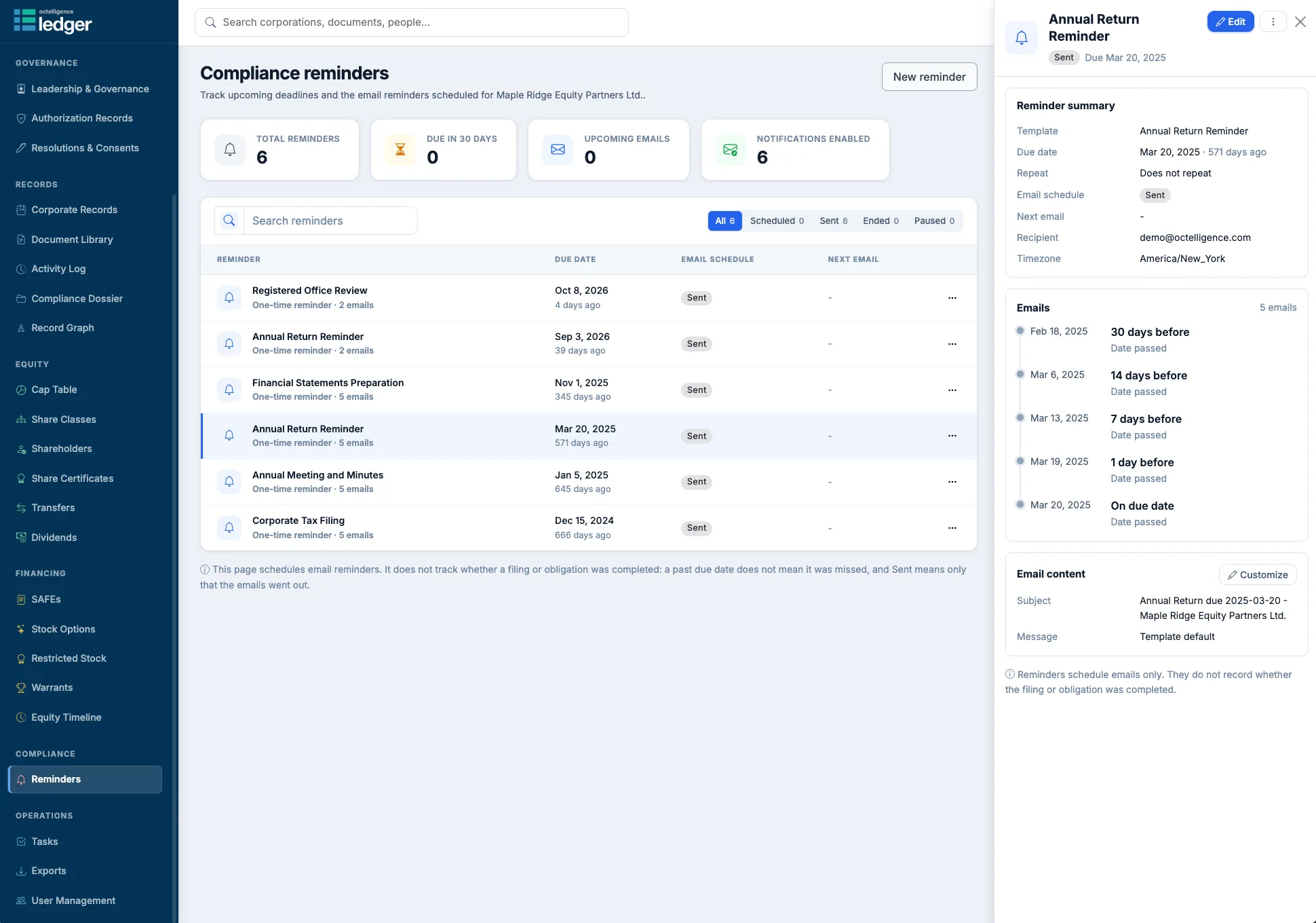
Octelligence tracks annual filing deadlines for every corporation in your portfolio, generates the required filing forms, and archives confirmations to the corporate records.
See Digital Corporate RecordsTracked deadlines, jurisdiction-specific forms, automated reminders, complete records.