Annual return filings across 41 jurisdictions
The yearly filing that confirms a corporation still exists. Canada calls it the annual return; the US uses annual report or statement of information; the UK calls it the confirmation statement. Different names, different deadlines, different fees, but the same consequence if you miss it, administrative dissolution.
One yearly filing, fifteen different names and rules
Every jurisdiction that grants limited liability requires the corporation to confirm, at least once a year, that it still exists and to update the public record. The filing has different names in different places, annual return in Canada, annual report or statement of information in the US, confirmation statement in the UK, but the function is identical: tell the registry the corporation is still active and update the registered office, directors, and (in some jurisdictions) shareholder details.
Missing the filing has consistently severe consequences. In every jurisdiction surveyed below, persistent non-filing leads to administrative dissolution: the corporation loses its legal existence. Contracts become unenforceable in its name. Bank accounts are frozen. Suppliers and customers walk away. Investors won't invest. Revival is possible but slow and expensive, every missed return must be filed retroactively, often with late fees, before the corporation is reinstated. This page summarizes the filing each jurisdiction requires and the deadlines you should be tracking.
Choose your jurisdiction
Each guide covers what to maintain, where to keep it, who can inspect, and what happens if you don't.
Canada (Federal / CBCA)
CBCA View requirements CanadaOntario
OBCA View requirements CanadaBritish Columbia
BCBCA View requirements CanadaAlberta
ABCA View requirements CanadaQuebec
Quebec REQ View requirements CanadaManitoba
MCA View requirements CanadaNew Brunswick
NBBCA View requirements CanadaNewfoundland and Labrador
NLCA View requirements CanadaNova Scotia
NSCA View requirements CanadaPrince Edward Island
PEIBCA View requirements CanadaSaskatchewan
SBCA View requirements United StatesDelaware
DGCL / DE Code View requirements United StatesCalifornia
Cal. Corp. Code View requirements United StatesNew York
NY BCL View requirements United StatesTexas
TBOC + Tax Code View requirements United StatesFlorida
FBCA View requirements United StatesNevada
NRS View requirements United StatesWashington
WA BCA View requirements United StatesMassachusetts
M.G.L. c. 156D View requirements United StatesWyoming
WBCA View requirements United StatesColorado
C.R.S. Title 7 View requirements United StatesUtah
URBCA View requirements United StatesIllinois
805 ILCS 5/ View requirements United StatesNew Jersey
NJBCA View requirements United StatesGeorgia
GBCC View requirements United StatesNorth Carolina
NCBCA View requirements United StatesVirginia
VSCA View requirements United StatesArizona
A.R.S. Title 10 View requirements United StatesTennessee
TBCA-TN View requirements United StatesMinnesota
Minn. Stat. § 302A View requirements United StatesOregon
ORS Ch. 60 View requirements United StatesMichigan
MICA View requirements United StatesOhio
OGCL View requirements United StatesPennsylvania
PBCL View requirements United StatesConnecticut
C.G.S. § 33-600 View requirements United StatesMaryland
MGCL View requirements United StatesIndiana
IBCL View requirements United StatesWisconsin
Wis. Stat. Ch. 180 View requirements United StatesMissouri
RSMo Ch. 351 View requirements United StatesSouth Carolina
SCBCA View requirements United KingdomUnited Kingdom
CA 2006 View requirementsCompare requirements across jurisdictions
The same artifact, different rules.
| Jurisdiction | Filing name | Deadline | Online fee | Penalty for non-filing |
|---|---|---|---|---|
| Canada (Federal / CBCA) | Annual return (Form 22) | Within 60 days of anniversary | $12 (CAD) | Dissolution after ~3 years (s. 212) |
| Ontario | Annual return (OBCA) | Anniversary date | $30 (within 60 days) - $40 | Cancellation after ~2 years (s. 240) |
| British Columbia | Annual report (BCBCA) | Within 2 months of anniversary | $50 (CAD) | Dissolution (s. 422) |
| Alberta | Annual return (ABCA) | Anniversary date | ~$50 (CAD) | Dissolution after ~3 years (s. 212) |
| Quebec | Annual updating declaration (REQ) | Within annual filing period | ~$98 (CAD) | Cancellation after 2 years |
| Delaware | Annual franchise tax report | March 1 | $400 minimum (assumed par value) | Charter forfeiture after 2 years (§ 510) |
| California | Statement of Information (SI-550) | Anniversary month | $25 (+ $800 minimum FTB tax) | $250 + suspension of corporate powers |
| New York | Biennial Statement | Every 2 years (anniversary month) | $9 | No administrative dissolution; franchise tax separate |
| Texas | Franchise tax report + PIR | May 15 | $0 base (tax owed varies); PIR free | Charter forfeiture after 2 years |
| Florida | Annual report | May 1 | $150 | Administrative dissolution in September |
| Nevada | Annual List + State Business License | Within 30 days of anniversary | $650 typical ($150 list + $500 license) | Default; charter revocation (NRS 78.180) |
| Washington | Annual report | End of anniversary month | $60 | Administrative dissolution after 60-day notice |
| Massachusetts | Annual report (§ 16.22) | Anniversary date | $125 | Administrative dissolution after 2 years (§ 14.21) |
| United Kingdom | Confirmation statement (s. 853A) | 14 days after review period end | £13 | Strike-off after 6+ months (s. 1003) |
Common patterns and dangerous gotchas
Three patterns recur across every jurisdiction we cover:
- The annual return is separate from the tax return. Every single jurisdiction treats the corporate-registry filing as distinct from the income-tax filing. The fees go to different addresses, the contents differ, and the deadlines are usually not aligned. Conflating the two, assuming the accountant's tax filing handles the annual return, is the single most common way small corporations drift toward administrative dissolution.
- Deadlines are often anniversary-based, not calendar-aligned. CBCA and most provincial Acts tie the deadline to the corporation's incorporation anniversary. US states are split: some require fixed annual dates (May 1 in Florida, May 15 franchise tax in Texas), others use the anniversary. UK confirmation statements use the corporation's anniversary date.
- The grace period varies but is finite. Most jurisdictions allow 30-90 days past the deadline with a late fee. Beyond that, administrative dissolution begins. The exact timing differs, Florida dissolves in September if the May deadline is missed; Delaware allows much longer; Canada CBCA dissolves after three years of non-filing.
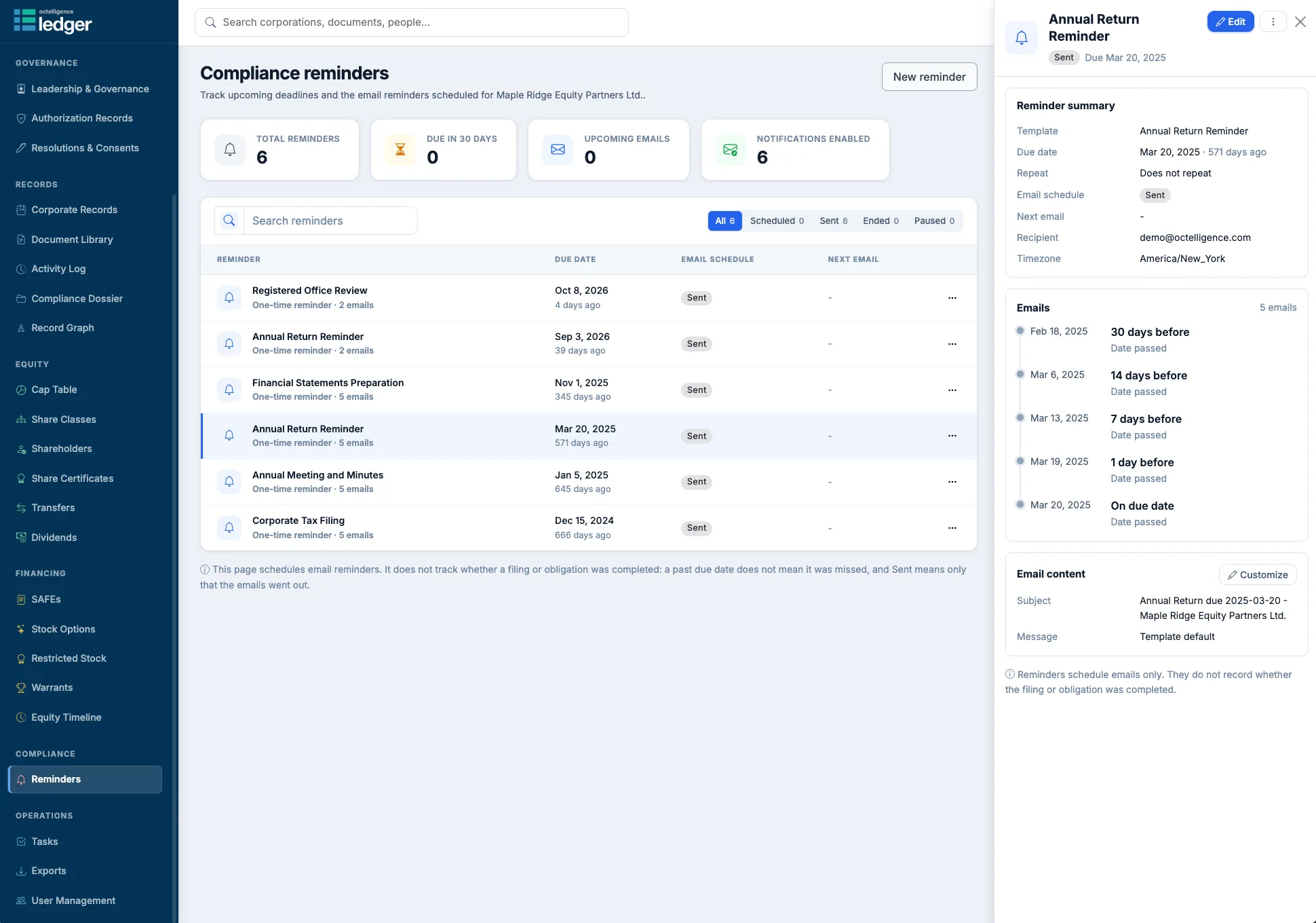
On Growth and above, Octelligence's filings calendar tracks annual return deadlines across every jurisdiction in your portfolio. Reminders fire ahead of the due date, the filed return is stored in the minute book, and the corporate registry record stays in sync with the corporation's internal record. Law firms and accounting practices can add entities to any plan as the client list grows.
See the filings calendarFrequently asked
No, and they should never be confused. The annual return is filed with the corporate registry (state, provincial, or federal) and confirms the corporation still exists, updating public information like the registered office and directors. The tax return is filed with the tax authority (IRS, CRA, HMRC, state tax board) and reports income. Different filings, different addresses, different deadlines.
First, a late fee. Then, after a defined period of continued non-filing, administrative dissolution: the corporation loses its legal existence. The exact timing varies by jurisdiction, Florida dissolves the same year if you miss the May 1 deadline by a few months, Canada's CBCA waits about three years. Revival is possible by filing all missed returns plus penalties, but the corporation is in administrative limbo in the interim.
Most jurisdictions tie the deadline to the corporation's incorporation anniversary, federal CBCA, Ontario, BC, Alberta, the UK confirmation statement. Some US states use fixed dates: Florida requires filing between January 1 and May 1, Texas franchise tax is due May 15, others use the anniversary month. The jurisdiction guides below list the exact deadline for each jurisdiction.
Yes, every jurisdiction we cover offers online filing, usually faster and cheaper than paper. Filing fees are typically $20-$150 depending on the jurisdiction. The UK confirmation statement is £13 online, Canadian CBCA annual return is $12 online, Ontario annual return is $20 (or free if filed within 60 days of anniversary).
Filings calendar, jurisdiction-aware deadlines, and a record of every return filed in the corporate records.