Annual franchise tax report for a Delaware corporation
Delaware corporations file an Annual Report and pay Franchise Tax under 8 Del. C. § 502 by March 1 each year. The Annual Report fee is $50, and the franchise tax ranges from a $175 minimum (Authorized Shares Method) to a $200,000 maximum, depending on which calculation method the corporation chooses.
| 8 Del. C. § 502 | Annual report and franchise tax required |
|---|---|
| Filing authority | Delaware Secretary of State, Division of Corporations |
| Form | Annual Franchise Tax Report (online) |
| Deadline | March 1 each year |
| Filing fee | $50 (annual report) + franchise tax ($175 minimum, $200,000 maximum) |
| Late consequences | $200 penalty + 1.5% monthly interest; loss of good standing |
| Revival | By filing all delinquent reports and paying all back taxes |
- Filed with the Delaware Division of Corporations at corp.delaware.gov
- Fee combines $50 annual report fee plus franchise tax (minimum $175 under Authorized Shares Method)
- Two calculation methods for franchise tax: Authorized Shares (default) or Assumed Par Value Capital (often lower)
- Due March 1 each year, regardless of fiscal year end or anniversary month
- Late filing triggers $200 penalty plus 1.5% monthly interest on unpaid tax
What 8 Del. C. § 502 requires
Section 502 of the Delaware General Corporation Law requires every Delaware corporation to file an Annual Franchise Tax Report and pay the franchise tax by March 1 each year. The report confirms the corporation's directors, registered agent, and registered office, and includes the calculation supporting the franchise tax payment. The fee structure is two-part: a fixed $50 annual report fee, plus the franchise tax (which is calculated separately).
The two franchise tax methods
Delaware allows corporations to choose between two franchise tax calculation methods. The default is the Authorized Shares Method: $175 for corporations with up to 5,000 authorized shares, then escalating tiers up to $200,000 for the largest corporations. The alternative is the Assumed Par Value Capital Method, which is often dramatically lower for corporations with many low-par-value authorized shares but few issued shares (a common startup pattern with 10 million authorized common shares). Corporations with large authorized-share counts should always evaluate the Assumed Par Value method, which can reduce a $20,000+ Authorized Shares calculation to under $1,000.
March 1 deadline and penalties
Delaware's March 1 deadline is fixed by statute and applies regardless of the corporation's fiscal year end or anniversary of incorporation. Late filing triggers a $200 penalty plus 1.5% interest per month on the unpaid tax. Sustained non-payment leads to the loss of good standing, which prevents the corporation from completing transactions that require a Certificate of Good Standing (e.g., financings, M&A closings, lending). Delaware corporations that have lost good standing can be reinstated by filing all delinquent reports and paying all back taxes and penalties.
What's distinctive about Delaware
Delaware's franchise tax structure is the most complex annual filing in the US, but for most corporations the franchise tax remains modest. The dual-method calculation is a planning lever: founders incorporating in Delaware should authorize sufficient shares for future growth without triggering the higher Authorized Shares tiers (or should be prepared to use the Assumed Par Value method). The March 1 deadline is well-known and rarely missed in practice, but the certificate of good standing requirement means the consequences of even brief delinquency can block a financing or sale. For counsel managing Delaware corporations, the franchise tax calculation is often the highest-value piece of routine ongoing-compliance work.
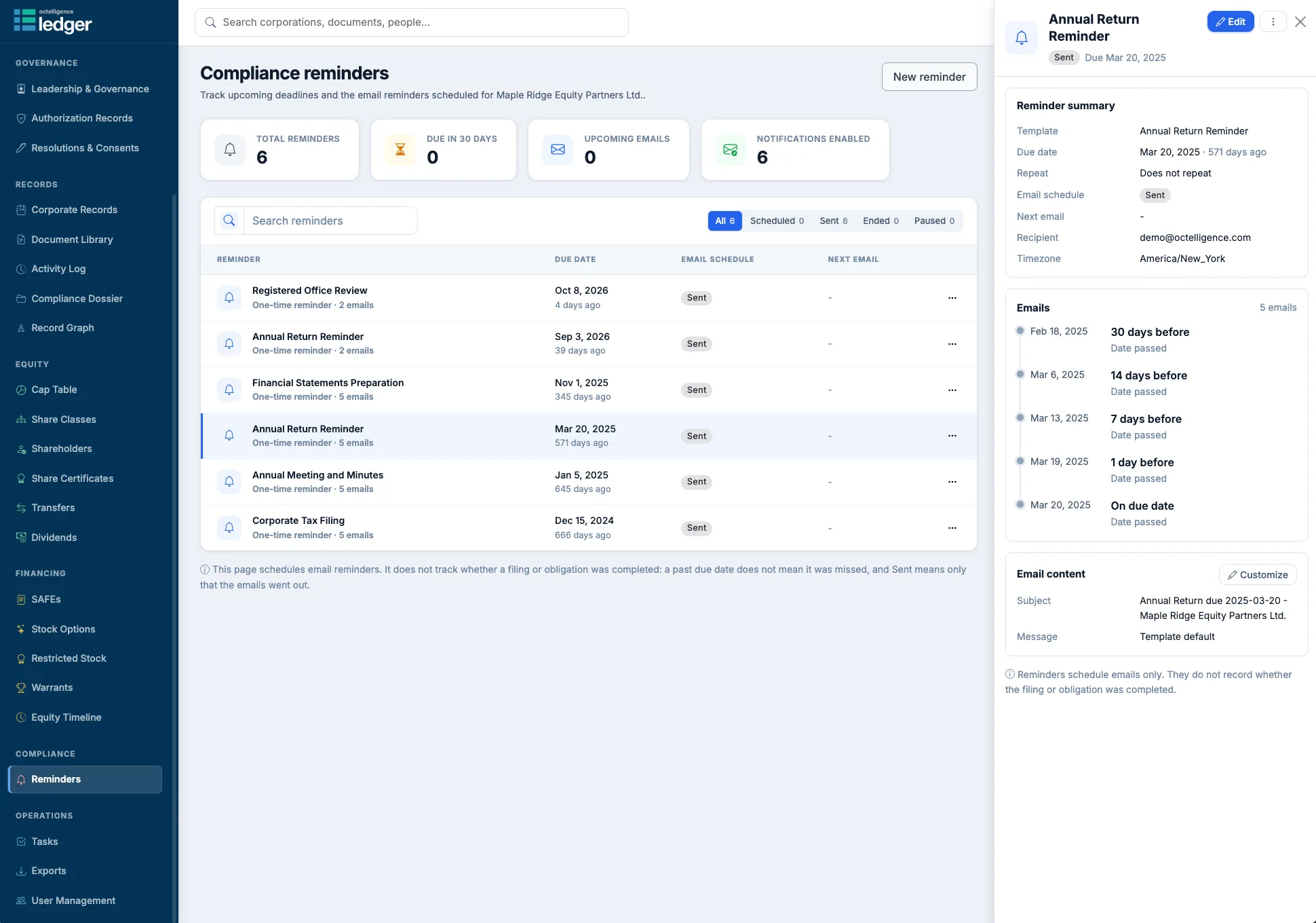
Octelligence tracks the annual return deadline alongside every other corporate obligation, prompts ahead of the due date, and stores the filed return in the minute book so the corporate registry record matches the internal record.
See Digital Corporate RecordsFilings calendar, jurisdiction-aware deadlines, and a record of every return filed in the corporate records.