Annual return filing for a federal Canadian (CBCA) corporation
Federal Canadian corporations file an annual return with Corporations Canada each year on the anniversary of incorporation. The CBCA annual return is short, cheap to file online, and absolutely essential, missing three consecutive returns leads to dissolution.
| CBCA s. 263 | Annual return required |
|---|---|
| CBCA s. 113 | Notice of directors (also updated annually) |
| CBCA s. 19 | Registered office (also updated annually) |
| CBCA s. 212 | Director may dissolve corporation for default |
| Industry Canada Form 22 | Annual return form |
- Due each year within 60 days of the corporation's anniversary of incorporation
- Filed with Corporations Canada online (preferred) or by mail; the online fee is $12, paper filing is $40
- Confirms: registered office, current directors, and corporation type details
- Missing three consecutive annual returns triggers administrative dissolution under s. 212
- Revival possible by filing all missed returns plus a $200 revival fee under s. 209
What CBCA s. 263 requires
Section 263 of the CBCA requires every federal Canadian corporation to file an annual return with the Director under the Act (Corporations Canada) each year. The return must be filed within 60 days following the anniversary date of incorporation, amalgamation, or continuance. The form is short, typically two pages, and confirms:
- The corporation's name and corporation number
- The registered office address (filed updates separately if it has changed)
- The current directors and their addresses
- Type of corporation and basic governance details
- Confirmation that the corporation is still active (not insolvent, not dissolved)
Fees and method of filing
The annual return can be filed:
- Online through Corporations Canada's online filing system, for $12
- By mail using Form 22, for $40
Online filing is the dominant method. The fee is paid at the time of filing by credit card; a confirmation is issued immediately. Bulk filing for portfolios is supported for law firms and accounting practices.
Dissolution under s. 212
If a CBCA corporation fails to file annual returns, the Director under the Act may dissolve the corporation under s. 212. The threshold is generally three consecutive years of missed filings (or other persistent non-compliance), though the Director has discretion to dissolve sooner where required by other circumstances. The Director typically sends a notice of intent to dissolve before taking action, giving the corporation an opportunity to file the missed returns.
Once dissolved under s. 212, the corporation can be revived under s. 209 by:
- Filing articles of revival
- Filing all missed annual returns
- Paying the revival fee (currently $200) plus the back-filing fees
- Bringing the registered office and directors information current
Revival restores the corporation to the same legal position as before dissolution, but the time and cost of revival is many times the cost of simply filing the annual returns on time.
Practical tips
The anniversary date is the key trigger. Set the filing reminder for 30-45 days before the anniversary, file online for $12, get the confirmation in minutes. For corporations with December anniversaries, the typical mistake is treating the annual return as a year-end obligation aligned with tax filings, but the deadline is the anniversary, not the fiscal year-end. Conflating the two leads to missed filings.
Annual returns are also distinct from the corporation's annual financial statements and any provincial extra-provincial filings. A CBCA corporation operating in Ontario must file the federal CBCA annual return AND the Ontario extra-provincial Initial Return and any subsequent Notice of Change. Each set has its own deadline.
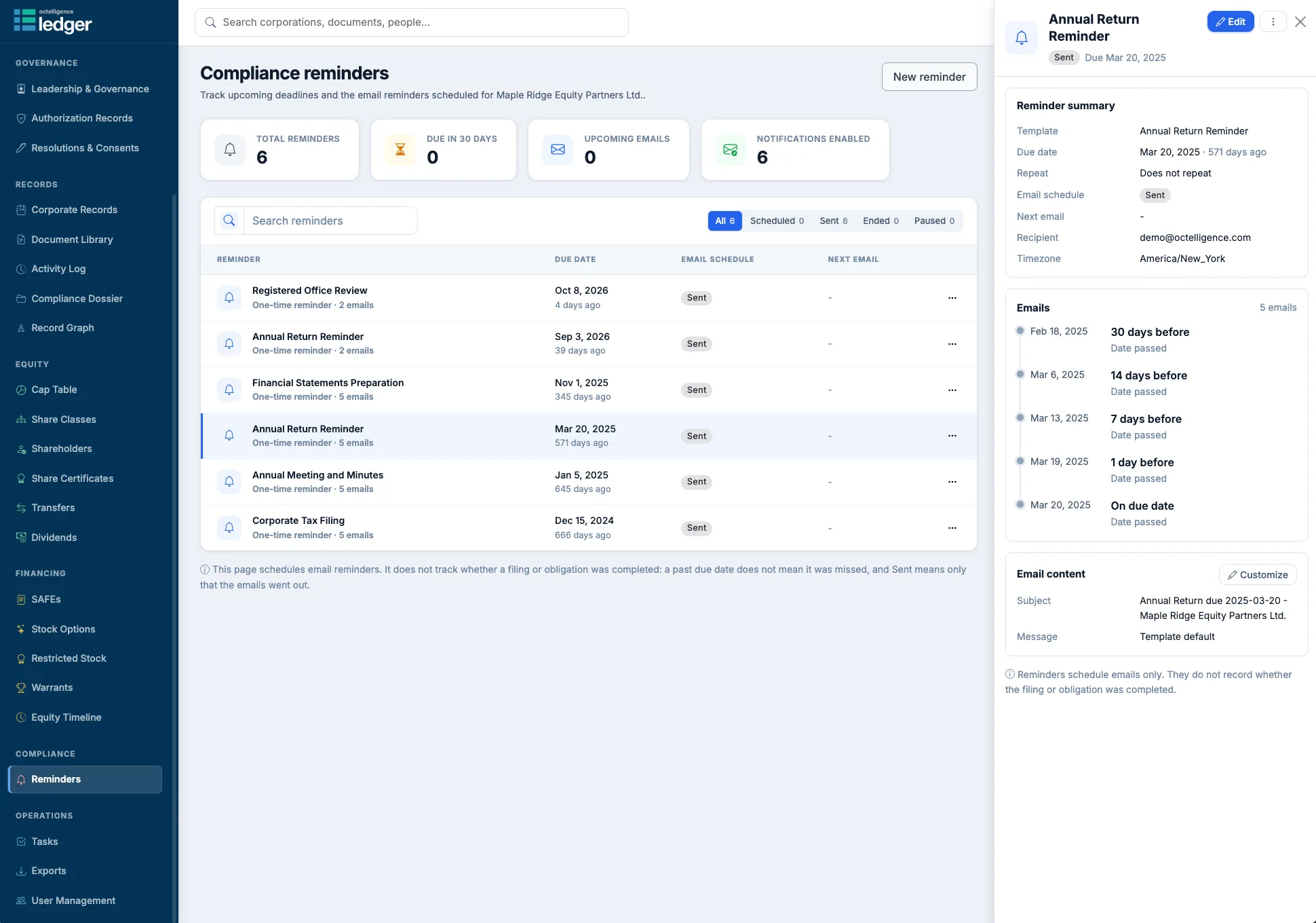
Octelligence tracks the annual return deadline alongside every other corporate obligation, prompts ahead of the due date, and stores the filed return in the minute book so the corporate registry record matches the internal record.
See Digital Corporate RecordsFilings calendar, jurisdiction-aware deadlines, and a record of every return filed in the corporate records.