Annual franchise tax and Public Information Report for a Texas corporation
Texas corporations file a Public Information Report (PIR) and Franchise Tax Report (or No Tax Due Report) with the Texas Comptroller of Public Accounts under Tex. Tax Code § 171 by May 15 each year. The PIR is free, and franchise tax depends on revenue (No Tax Due is available for corporations under the $1.23M revenue threshold).
| Tex. Tax Code § 171 | Franchise tax and PIR required |
|---|---|
| Filing authority | Texas Comptroller of Public Accounts, not the Secretary of State |
| Form | Public Information Report (PIR) + Franchise Tax Report (or No Tax Due Report) |
| Deadline | May 15 each year |
| Filing fee | $0 PIR; franchise tax depends on revenue (No Tax Due available under $1.23M) |
| Late consequences | $50 late fee + 5% to 10% penalty; forfeiture of right to do business |
| Reinstatement | By curing all defaults including back taxes |
- Filed with the Texas Comptroller of Public Accounts (not the Secretary of State)
- PIR fee $0; franchise tax depends on revenue
- No Tax Due Report available for corporations with revenue under $1.23 million
- Due May 15 each year, regardless of fiscal year
- Late filing triggers $50 late fee plus 5-10% penalty on tax owed; sustained delinquency forfeits the right to do business
What Tex. Tax Code § 171 requires
Section 171 of the Texas Tax Code requires every Texas corporation (and most LLCs and partnerships) to file a Public Information Report (PIR) with the Texas Comptroller of Public Accounts by May 15 each year. The PIR confirms registered agent, principal office, directors, and officers. The PIR itself has no fee. Separately, the corporation files either a Franchise Tax Report or a No Tax Due Report, depending on whether the corporation's revenue exceeds the threshold (currently $1.23 million annualized).
The No Tax Due Report
For corporations with Texas-sourced revenue under $1.23 million annualized, the No Tax Due Report (Form 05-163) replaces the full Franchise Tax Report. The No Tax Due Report is simple to file and confirms that no tax is owed; no payment is required. For corporations over the threshold, the Franchise Tax Report calculates tax based on margin (revenue less cost of goods sold or compensation, depending on calculation method) at 0.375% for retail/wholesale or 0.75% for other businesses.
The May 15 fixed deadline
Texas uses a fixed May 15 deadline for all corporations, regardless of fiscal year. The fixed-day approach simplifies calendar management but concentrates workload around mid-May. Texas grants automatic extension to November 15 by filing a Form 05-164, though the extension does not waive the tax obligation (only the filing deadline).
What's distinctive about Texas
Texas's combined PIR-and-franchise-tax regime is administered entirely by the Comptroller rather than the Secretary of State. This means corporate compliance and tax compliance are closely linked in Texas. The No Tax Due threshold of $1.23 million is generous and means most closely-held private corporations owe no tax (and have minimal compliance burden). For corporations above the threshold, the margin-based franchise tax can be substantial. Texas does not have a corporate income tax (only the franchise tax), which is a meaningful advantage over states with both, but the franchise tax calculation itself can be more complex than a typical income tax for businesses straddling multiple revenue types.
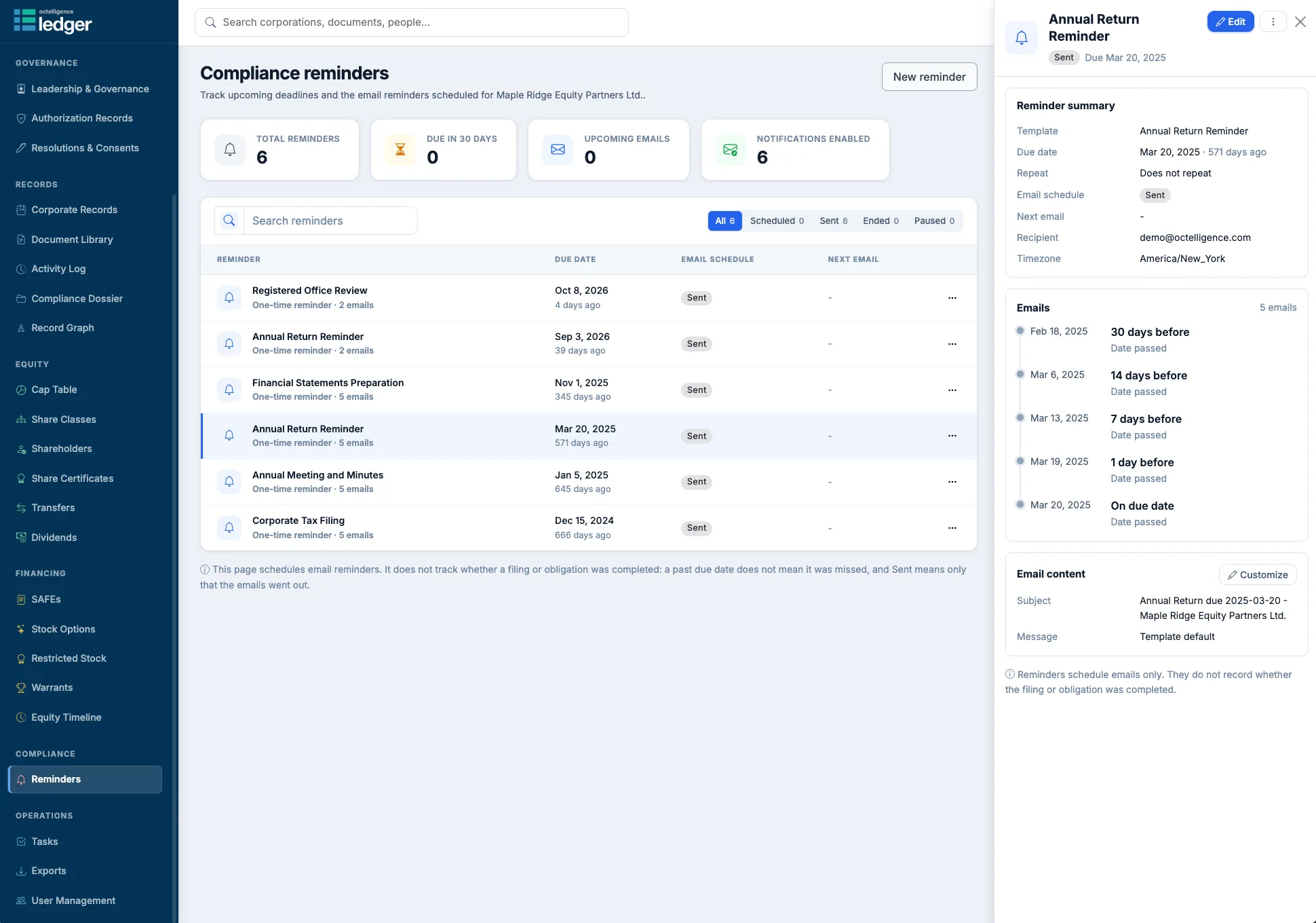
Octelligence tracks the annual return deadline alongside every other corporate obligation, prompts ahead of the due date, and stores the filed return in the minute book so the corporate registry record matches the internal record.
See Digital Corporate RecordsFilings calendar, jurisdiction-aware deadlines, and a record of every return filed in the corporate records.