Directors' resolutions under the CBCA (federal Canadian corporations)
How a CBCA board passes resolutions, by meeting or in writing under s. 117, what must be in the document, and the difference between an ordinary written resolution and a unanimous shareholders agreement.
| s. 117 | Resolution in lieu of a meeting (unanimous written resolution) |
|---|---|
| s. 119 | Validity of meetings and resolutions |
| s. 123 | Validity of acts of directors and officers despite procedural irregularities |
| s. 121 | Officers and the power to delegate |
- Resolutions can be passed at a meeting (with quorum and vote) or in writing under s. 117 (signed by all directors entitled to vote)
- Written resolution must be signed by every director who would have been entitled to vote; an abstention or absence makes the written form invalid
- Resolution is effective on the date the last director signs, unless the resolution itself specifies a different effective date
- Filed to the minute book under s. 20; a copy must be available at the registered office for shareholder inspection (s. 21)
- Directors who are conflicted on the matter cannot sign; they must abstain, which means a meeting (rather than written resolution) is required
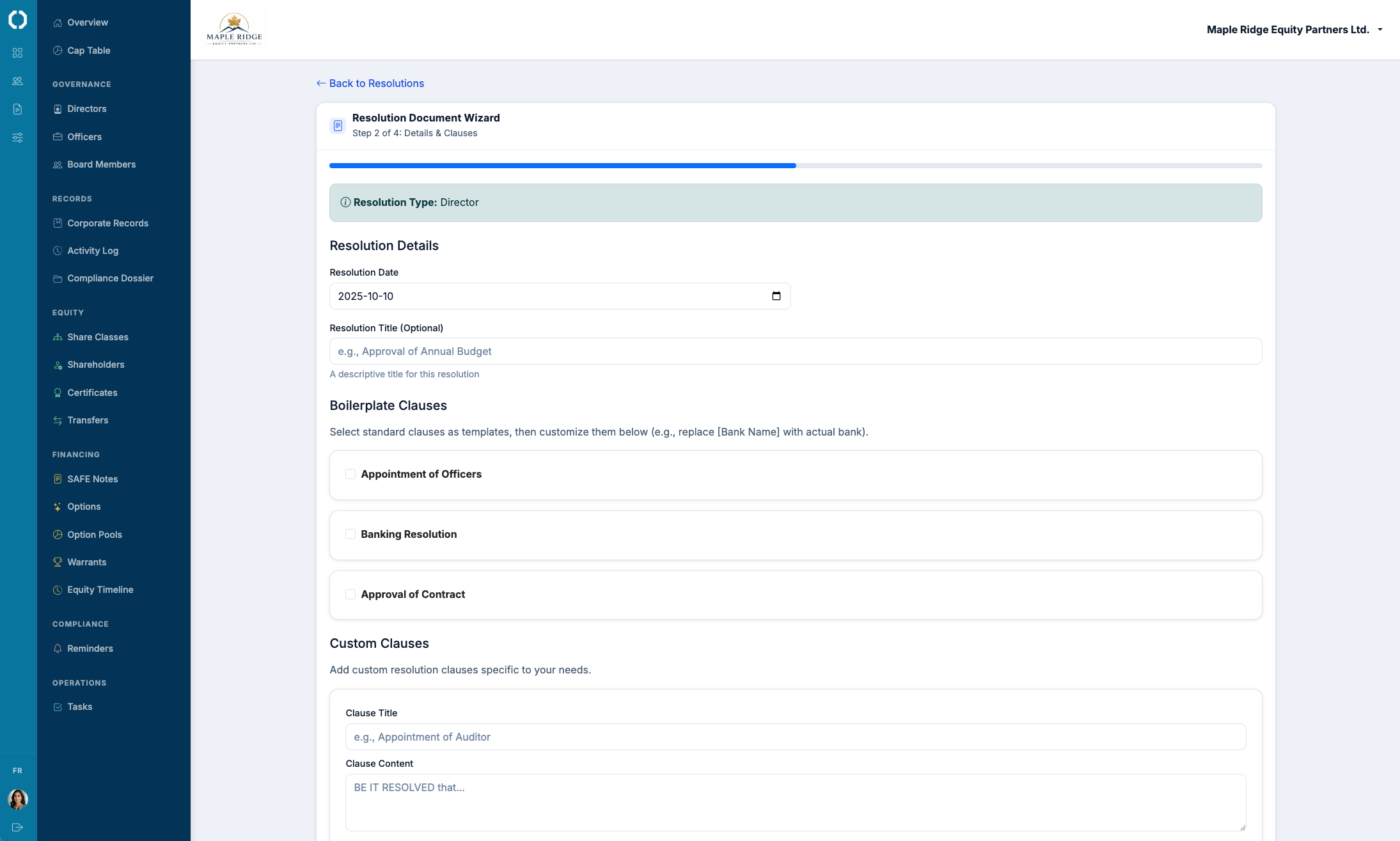
How CBCA s. 117 works
Section 117 is the cornerstone of practical board governance in CBCA corporations. It permits a resolution to be passed without a meeting, provided every director entitled to vote on the matter signs the written resolution. The signature requirement is strict: every director must sign. If any director is unwilling, unable, or unavailable to sign, the written resolution mechanism cannot be used and a meeting must be called.
- A written resolution has the same force and effect as if passed at a directors' meeting with quorum, vote, and recorded in the minutes
- The resolution is dated as of the date of the last signature, unless an effective date is specified
- Original signed copy is filed to the corporation's minute book
- Acceptable signatures: ink, electronic (under PIPEDA-compliant systems), or counterpart originals (each director signs a separate copy)
Conflicts of interest under s. 120
A director who has a material interest in a contract or transaction with the corporation is subject to disclosure obligations under s. 120 and, generally, cannot vote on the related resolution. This means: (a) the conflicted director must disclose the interest at or before the meeting where the matter is discussed, (b) the disclosure is recorded in the minutes, and (c) the conflicted director cannot count toward quorum or vote on that specific resolution. For a written resolution, the same rule applies — a conflicted director cannot sign, which usually means the written-resolution mechanism is unavailable on that matter and a meeting with quorum (excluding the conflicted director) is required.
Validity despite procedural irregularities
CBCA s. 123 provides important protection: acts of directors are valid notwithstanding any defect in their election, appointment, or qualification that is later discovered. This protects third parties who relied on the directors' authority in good faith. But s. 123 does not cure substantive defects — for example, a resolution passed without proper notice of meeting, or a written resolution that was never actually signed by all directors. Those remain invalid.
Octelligence captures every directors' resolution against the corporation it governs, with full signature record and unalterable timestamp. Filed automatically to the minute book.
See Digital Corporate RecordsTemplates per jurisdiction, electronic signature, complete activity log, every resolution tied to its underlying transaction.