Directors' resolutions under the UK Companies Act 2006
How a UK private limited company's board passes resolutions, including the written-resolution mechanism for directors and the s. 175 conflict-of-interest duty.
| s. 288 | Written resolutions of private companies |
|---|---|
| s. 282-283 | Directors' resolutions and unanimity |
| s. 175 | Director conflict-of-interest duty |
- UK Companies Act 2006 governs all UK companies; private companies have wide discretion in resolution mechanics
- Section 288 governs written resolutions; subject to the articles, can be signed by directors
- Director duties under sections 170-181, including the s. 175 conflict-of-interest duty
- UK corporations can operate by written resolution without a meeting; subject to the articles
- Records of resolutions are part of the statutory records under s. 248
UK CA 2006 written resolutions for directors
The UK Companies Act 2006 governs directors' resolutions, but the precise mechanics are largely left to the articles. The standard model articles for private companies permit decisions by either: (a) a directors' meeting (with quorum, typically 2), or (b) a written resolution signed by all directors entitled to vote. The model articles for public companies are stricter and typically require meetings.
Director duties under sections 170-181
The Companies Act 2006 codifies director duties for the first time in UK statute: to act within powers (s. 171), to promote the success of the company (s. 172), to exercise independent judgment (s. 173), reasonable care and skill (s. 174), to avoid conflicts (s. 175), not to accept third-party benefits (s. 176), and to disclose interests in proposed transactions (s. 177). Section 175 is the conflict-of-interest provision: a director must avoid situations in which they have a direct or indirect interest that conflicts with the company's interests.
Statutory records under s. 248
UK companies must keep records of directors' resolutions as part of the statutory records. Records can be kept at the registered office or another specified location; they must be available for inspection by company officers. Records of board resolutions are not public, unlike shareholder resolutions filed at Companies House.
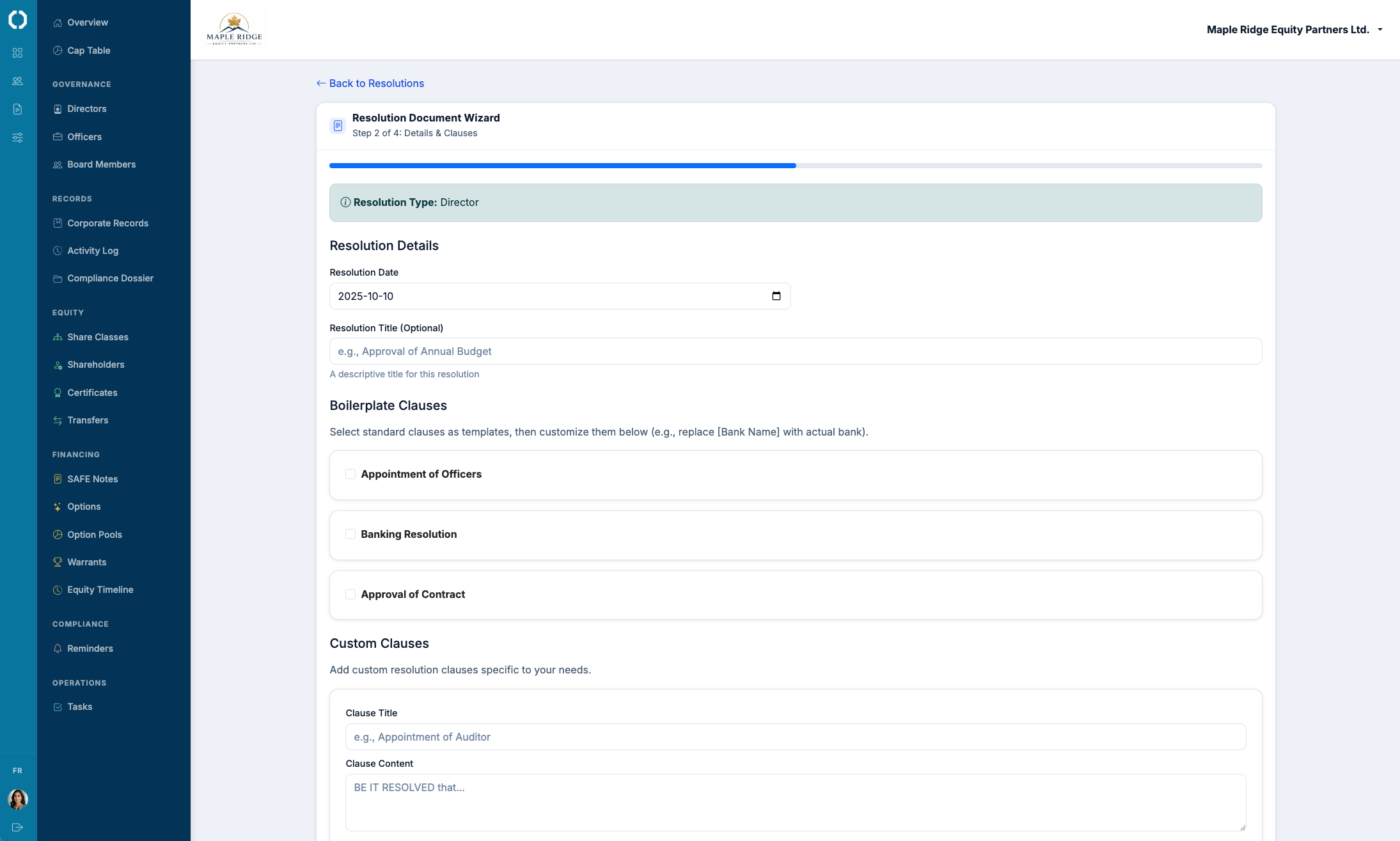
Octelligence captures every directors' resolution against the corporation it governs, with full signature record and unalterable timestamp. Filed automatically to the minute book.
See Digital Corporate RecordsTemplates per jurisdiction, electronic signature, complete activity log, every resolution tied to its underlying transaction.