How to amend bylaws
The bylaws are the operating manual for how the board and the shareholders act between annual meetings: notice periods, quorum, officer authorities, indemnification standards. Amending them is usually a board action, sometimes confirmed by shareholders, always recorded in the minute book. The procedure below documents the path from drafting to retention.
| When | To update operational governance: meeting procedures, officer authority, indemnification, quorum |
|---|---|
| Who approves | The board (in most jurisdictions), confirmed by shareholders at the next meeting where statute requires |
| Statutory anchor | CBCA s. 103, OBCA s. 116, DGCL § 109, Companies Act 2006 s. 21 (articles of association) |
| Filed publicly | No in CBCA/OBCA/DGCL; yes in the UK (articles of association are filed with Companies House) |
- Bylaws are internal governance rules; articles are the public charter on file with the registrar
- In CBCA and OBCA jurisdictions, board adopts the amendment and shareholders confirm at the next meeting
- In Delaware, the certificate determines who holds bylaw amendment power
- UK articles of association are amended by special resolution and filed with Companies House
- Bylaws that conflict with the articles are void to the extent of conflict; review against the articles before adoption
On this page
Steps
Confirm authority to amend the bylaws
The bylaws set out the corporation's internal governance rules: meeting procedures, officer roles, director qualifications, quorum, indemnification. Authority to amend is typically vested in the board, subject to confirmation by shareholders at the next meeting (CBCA s. 103, OBCA s. 116). Under DGCL § 109, the certificate of incorporation determines who holds the amendment power; by default it is the shareholders, but it may be conferred concurrently on the directors. Confirm which body holds amendment authority for the specific provision being changed.Draft the amendment in clean replacement form
Draft the amended bylaw as it will read after amendment, not as redline. Reference the existing bylaw being amended (article number, section number) and provide the new language verbatim. If the amendment is a wholesale restatement, prepare the entire bylaw document as the new bylaws. The drafting must remain consistent with the articles of incorporation; bylaw provisions that conflict with the articles are void to the extent of the conflict.Pass the board resolution adopting the amendment
The board passes a resolution adopting the amended bylaw, effective on the date of the resolution (or a specified later date). The resolution attaches the text of the amendment and notes that the amendment will be submitted for shareholder confirmation at the next meeting if required by the statute. See how to pass a board resolution.Submit the amendment for shareholder confirmation at the next meeting
Under CBCA s. 103(2) and OBCA s. 116(2), a bylaw made or amended by the directors is effective immediately but must be submitted to the shareholders at the next meeting for confirmation, amendment, or rejection by ordinary resolution. If shareholders reject the amendment, it ceases to be effective on the date of rejection but actions taken under it before that date are valid. Under DGCL, if both the certificate and the bylaws permit board amendment, shareholder confirmation is not required. See how to run an annual meeting.Record the amendment in the minute book
The signed board resolution adopting the amendment, the certified amended bylaw text (or the full restated bylaws), and any subsequent shareholder confirmation resolution are placed in the minute book under the bylaws section. The minute book index is updated to reflect the amendment. Where the corporation maintains a consolidated bylaws document, both the historical version and the amended version are retained so that the bylaws in effect at any prior date can be reconstructed. See how to maintain a minute book.Distribute the amended bylaws and update governance documents
The amended bylaws are distributed to the directors, the officers, external counsel, and (in jurisdictions where shareholders have a right to receive them) the shareholders. Internal governance documents that reference the bylaws (board meeting agenda templates, officer authority memos, indemnification agreements) are reviewed for consequential updates. The corporation's record of corporate governance materials is refreshed.Notify counterparties whose contracts reference the bylaws
Some contracts (indemnification agreements, certain financing documents, shareholders agreements, employment agreements with officer roles defined by reference to bylaws) reference the bylaws. Review those contracts to confirm whether the amendment affects any contractual term. Where the contract requires notice of bylaw changes, deliver notice per its terms. Where the contract incorporates bylaws by reference, consider whether a consequential amendment to the contract is appropriate.
Jurisdiction notes
The amendment authority and the shareholder-confirmation requirement vary across jurisdictions:
- Delaware (DGCL). Bylaws under DGCL § 109. Shareholders hold amendment power by default; the certificate may also confer amendment power on the directors (concurrently). When both hold power, directors can amend on their own without shareholder confirmation, but shareholders may also amend and may amend a director-made bylaw. Specific provisions (like exclusive forum provisions) may have heightened requirements. View jurisdiction guide
- California. Bylaws under California Corporations Code §§ 211 and 212. Directors may amend the bylaws, but shareholders may also amend; the certificate or bylaws may set a higher threshold for specific provisions. Director-made amendments take effect immediately. View jurisdiction guide
- Canada (CBCA). Bylaws under CBCA s. 103. Directors adopt bylaw amendments effective immediately and submit to shareholders at the next meeting for confirmation by ordinary resolution. If shareholders reject, the bylaw ceases to be effective from rejection forward. Certain "fundamental" bylaw changes may require special resolution depending on subject. View jurisdiction guide
- Ontario (OBCA). Bylaws under OBCA s. 116. Procedure mirrors the CBCA. View jurisdiction guide
- United Kingdom. The UK has articles of association rather than separate bylaws. Amendment under Companies Act 2006 s. 21 requires a shareholder special resolution (75% of votes cast). Amended articles must be filed with Companies House within 15 days under s. 26. The articles are public. View jurisdiction guide
Common mistakes
- Adoption without checking the articles. The board amends a bylaw provision that conflicts with the articles (a quorum provision, a notice period, a class-vote requirement). The bylaw is void to the extent of the conflict, but it is being relied on for actions in the interim.
- Forgetting shareholder confirmation. The CBCA-incorporated corporation amends a bylaw and treats it as final. The next shareholder meeting passes without the amendment being submitted for confirmation. The amendment remains effective but the shareholders have been deprived of their statutory right to confirm or reject.
- Bylaws drift from operating practice. The bylaws say board meetings require seven days' notice; the board has been giving 48 hours for years. The bylaws are not amended to reflect practice, so every recent meeting has been on technically short notice. The first time a director challenges a decision on procedural grounds, the gap is revealed.
- No version history. The bylaws have been amended four times over five years. Only the current version is retained. A diligence question about the bylaws in effect on a specific historical date cannot be answered.
- Distribution gap. The amended bylaws are adopted but not distributed to officers and counsel. The CFO acts under the old bylaws (which limited officer signing authority); the new bylaws expanded it but the CFO doesn't know.
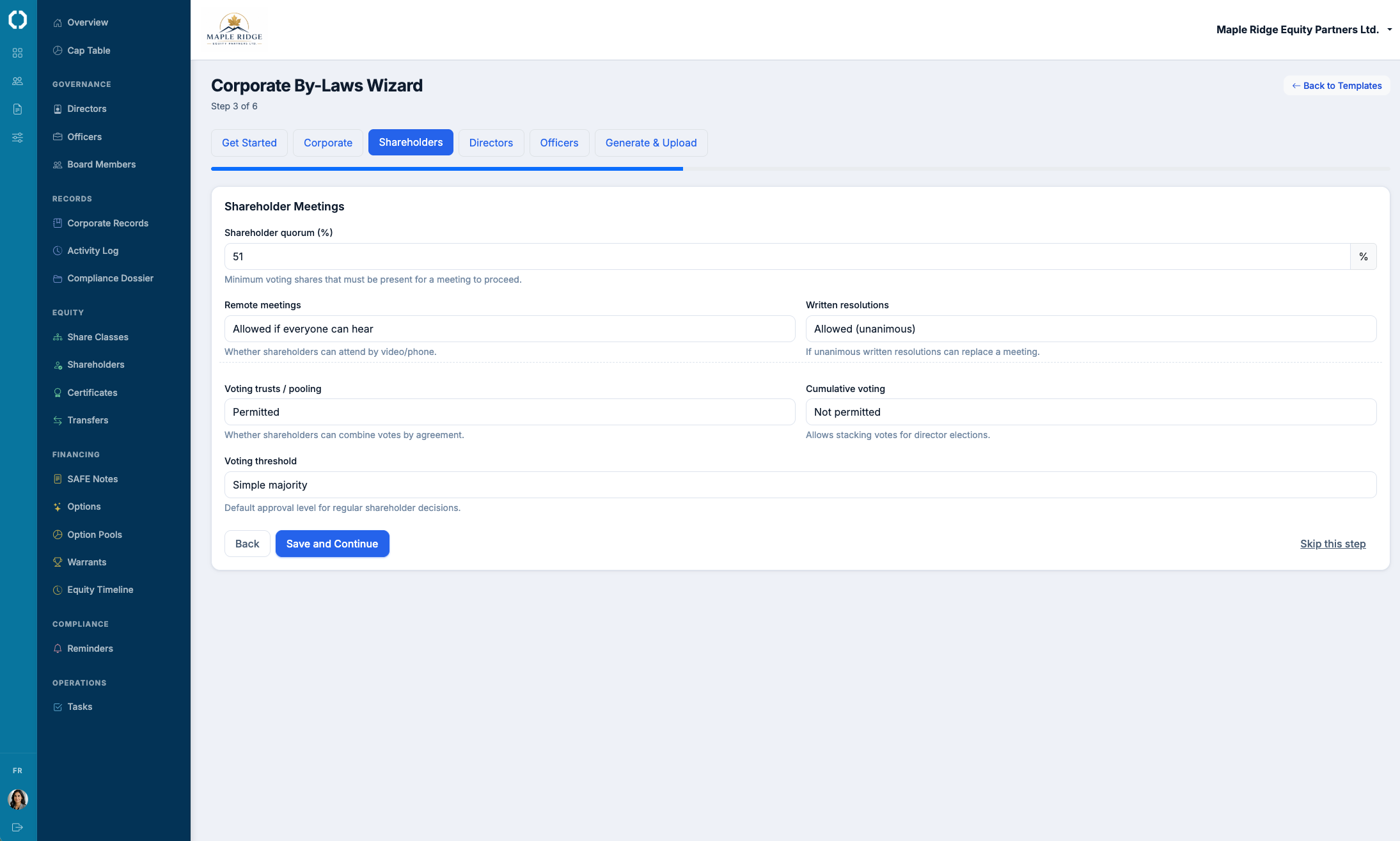
Octelligence stores the bylaws with every prior version, the adopting resolution, and any shareholder confirmation. The current version is what officers and directors see by default, but the historical version in effect on any prior date is one click away. Updates push notifications to the standing distribution list of directors, officers, and counsel.
See Digital Corporate RecordsCommon questions
Every amendment recorded with its authorizing resolution, the prior version preserved, and the standing distribution list notified.