How to call a special meeting of shareholders
A special meeting (an extraordinary general meeting in UK usage) is the procedural vehicle for any shareholder business that cannot wait until the annual meeting: charter amendments, board removals, major transaction approvals, financing authorizations. The procedure runs through statute and bylaws on every step, from who can call the meeting to what business can be transacted to how the result is recorded.
| When | Between annual meetings, for specific business that cannot wait |
|---|---|
| Who can call | The board, or shareholders meeting the requisition threshold (typically 5%) |
| Notice | 21 to 60 days (CBCA); at least 10 days (DGCL); 14 clear days (UK) |
| Records | Notice, proxies, ballots, scrutineer report, minutes, resolutions |
- The board or qualified requisitioning shareholders can call the meeting
- Notice must describe the date, place, record date, and every item of business
- Business at the meeting is limited to items in the notice (with narrow exceptions)
- Quorum, notice period, and voting thresholds are set by statute and bylaws
- Minutes, proxies, ballots, and the scrutineer's report go in the minute book
On this page
Steps
Confirm authority to call the meeting
A special meeting (called an extraordinary general meeting in the UK) can be called by the board on its own initiative, by a director where the bylaws permit, or by shareholders meeting the requisition threshold under the statute or bylaws. Under the CBCA, holders of 5% of the issued voting shares may requisition the directors to call a meeting (s. 143). Under DGCL § 211, shareholders may not call meetings unless the certificate or bylaws permit. Under the Companies Act 2006 s. 303, members holding 5% of the paid-up share capital can require directors to call a meeting.Fix the date, the record date, and the business of the meeting
The board sets the meeting date, the record date (the date on which shareholders entitled to vote are identified), and the items of business. The notice and the meeting are limited to the items identified in the notice; business not described in the notice generally cannot be transacted, with limited statutory exceptions for procedural matters. The record date is typically 30 to 60 days before the meeting (the precise window varies by statute).Give written notice to every shareholder entitled to vote
Written notice of the meeting is sent to every shareholder of record entitled to vote, the directors, and the auditor (where applicable). The notice period is set by the statute and bylaws: 21 to 50 days under the CBCA (s. 135), at least 10 days under DGCL § 222, at least 14 clear days for a UK general meeting under Companies Act 2006 s. 307. The notice describes the date, time, and place of the meeting; the record date; the business to be transacted; and any special resolutions verbatim.Distribute proxy materials and any meeting circular
Where shareholders may vote by proxy, the corporation sends proxy forms with the notice. For matters requiring a special resolution or affecting class rights, an information circular (proxy statement) describing the proposal and its effect is included. In the UK, a circular accompanies general meeting notices for non-ordinary business. The materials must be sent far enough in advance to give shareholders a meaningful opportunity to consider the proposal.Hold the meeting and confirm quorum
At the meeting, the chair confirms a quorum (the minimum number of shareholders or shares represented required for the meeting to transact business). Under most statutes, the default quorum is one or more shareholders present in person or by proxy holding a specified percentage of the voting shares, but the bylaws can set a different threshold. The chair takes the business of the meeting in the order presented in the notice. Each resolution is voted on by show of hands or by poll if demanded.Record the results and the minutes
The corporate secretary records the meeting minutes: who attended, the quorum determination, the resolutions proposed, the votes recorded (counts for and against and abstentions, by proxy and in person), and the resolutions passed or defeated. Proxies, ballots, and the scrutineer's report (if a poll was held) are retained. The signed minutes go into the minute book under the meeting date. See how to maintain a minute book.Implement the resolutions and file where required
Resolutions that change corporate-charter terms (amendments to articles, capital structure changes) are filed with the corporate registrar. Resolutions that change the board (election or removal of directors) trigger filings to update the public record. Resolutions that authorize transactions (an asset sale, a financing, a wind-up) authorize the officers to execute. Each resolution is implemented per its terms and the implementation documents are retained with the minutes.
Jurisdiction notes
The notice period, requisition threshold, and quorum differ across jurisdictions but the procedural shape is consistent:
- Delaware (DGCL). Special meeting under DGCL § 211(d): may be called by the board or any person authorized by the certificate or bylaws. Notice period at least 10 days, not more than 60 days, under § 222. Quorum default is a majority of the shares entitled to vote (§ 216). View jurisdiction guide
- California. Special meeting under California Corporations Code § 600(d): may be called by the board, the chair, the president, or holders of at least 10% of the voting shares. Notice 10 to 60 days under § 601. Quorum default is a majority of the shares entitled to vote. View jurisdiction guide
- Canada (CBCA). Special meeting may be called by the directors at any time under CBCA s. 133. Shareholders holding 5% of voting shares may requisition the directors under s. 143. Notice 21 to 60 days under s. 135. Quorum set by bylaws, default a majority of the voting shares present in person or by proxy (s. 139). View jurisdiction guide
- Ontario (OBCA). Procedure under OBCA ss. 94, 95, and 105. Mirrors the CBCA with provincial-specific record-date and quorum rules. View jurisdiction guide
- United Kingdom. General meeting under Companies Act 2006 ss. 302, 303, and 307. Directors may call at any time; members holding 5% of paid-up share capital may require directors to call (s. 303). Notice 14 clear days (private company general meeting) or 21 clear days (public company AGM). Quorum default two members present in person or by proxy (s. 318). View jurisdiction guide
Common mistakes
- Short notice that nobody objects to until later. Notice is given 10 days before the meeting in a CBCA jurisdiction where the minimum is 21 days. Every shareholder attends or sends a proxy and the resolutions pass. Three months later a shareholder challenges the meeting as improperly called, and the burden falls on the corporation to show that every shareholder consented to short notice in writing.
- Business added at the meeting outside the notice. The chair calls a "any other business" item at a special meeting and a resolution is passed. The resolution is later challenged on the basis that special meeting business is limited to items in the notice.
- Record date not properly fixed. The board calls the meeting but does not fix a record date, or fixes it after the notice is sent. The shareholder list against which the notice was sent and against which voting is tabulated drifts, and challenged proxies are difficult to resolve.
- Proxy form non-compliant. The proxy form does not contain the statutorily required language (CBCA s. 150 form requirements, equivalent provincial and federal US requirements). Proxies returned on the defective form are challenged at the meeting.
- Minutes not signed or retained. The meeting concludes and resolutions are implemented but the minutes are never signed or placed in the minute book. The meeting is unverifiable in diligence; only the implementation documents and informal records remain.
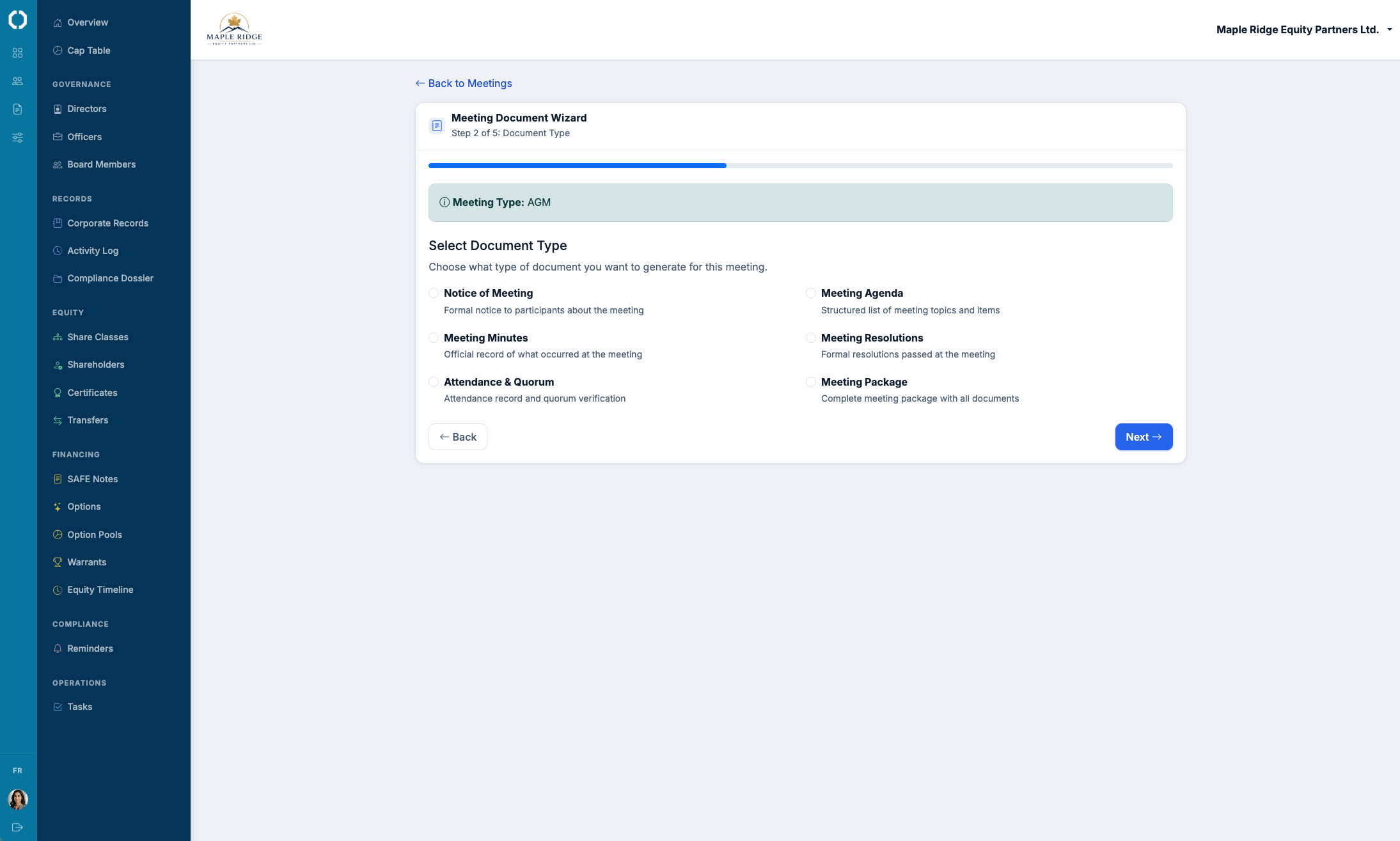
Octelligence generates the notice from the meeting record, distributes it to shareholders on the register, collects proxies and ballots, tabulates the vote against the record-date shareholder list, and stores the minutes alongside the resolutions and supporting materials. The result is a meeting that can be reconstructed from a single record.
See Digital Corporate RecordsCommon questions
Record-date shareholder list, proxy collection, ballot tabulation, scrutineer report, and signed minutes filed in the minute book as one event.