How to convert a SAFE
A SAFE is a forward agreement to issue shares on a future event. Conversion is the moment that promise becomes an issued share. The mechanics depend on the SAFE template (pre-money or post-money), the cap, the discount, and the trigger (priced round, acquisition, dissolution). The procedure below runs the conversion at a priced equity round, with the share count, the register entry, and the cap-table movement reconciled to each SAFE.
| When | On the closing of an Equity Financing (priced round), Liquidity Event, or Dissolution Event |
|---|---|
| Price | The lower of (a) the new round price discounted and (b) the cap-implied price |
| Share class | Usually the new preferred series (often a shadow sub-series at the SAFE price) |
| Records | Share register, cap table, SAFE ledger, board resolution, certificate |
- Conversion is triggered by a priced round, a liquidity event, or dissolution under the SAFE
- Each SAFE converts at the lower of its discount price and its cap-implied price
- Pre-money and post-money SAFEs follow different denominators for the cap price
- Multi-SAFE rounds with post-money SAFEs need to be solved simultaneously
- Each conversion is a share issuance on the share register, reconciled to the SAFE ledger
On this page
Steps
Identify the conversion trigger
A SAFE converts on the occurrence of an Equity Financing (a priced preferred-stock round), a Liquidity Event (an acquisition, change of control, or IPO), or a Dissolution Event. The conversion event is defined in the SAFE itself. Equity Financing is the most common conversion trigger and is the primary focus of this procedure; Liquidity and Dissolution Events follow different mechanics under the same SAFE.Identify each SAFE's discount and valuation cap
Each SAFE has its own discount rate (typically 10% to 25%, applied to the new round price) and valuation cap (a maximum company valuation for purposes of calculating the SAFE conversion price). Some SAFEs have only a cap, only a discount, both, or neither (MFN SAFE). Conversion price for each SAFE is the lower of (a) the discount-adjusted price and (b) the cap-implied price. Calculating cap-implied price requires choosing a denominator (pre-money cap, post-money cap, or specific variants).Determine the conversion price per SAFE
For a discount-only SAFE: SAFE price = (new round price) × (1 minus discount). For a cap-only SAFE (pre-money SAFE): SAFE price = cap divided by the SAFE conversion denominator (the company capitalization defined in the SAFE, typically including the option pool but excluding the new investment). For a post-money SAFE (Y Combinator 2018+): the SAFE owns a fixed percentage of the post-money cap table, calculated as (investment) divided by (post-money cap). The SAFE price is the lower of the discount price and the cap price; the holder gets the better deal. Use the SAFE conversion simulator for a single SAFE or the multi-SAFE conversion simulator for a stack.Calculate the share count each SAFE converts into
Share count = (SAFE investment amount) divided by (SAFE conversion price). The result is typically a non-integer; fractional shares are usually rounded down with the residual cash refunded, per the SAFE terms. For post-money SAFEs, the share count is whatever delivers the agreed post-money ownership percentage at the conversion. Multi-SAFE rounds need to be solved simultaneously because each post-money SAFE's share count depends on the others' share counts.Issue the converted shares to the SAFE holder
On the closing of the priced round, the corporation issues the converted shares to each SAFE holder. The shares are typically a series of preferred stock (often a shadow series with the same economic terms as the new preferred, but at the SAFE conversion price; the Y Combinator template uses Safe Preferred Stock). The board resolution authorizing the priced round also authorizes the SAFE conversions, and each SAFE holder receives a stock certificate (or uncertificated equivalent) reflecting the converted shares. See how to issue shares.Update the share register, cap table, and SAFE ledger
Each SAFE conversion is recorded as a share issuance on the share register on the closing date, with consideration equal to the SAFE investment amount. The cap table reflects the converted shares with the SAFE holder's name, the share count, and the new class. The SAFE ledger is updated to mark the SAFE as converted (no longer outstanding). The original SAFE document is retained in the minute book alongside the resolution authorizing the conversion and the certificate issued.Report and disclose the conversion
For US issuers, the conversion is a securities transaction reportable on Form D if the original SAFE issuance was reported. Some state blue-sky filings have notice obligations. For the SAFE holder, the conversion is generally a tax-deferred event for US holders (capital-asset treatment continues), but specific facts (Section 1202 holding period, qualified small business stock) should be confirmed at conversion. Inform the SAFE holder of the conversion mechanics, the share count received, the new class of stock, and any onward governance terms (voting rights, drag-along, transfer restrictions).
Jurisdiction notes
SAFEs are a US-originated instrument; conversion mechanics are similar in non-US jurisdictions but the local-law characterization varies:
- Delaware (DGCL). Conversion is a share issuance authorized under DGCL § 152, with the consideration being the original SAFE investment. The new preferred class (or shadow sub-series) must be authorized in the certificate of amendment filed for the priced round under § 242. SEC Rule 506 reliance for the conversion typically rests on the same exemption as the original SAFE issuance. View jurisdiction guide
- California. Conversion under California Corporations Code § 408 issuance authority. California state-securities filings (Section 25102(f) or 25102(o)) apply if not otherwise pre-empted by NSMIA. View jurisdiction guide
- Canada (CBCA). Conversion under CBCA s. 25. SAFEs are less common in Canada, where convertible notes and Canadian-form SAFEs (sometimes called CSAFEs) are used. Canadian securities-law exemptions (NI 45-106) typically apply, with appropriate filings if applicable. View jurisdiction guide
- Ontario (OBCA). Conversion under OBCA s. 25. Provincial securities-law treatment under the Ontario Securities Act, typically relying on the accredited-investor or related-party exemptions in NI 45-106. View jurisdiction guide
- United Kingdom. UK SAFEs (sometimes called Advance Subscription Agreements) are common as an EIS/SEIS-friendly variant. Share issuance under Companies Act 2006 ss. 549 and 550 (allotment authority) and s. 561 (pre-emption, often disapplied for ASAs). EIS and SEIS rules apply at the conversion event and the relevant HMRC compliance statement is filed after the share issuance. View jurisdiction guide
Common mistakes
- Using the wrong denominator for the cap. The SAFE is a pre-money template but the conversion is calculated as if it were post-money (or vice versa). The error materially changes the share count. The SAFE template definitions of company capitalization control, not the practitioner's general understanding.
- Treating SAFEs as debt. The SAFE is recorded on the cap table as a debt instrument or a convertible note. At conversion, the calculation treats the SAFE as if it accrued interest (it doesn't) or has a maturity date (it doesn't). The conversion math is wrong by construction.
- Multi-SAFE round computed sequentially. The stack of post-money SAFEs is converted one at a time instead of simultaneously. Each conversion changes the cap table, which changes the next post-money percentage. Sequential math produces an incorrect total post-money ownership across SAFE holders.
- MFN clauses ignored. A SAFE with an MFN was issued early; later SAFEs with better terms were issued. At conversion, the MFN holder is converted on the original terms, not the more favourable terms it elected into. The holder later challenges the conversion.
- Conversion not recorded on the register. The shares are issued in name, the conversion is calculated correctly, but the share register and cap table are not updated. Months later, diligence finds outstanding SAFEs on the SAFE ledger that the cap table doesn't reflect as converted shares.
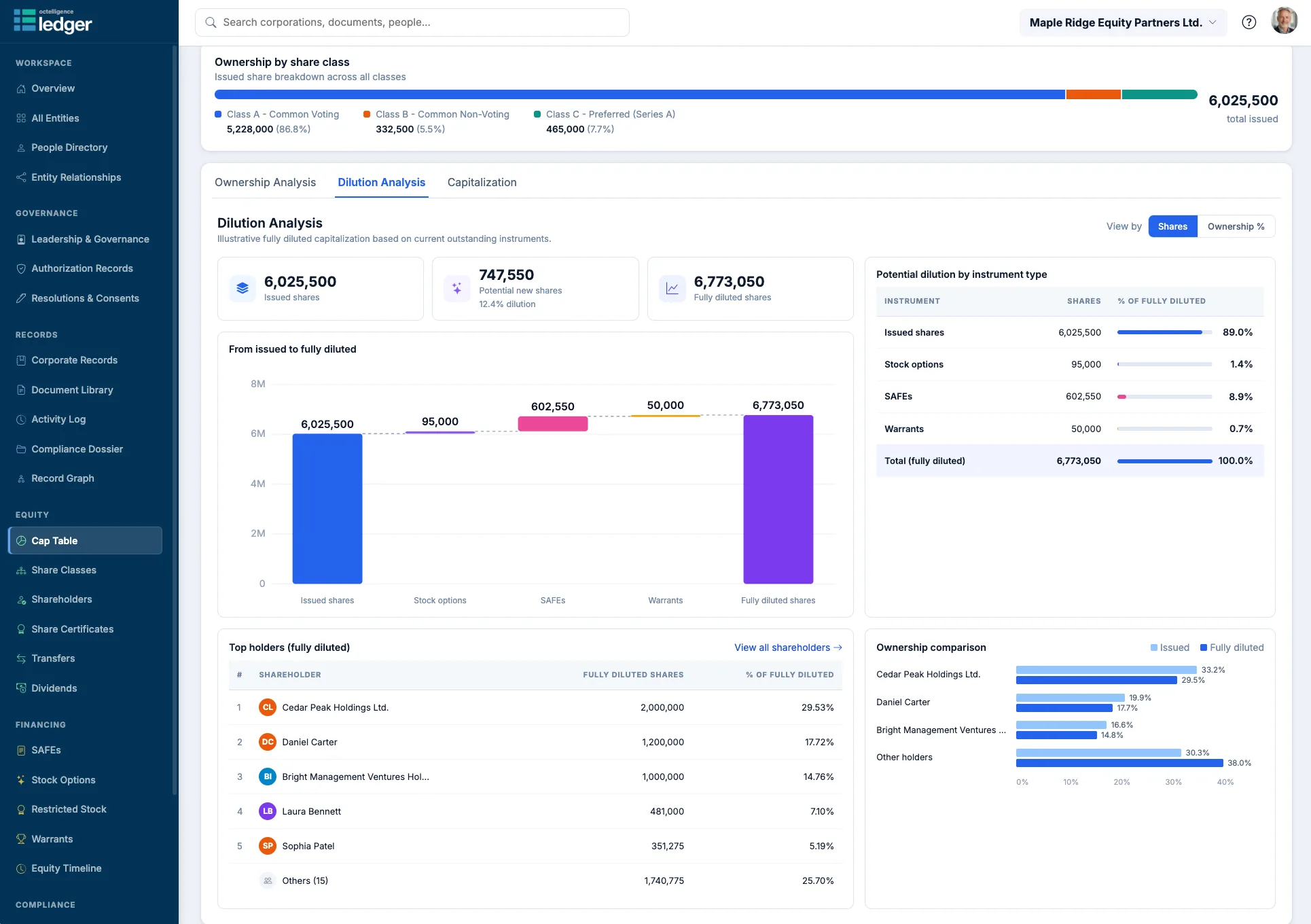
Octelligence reads each SAFE's terms, runs the conversion math at the priced round (single SAFE or simultaneous multi-SAFE), issues the converted shares, updates the share register and the SAFE ledger, and stores the SAFE document with the conversion resolution and the issued certificate. The diligence export traces each issued share back to a specific SAFE.
See Cap Tables & FinancingCommon questions
Each SAFE's cap and discount applied, shares issued, register updated, and SAFE marked converted with the supporting resolution.