How to run a priced equity round
A priced round is the financing event where the corporation issues new shares at a determined per-share price, typically to one or more institutional investors. Done correctly, it produces a clean closing record where the share count, per-share price, option pool, and resulting cap table all reconcile. Done incorrectly, it produces a closing that takes weeks to clean up post-fact, often with valuation surprises for the founders.
| When | Series Seed / A / B / C+ priced equity financings |
|---|---|
| Lead time | 8-16 weeks from initial conversations to closing |
| Documents produced | Term sheet, financing docs (SPA, IRA, Voting Agt., ROFR/Co-Sale), restated articles, board + shareholder resolutions, updated cap table |
| Statutory anchor | Corporation statute (issuance) + securities law (private placement exemption) |
- Term sheet locks the principal economic and governance terms before legal drafting begins
- Pre-money valuation, round size, and option pool top-up together determine the per-share price
- Option pool top-up is by convention pre-money: existing holders absorb the dilution
- Restated articles add the new preferred series with rights, preferences, and protective provisions
- Closing requires board approval, shareholder approval (preferred series amendments), and customary closing conditions
On this page
Steps
Negotiate and sign the term sheet
The term sheet is the non-binding (except for confidentiality and exclusivity) summary of the principal economic and governance terms: pre-money valuation, round size, per-share price (computed from those two), liquidation preference, dividend, anti-dilution, voting rights, board composition, information rights, pro-rata, drag-along, tag-along, ROFR, and the conditions to closing. The term sheet is the leverage moment; once signed, the legal drafting that follows is shaped by what it says. Founders should negotiate every term that has commercial meaning, not just the headline valuation.Lock the valuation and option pool
Pre-money valuation, round size, and option pool top-up together determine the per-share price and the resulting founder dilution. The standard convention is that the option pool top-up is pre-money: existing holders (founders, prior investors) absorb the dilution from the new pool, not the new investors. This means a 10% post-money pool top-up dilutes founders meaningfully more than the cash investment alone. Founders should run the dilution math explicitly under the term-sheet pool size before signing, and push back if the pool is sized larger than the actual hire plan requires.Engage counsel and draft financing documents
The standard NVCA financing document set is: Share Purchase Agreement (SPA), Investor Rights Agreement (IRA), Voting Agreement, Right of First Refusal and Co-Sale Agreement, and an Amended and Restated Certificate of Incorporation (or restated articles for non-Delaware corporations). The drafts are circulated, counsel for each side marks them up, and the documents converge through redline iterations. Counsel costs scale with deal size and document complexity; for early-stage rounds, well-counseled founders can keep total round-document costs in a defensible range.Restate the articles to add the new preferred series
The restated articles add the new preferred series with the rights, preferences, and privileges negotiated in the term sheet: liquidation preference (typically 1x non-participating for venture preferred, sometimes participating), dividend right, voting rights, anti-dilution protection (typically broad-based weighted average), and protective provisions (the list of corporate actions that require preferred series consent). The restated articles are filed with the state corporate registry concurrently with the closing.Obtain board and shareholder approvals
The board approves: the financing transaction, the financing documents, the issuance of the new preferred series, the option pool top-up (the increase in shares authorized for issuance under the equity incentive plan), and any officer authorizations needed. The shareholders approve: the amendment to the certificate of incorporation (creating the new preferred series), the option pool increase if it requires shareholder consent under the prior preferred consents, and any class-vote items the existing preferred series control. Board and shareholder consents are typically by written consent rather than meeting; see pass a board resolution for the mechanics.Close and fund
Closing happens when all conditions precedent are satisfied: signed financing documents, restated articles filed, board and shareholder consents executed, legal opinions delivered if required, and (most importantly) the investor wire received. The closing date in the SPA is the effective date of the issuance. Counsel coordinates the closing checklist to ensure that all items happen in the correct order: the wire is typically received on the closing date, the new share certificates are issued (or uncertificated records made) the same day, and the register is updated.Reconcile the cap table and update records
After closing, the share register records each new investor's holding with certificate number, share count, consideration, and closing date. The cap table is regenerated from the register, including the new preferred series. The option pool top-up is reflected as authorized-but-unissued shares. The board resolutions, executed financing documents, restated articles, and updated cap table all go into the minute book in chronological order. The post-closing record is the bundle every future diligence engagement starts from.
Common mistakes
- Pre-money vs post-money option pool confusion. The term sheet specifies a pool size but doesn't clarify whether it's pre-money (founders absorb dilution) or post-money (investors absorb dilution). Default convention is pre-money, but the founders should confirm this in negotiation and re-run the dilution math under both assumptions to see what the term sheet actually does to ownership.
- Under-modeling the founder dilution. Founders look at the headline valuation and round size, miss the option pool top-up, miss the prior SAFEs converting at this round, and discover at closing that their ownership has fallen further than expected. See model founder dilution for the proper way to model this before signing the term sheet.
- Side letters not reflected in the cap table. Investor-specific side letters (MFN, pro-rata above the standard, board observer rights for non-board investors) are executed alongside the main financing documents but not always reflected in the cap-table tracking. Years later, the side letters surface in diligence and create open questions about who has what rights.
- Protective provisions over-extending board control. The protective provisions list (the items that require preferred series consent) grows during drafting beyond the term sheet's terms. Each provision is a board-control mechanism. Founders should review the final list against the term sheet and push back on additions not negotiated at the term-sheet stage.
- Closing happens before the wire clears. The closing date in the SPA is the effective date of the issuance, but the consideration must actually be received. If the wire arrives the next business day, the closing date is technically wrong. Counsel should not declare closing complete until the cash is in the account.
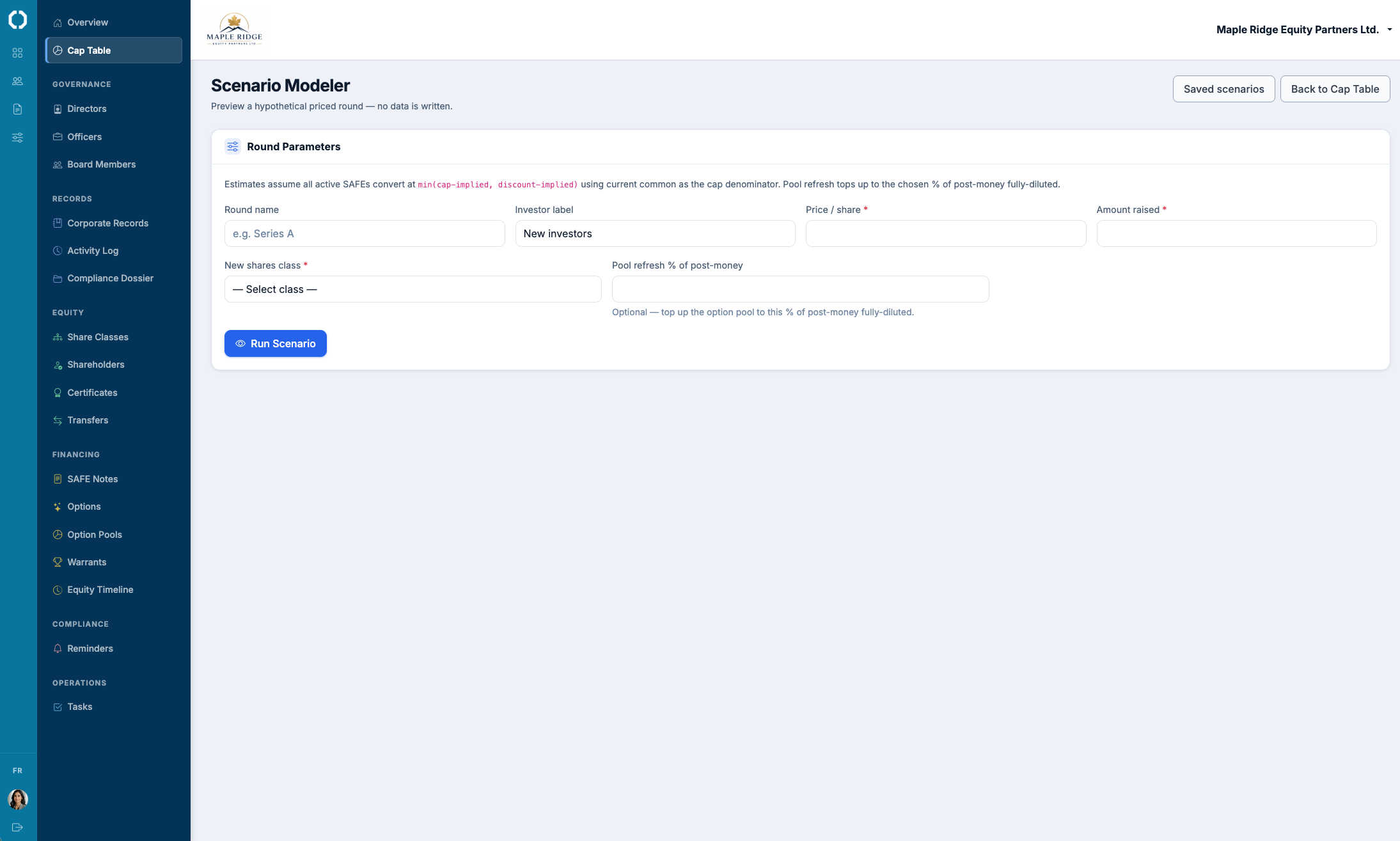
Octelligence keeps the cap table reconciled to the share register, models pre-money option pool top-ups, and produces the post-closing record bundle that diligence counsel expects. The closing is on the documents, not on cap-table reconstruction.
See Cap Tables & FinancingCommon questions
Pre-money pool modeling, SAFE conversion at closing, restated-articles tracking, and the post-closing record bundle, ready for the next diligence.