How to handle a secondary transaction
A secondary is a sale of existing private-corporation shares from one shareholder to a new buyer. The corporation is not the seller or the buyer, but the transaction still runs through the corporation's transfer restrictions, the rights of first refusal, the co-sale rights, the board's transfer approval, and the share register. The procedure below documents each gate the transaction passes through, in order.
| When | To provide liquidity to existing shareholders before an exit event |
|---|---|
| Who approves | The board (transfer consent), the corporation (ROFR), specified investors (co-sale) |
| Securities exemption | Rule 144 (US restricted securities), NI 45-106 (Canada), FSMA exemption (UK) |
| Records | Transfer agreement, ROFR notices, board consent, register update, certificate exchange |
- The corporation's outstanding equity is unchanged; only the holder of the transferred shares changes
- Transfer restrictions in the bylaws, shareholders agreement, and original purchase docs must be reviewed
- ROFR and co-sale rights must be processed before the transfer can close
- Board consent is typically required, recorded by resolution
- Securities-law exemptions apply to both sides: seller's resale exemption and buyer's eligibility
On this page
Steps
Identify the transfer restrictions that apply
A secondary transaction is the sale of existing shares from one private-corporation shareholder to another buyer. Private corporation shares are typically subject to transfer restrictions in the bylaws, the shareholders agreement, the investor rights agreement, and (for founder shares) the restricted-stock purchase agreement. Review each instrument for board consent requirements, rights of first refusal, co-sale rights, drag-along provisions, and permitted-transferee carve-outs.Negotiate the transaction and document the term sheet
The selling shareholder and the proposed buyer negotiate the share count, the price per share, the closing date, and any conditions (rep and warranty package, escrow, indemnities). For an investor-led secondary or a tender offer, the corporation typically participates in setting the structure to manage onward governance and securities-law compliance. A term sheet captures the agreed terms before legal documents are drafted.Run the right-of-first-refusal and co-sale processes
If the shareholders agreement gives the corporation a right of first refusal (ROFR), the seller delivers a notice describing the proposed transfer; the corporation has the period specified (typically 30 days) to elect to purchase on the same terms. If the corporation passes, the right may flow through to specified other shareholders (often the major investors). If a co-sale right applies, eligible shareholders may sell a pro-rata portion of their holdings to the proposed buyer on the same terms. Only after these rights are exhausted may the proposed transfer proceed.Obtain board consent and confirm regulatory compliance
The board (or a transfer-approval committee) considers and approves the transfer, recording its approval by resolution. Securities-law compliance is confirmed: the buyer must be eligible under the original issuance exemption (typically accredited-investor status under Rule 506; equivalent under NI 45-106; sophisticated-investor framework in the UK), and the seller's transfer must qualify for a resale exemption (Rule 144 for restricted securities; equivalent national rules). Compliance with any rights-of-co-sale, drag-along, or other contractual provisions is confirmed before closing. See how to pass a board resolution.Execute the share transfer agreement and exchange consideration
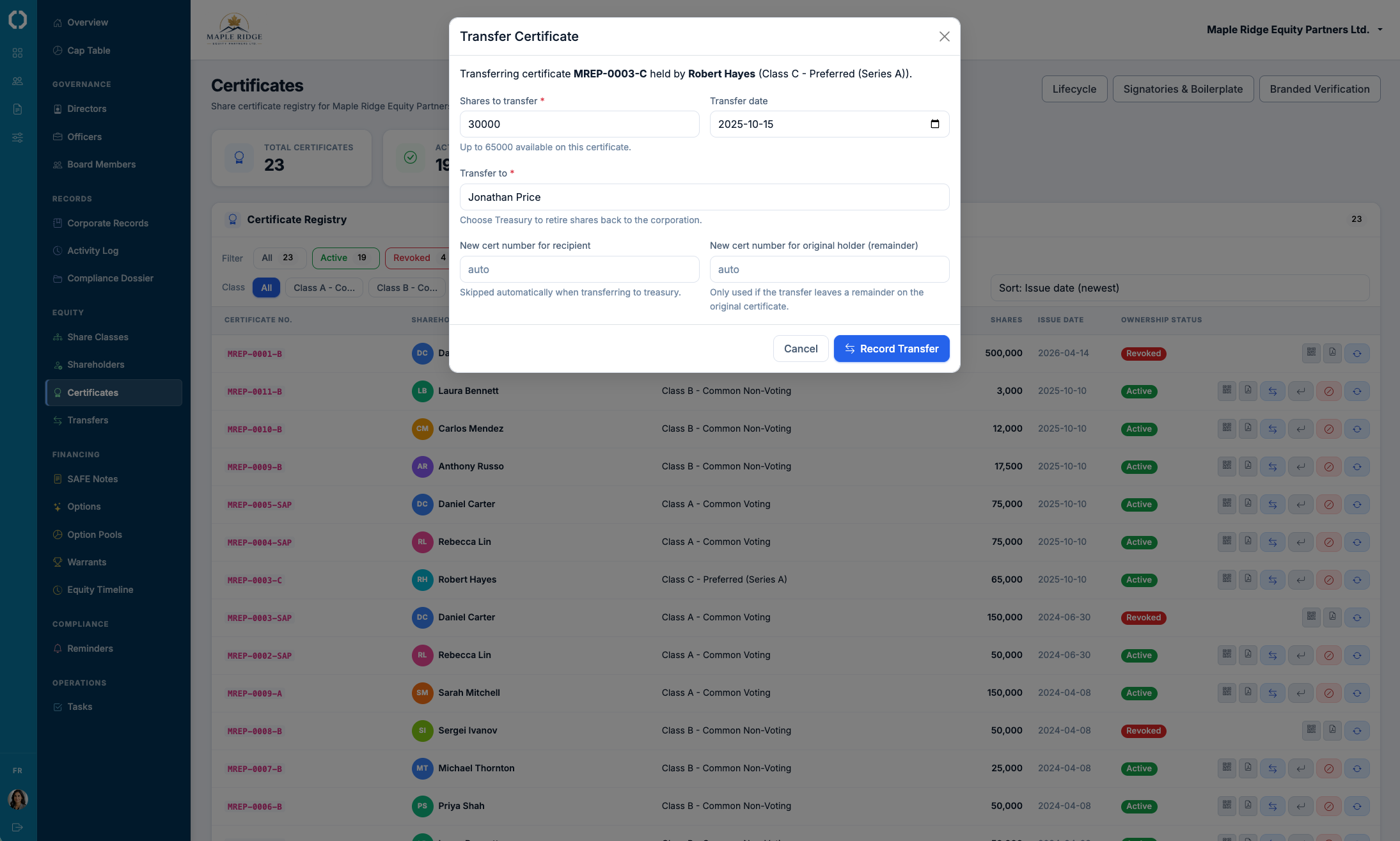
The seller and buyer execute the share transfer agreement (which contains the price, the representations and warranties, the indemnities, the closing conditions, and the seller's release of the corporation). The buyer often also countersigns the existing shareholders agreement and other governance documents to bind themselves to the same terms as the seller. The seller delivers the share certificate; the corporation cancels it. The buyer pays the purchase price. See how to transfer shares for the standard transfer mechanics.Update the share register, cap table, and minute book
On the transfer date, the share register records the cancellation of the seller's certificate and the issuance of a new certificate to the buyer with a new certificate number. The cap table updates the shareholder name and the contact details without changing the share count, class, or rights for the transferred shares (a transfer does not change the corporation's outstanding equity, only the holder of it). The transfer agreement, the board consent, the ROFR notices, and the certificate transactions are retained in the minute book.Handle tax reporting and ongoing investor administration
The seller's disposition is reported on their individual tax return (Schedule D in the US, T1 capital-gains schedule in Canada, capital-gains summary in the UK). The corporation has no withholding obligation on a typical secondary unless the seller is a non-resident (US FIRPTA, Canadian s. 116 clearance, UK NRCGT). The buyer is added to the corporation's investor administration: distribution lists, K-1/T5 reporting, 83(b)-cleanup if relevant, and access to investor materials.
Jurisdiction notes
The transfer-restriction enforceability and the resale-exemption framework differ by jurisdiction:
- Delaware (DGCL). Transfer restrictions in the certificate or bylaws are enforceable under DGCL § 202 if they meet specific notice and conspicuousness requirements. Resale exemption under SEC Rule 144 (one-year holding period for restricted securities of non-reporting companies). FIRPTA withholding under IRC § 1445 for non-resident sellers of US-real-property-interest corporations. View jurisdiction guide
- California. Transfer restrictions under California Corporations Code § 204(b). Resale exemption under SEC Rule 144 plus California Section 25102(o) for certain securities. View jurisdiction guide
- Canada (CBCA). Transfer restrictions valid under CBCA s. 49(8) if set out in the articles or bylaws. Resale through NI 45-102 (resales of restricted securities, four-month hold period) or NI 45-106 prospectus exemptions. Non-resident sellers subject to ITA s. 116 clearance certificate for "taxable Canadian property." View jurisdiction guide
- Ontario (OBCA). Transfer restrictions under OBCA s. 42. Resale and exemption rules through National Instruments; same hold-period framework as CBCA jurisdictions. View jurisdiction guide
- United Kingdom. Transfer restrictions enforceable under the articles of association. Stamp duty at 0.5% of the consideration payable on private-company share transfers under FA 1986 (paid by the buyer; the form SH03 or stock transfer form is stamped by HMRC). Non-resident capital-gains tax under NRCGT for indirect disposals of UK property. View jurisdiction guide
Common mistakes
- ROFR notice never given. The seller and the buyer agree on a transfer and the seller does not deliver the ROFR notice required by the shareholders agreement. The transfer is registered. The corporation or other ROFR holders later challenge the transfer; the seller has breached the contract.
- Board consent skipped. The transfer happens between the parties and the seller asks the corporation to update the register. The board never considered or consented to the transfer. The corporation can refuse to register the transfer until consent is obtained, but the seller and buyer have already exchanged consideration.
- Buyer not bound to the shareholders agreement. The buyer receives the shares but does not countersign the shareholders agreement, the investor rights agreement, or the drag-along terms. The buyer is now a shareholder without the governance constraints that bind the other shareholders. The next acquisition negotiation reveals the gap.
- Section 1202 holding period assumed. The buyer assumes that they have the seller's Section 1202 holding period. They do not. The buyer's holding period starts at the purchase date and Section 1202 qualification is typically not available because the buyer did not acquire from the corporation at original issuance.
- Non-resident seller without clearance. The seller is a non-Canadian resident and the corporation is a Canadian-incorporated entity holding taxable Canadian property. The seller does not obtain a s. 116 clearance certificate. The buyer is liable for the unwithheld tax (25% of the proceeds) plus penalties.
Octelligence tracks the transfer restrictions, ROFR and co-sale rights, board consent requirements, and securities-law exemptions for each shareholder. A proposed secondary surfaces the applicable gates automatically; the workflow produces the ROFR notice, the board consent resolution, the transfer agreement signature pages, and the register update from one record.
See Cap Tables & FinancingCommon questions
Every gate the transaction passes through tracked from the term sheet through to the buyer's first investor distribution list.