How to redeem or buy back shares
Buybacks and redemptions are how a corporation reduces its own outstanding equity: a structural class redemption under the articles, or a negotiated repurchase from a willing seller. Both pass through statutory solvency tests, a board determination, and a register update that records the shares as cancelled (or held in treasury where the jurisdiction permits).
| When | To retire shares from a willing seller (repurchase) or under class redemption rights |
|---|---|
| Authorized by | The board, after confirming the solvency tests are met |
| Statutory anchor | CBCA ss. 34 to 36, DGCL §§ 160 and 170, Companies Act 2006 Part 18 |
| Effect | Shares are cancelled or moved to treasury; cap table and stated capital reduce |
- Redemption derives from the articles; repurchase derives from a contract with the seller
- The two-part solvency test must be met at the time of the transaction
- Repurchase price for a private corporation should be supported by valuation evidence
- Cancellation is mandatory in Canadian federal/provincial regimes; treasury shares are permitted in most US states and the UK
- Tax treatment for the seller can be sale or dividend depending on the structure
On this page
Steps
Identify the legal basis: redemption or repurchase
Redemption is the corporation's exercise of a redemption right attached to a class of shares (the redemption terms are set in the articles, the shareholder cannot refuse). Repurchase (or buyback) is the corporation's negotiated purchase of its own shares from a shareholder who agrees to sell. Both are governed by the corporation statute, but the authority is different: redemption derives from the articles; repurchase derives from a contract with the seller, authorized by the board.Apply the statutory solvency tests
A corporation may not redeem or repurchase its shares if doing so would render it unable to pay its liabilities as they become due, or if the realizable value of its assets would be less than the aggregate of its liabilities and stated capital after the transaction. The CBCA s. 34 expressly imposes the two-part solvency test for repurchases; s. 36 applies the same test to redemptions. DGCL § 160 imposes a similar capital-impairment test under § 160 and § 170. The board records its solvency determination at the time of the transaction.Determine the price
For redemption, the price is set by the redemption terms in the articles (typically the stated capital per share plus declared but unpaid dividends, or a formula price). For repurchase, the price is negotiated between the corporation and the selling shareholder, with the directors confirming that the price is fair and supported by appropriate evidence (recent transactions, a 409A or other valuation, or board judgement). Selecting a price materially below fair value risks creating phantom income for remaining shareholders or contravening fiduciary duties.Pass the board resolution authorizing the transaction
The board passes a resolution authorizing the redemption or repurchase, recording the solvency determination, the price and consideration, the authorized officers, and the treatment of the redeemed or repurchased shares (cancellation vs treasury). For a repurchase, the resolution authorizes execution of the share repurchase agreement. See how to pass a board resolution.Execute the share repurchase agreement (for repurchase only) and pay the consideration
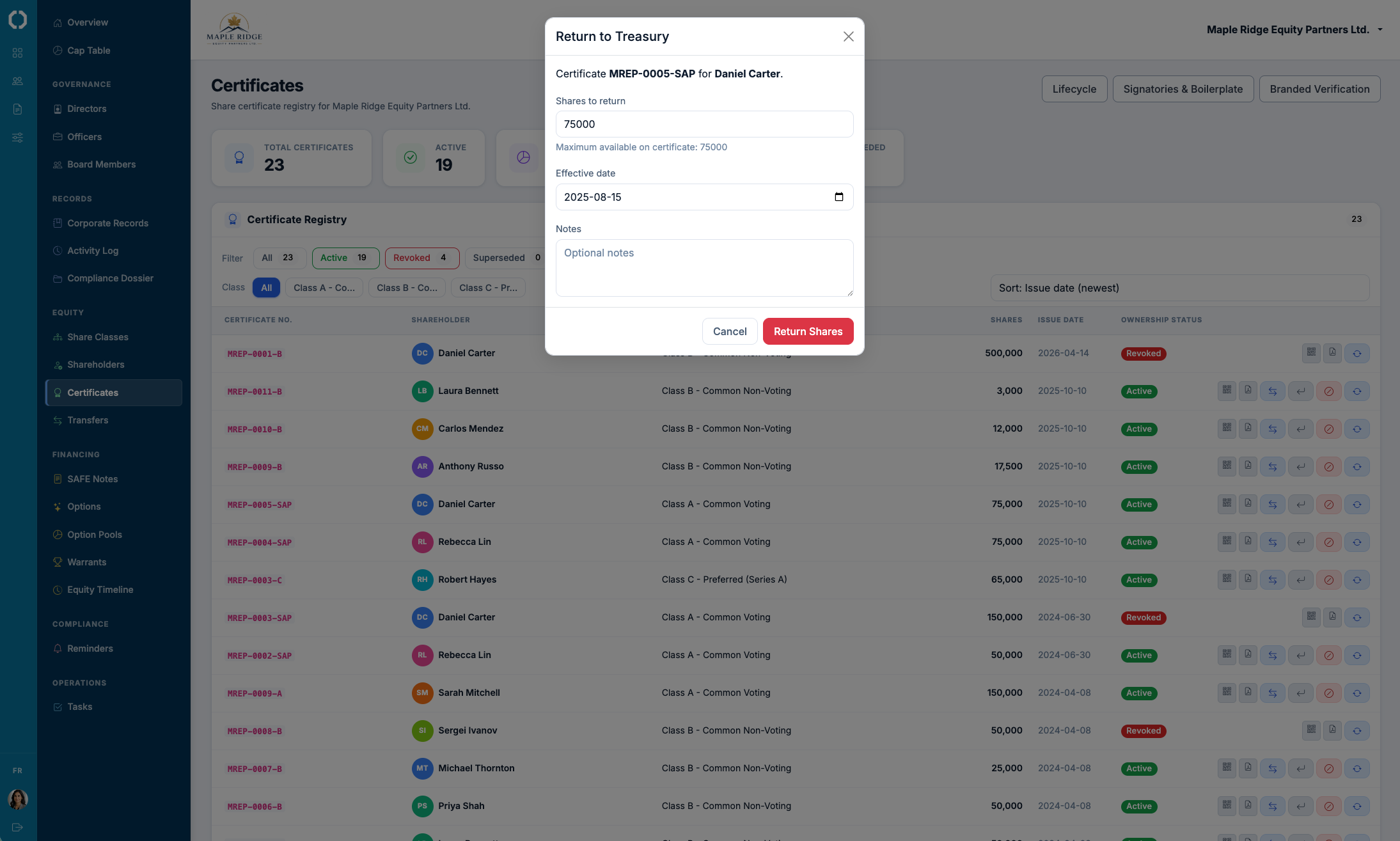
For a repurchase, the corporation and the selling shareholder execute a share repurchase agreement that documents the price, the closing date, representations and warranties (including title to the shares), and the release of the corporation. The shareholder delivers the share certificate (or other ownership instrument) and the corporation pays the consideration on closing. For a redemption, the corporation gives notice to the shareholder as required by the articles and pays the redemption price on the redemption date.Cancel the shares or move them to treasury
Under the CBCA, OBCA, and many Canadian provincial statutes, redeemed and repurchased shares are cancelled and returned to the unissued pool (no treasury shares). Under the DGCL and many US states, the corporation may choose to cancel the shares or hold them as treasury shares (issued but not outstanding, with no voting or dividend rights). The choice is recorded in the resolution. The share register entry marks the cancellation or treasury status on the transaction date.Update the register, cap table, stated capital account, and minute book
The share register records the redemption or repurchase as a separate entry from a transfer (a transfer is between shareholders; a redemption or repurchase removes shares from circulation). The cap table reflects the reduced share count for the class. The stated capital account for the class is reduced by the proportionate amount (CBCA s. 39, similar treatment under OBCA). The repurchase agreement (or redemption notice), the board resolution, the cancelled certificate, and the solvency determination are retained in the minute book.
Jurisdiction notes
The solvency thresholds, treasury-share treatment, and disclosure obligations differ:
- Delaware (DGCL). Repurchase under § 160; redemption under § 151(b). Capital-impairment test under § 160 prohibits repurchases that would impair capital. Repurchased shares may be held as treasury shares (§ 154) or cancelled. Federal tax characterization under IRC § 302 (sale vs dividend). View jurisdiction guide
- California. Repurchase under California Corporations Code §§ 500 to 511. Two-part solvency test (retained earnings test or balance-sheet test) under § 500. Treasury shares not recognized under California law; repurchased shares are cancelled and returned to unissued status. View jurisdiction guide
- Canada (CBCA). Repurchase under s. 34; redemption under s. 36. Two-part solvency test under both sections (liquidity and balance-sheet). All repurchased and redeemed shares are cancelled and returned to authorized capital under s. 39. Tax treatment under ITA s. 84(3). View jurisdiction guide
- Ontario (OBCA). Repurchase under s. 30; redemption under s. 32. Solvency tests parallel the CBCA. Cancellation under s. 33. Tax treatment as for the CBCA. View jurisdiction guide
- United Kingdom. Repurchase under Companies Act 2006 Part 18. Authority required from shareholders by ordinary resolution for market repurchases (s. 701) or by special resolution for off-market repurchases (s. 694). Repurchase funded from distributable profits or fresh share issuance (s. 692), or in limited cases from capital (s. 709, with creditor-notice procedure). Treasury shares permitted up to 10% under s. 724. View jurisdiction guide
Common mistakes
- Solvency check skipped. The board approves a repurchase from a departing founder without considering the solvency tests. Six months later, the corporation cannot pay its trade payables. The directors are personally liable under CBCA s. 118 for the amount paid to the founder.
- Treasury vs cancellation misclassified. A Canadian-incorporated corporation records a repurchase as "treasury shares," which the CBCA does not recognize. The register entry, cap table, and stated capital account are inconsistent with the statutory result (cancellation), creating a defect that surfaces in diligence.
- Price set without valuation evidence. A repurchase is closed at a price based on a verbal "founder's last conversation" with the seller. The price is materially below fair value. The other shareholders later claim a constructive dividend; the seller later claims the price was below market value.
- Repurchase from one shareholder without addressing pre-emptive rights. The shareholders agreement provides that any repurchase by the corporation triggers a pro-rata offer to all class holders. The corporation repurchases from one shareholder without making the offer. Other shareholders later challenge the transaction.
- Stated capital not reduced. The shares are cancelled but the stated capital account is not reduced on the corporation's books. Future capital actions, dividend tests, and tax filings reference an inflated stated capital that does not match the share count.
Octelligence records the repurchase or redemption with the supporting resolution, the solvency determination, the repurchase agreement, the cancelled certificate, and the updated register, cap table, and stated capital all from a single workflow. The diligence export shows the chain of authority from the articles or the seller's signature back to the cancelled or treasury entry.
See Cap Tables & FinancingCommon questions
Repurchase agreement, board resolution, cancelled certificate, and updated register and stated capital all tied to a single event with full diligence trail.