How to maintain a minute book in Nevada
Nevada's NRS § 78.105 prescribes the stock ledger and shareholder list and grants stockholder inspection rights, but only to holders of 15% or more of the outstanding shares (one of the highest US thresholds). The 15% threshold is one of Nevada's most distinctive features and a primary reason for Nevada incorporation by management-protective and privacy-oriented corporations.
| Statutory records | Stock ledger, shareholder list, and corporate records |
|---|---|
| Inspection right | Stockholder of 15%+ may inspect (Nevada's distinctive high threshold) |
| Retention period | Common law and IRS rules |
| NRS § 78.105 | Stock ledger, shareholder list, inspection (15% threshold) |
| NRS § 78.110 | Annual list of officers and directors |
| NRS § 78.130 | Records and inspection by directors |
| NRS § 78.115 | Bylaws |
| NRS § 78.310 | Annual meeting of stockholders |
| Federal CTA | FinCEN BOI register |
- NRS § 78.105 prescribes stock ledger and shareholder list
- Inspection right limited to stockholders holding 15% or more (one of the highest US thresholds)
- Annual list of officers and directors under § 78.110
- Records may be kept at any location including outside Nevada
- Federal FinCEN BOI applies separately
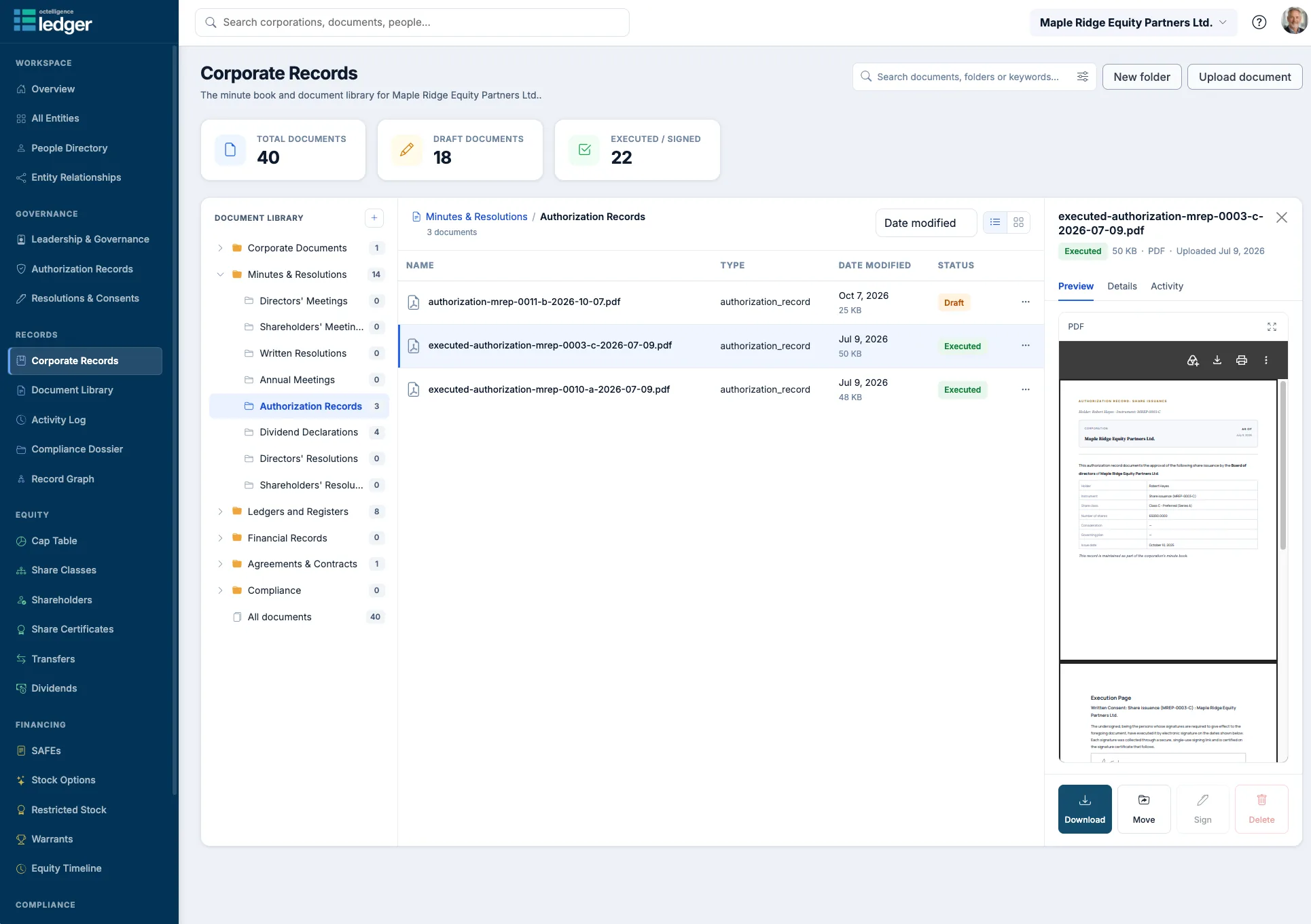
Records inventory under NRS § 78.105
Nevada NRS § 78.105 requires every corporation to maintain a stock ledger or duplicate stock ledger with names of stockholders, residences, share counts, and certificate numbers. The corporation must also maintain a current shareholder list at the registered office. The records inventory is narrower than Florida or California; Nevada is more management-protective and less prescriptive about records contents.
The distinctive 15% inspection threshold
Nevada NRS § 78.105 grants inspection rights only to stockholders holding 15% or more of the outstanding shares (or to a stockholder authorized in writing by 15%-or-more stockholders). This threshold is the highest of any major US jurisdiction. Compare to DGCL § 220 (no threshold but proper-purpose required), California § 1601 (5% threshold or any voting-trust holder), and Florida § 607.1602 (no threshold but stated purpose required). The 15% threshold significantly limits minority-stockholder discovery and is a key Nevada protective feature.
Director inspection under NRS § 78.130
Nevada NRS § 78.130 grants directors an absolute right to inspect the books and records, similar to California § 1602. Director inspection is unaffected by the 15% threshold applicable to stockholder inspection. Directors may examine any books and records at any reasonable time.
Records location and form
Nevada permits records in any form including digital, kept at any location including outside Nevada. The corporation must be able to produce records at the registered office on demand. Many Nevada corporations are operationally located in California, New York, or elsewhere; the registered office serves as the statutory address but actual records are kept where the corporation operates.
Annual list of officers and directors under § 78.110
Nevada NRS § 78.110 requires an annual filing with the Secretary of State listing current officers and directors. The annual list filing is distinct from internal corporate records but is part of the public record and the diligence-ready package.
Procedure
The minute book maintenance routine as it applies in Nevada, in seven steps:
Establish the stock ledger and records at the registered office (or designated location)
At incorporation, establish the stock ledger and corporate records. Records may be kept outside Nevada provided they are producible at the registered office on demand.Maintain the stock ledger under § 78.105
The stock ledger lists every stockholder with name, residence, share count, and certificate number. Updates on every issuance, transfer, redemption, and address change.Record corporate actions on the date of the action
Board and shareholder actions on the date they occur.Respond to § 78.105 inspection demands: confirm 15% threshold
Critically, Nevada inspection demands are limited to stockholders holding 15% or more. On any inspection demand, first confirm the demanding stockholder's holdings against the stock ledger. Sub-15% demands may be refused on threshold grounds; this is one of Nevada's most distinctive protective features.Respond to director inspection demands under § 78.130
Directors' inspection right is absolute and unaffected by the 15% threshold.File the annual list of officers and directors under § 78.110
Annual list filed with the Nevada Secretary of State. Filing fee is modest. Late filing attracts penalties and ultimately administrative dissolution.Maintain FinCEN BOI register
FinCEN BOI report maintained alongside corporate records, updated within 30 days. Nevada's privacy-oriented protection at the state level does not preempt federal FinCEN BOI.
Common mistakes
Common Nevada-specific failure points in maintaining corporate records:
- Granting inspection to sub-15% stockholders (NRS § 78.105 limits to 15%+ stockholders)
- Missing the annual list of officers and directors under § 78.110
- Failing to maintain FinCEN BOI (Nevada state protections don't preempt federal CTA)
- Refusing director inspection under § 78.130 (director's right is absolute and not subject to the 15% threshold)
Octelligence keeps the minute book, the share register, the certificates, and the cap table in one record. Every resolution, meeting, issuance, and transfer is dated, indexed, and linked to its supporting documents. The NRS Ch. 78 inspection right, the retention period, and the beneficial-ownership register requirement are jurisdiction-aware. Diligence can reproduce the corporate record at any past date.
See Digital Corporate RecordsCommon questions in Nevada
Octelligence keeps the minute book, the share register, and the cap table reconciled together with full NRS Ch. 78 awareness of inspection rights and retention periods.