How to maintain a minute book in Delaware
Delaware does not use the term "minute book" in its statute; the DGCL requires only the stock ledger under § 219 and grants stockholder inspection rights under § 220 with a proper-purpose requirement. Practitioners apply the term "corporate records book" or "minute book" informally to the bundle that holds the statutorily-required records plus the documents diligence counsel will request.
| Statutory records | Corporate records book (stock ledger plus practitioner's bundle) |
|---|---|
| Inspection right | Proper purpose required under DGCL § 220 |
| Retention period | 3 years for most records (no specific dissolution retention; common law applies) |
| DGCL § 224 | Records in any form; digital permitted |
| DGCL § 220 | Inspection of books and records by stockholders |
| DGCL § 219 | Stock ledger as controlling record |
| DGCL § 142 | Officer records |
| DGCL § 141(f) | Action by written consent of directors |
| Federal CTA | FinCEN BOI register under the Corporate Transparency Act |
- DGCL § 224 permits records in any form including digital
- DGCL § 220 inspection right requires proper purpose (higher bar than Canadian no-purpose regimes)
- Stock ledger under § 219 is the controlling record of stockholders
- Federal FinCEN BOI register under the Corporate Transparency Act applies to most Delaware corporations
- No statutory dissolution-retention period; common law and IRS retention rules apply
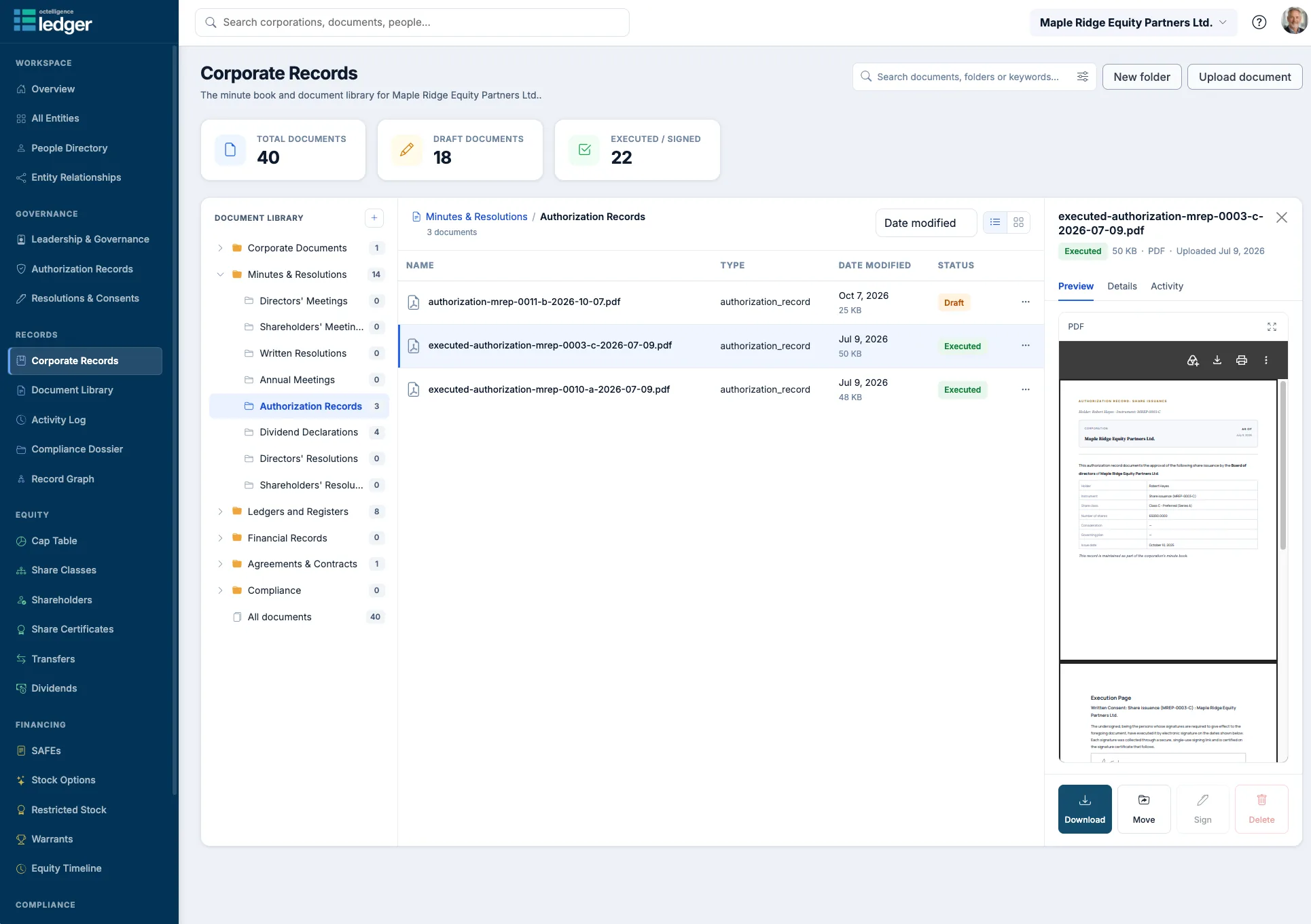
Records permitted in any form under DGCL § 224
DGCL § 224 permits any corporation to maintain its records in any form, including electronic, provided the records can be converted into clearly legible written form within a reasonable time. Modern Delaware C-corps typically maintain records in digital corporate-records systems or cloud-based document management. Physical "corporate records books" are also valid but increasingly rare.
Inspection rights under DGCL § 220 and the proper-purpose standard
Section 220 grants stockholders the right to inspect the corporation's books and records for a "proper purpose" reasonably related to their interests as stockholders. Investigating waste or mismanagement, valuing shares, and communicating with other stockholders are recognized proper purposes; personal grievances or fishing expeditions are not. The corporation may refuse inspection that it believes lacks proper purpose, but the stockholder may bring a summary proceeding in the Court of Chancery to compel inspection.
Stock ledger as the controlling record under § 219
DGCL § 219 requires every Delaware corporation to maintain a stock ledger listing every stockholder of record. The stock ledger is the controlling record for voting eligibility, dividend entitlement, and § 220 inspection demands. When the stock ledger and the cap table disagree, the stock ledger controls. The stock ledger may be electronic; the corporation may use a transfer agent.
The practitioner's "corporate records bundle"
Although the DGCL prescribes only the stock ledger, Delaware practitioners maintain a broader bundle including: certificate of incorporation and all amendments, bylaws, all board and stockholder consents and minutes, registers of directors and officers, certificates issued (where certificated), 83(b) elections, Form D filings, state blue-sky filings, and FinCEN BOI filings. This bundle is what diligence counsel, lenders, and regulators will request.
FinCEN BOI under the Corporate Transparency Act
Most Delaware corporations are "reporting companies" under the federal Corporate Transparency Act (effective January 2024) and must file beneficial-ownership information with FinCEN. The BOI report identifies individuals with substantial control or 25%+ ownership. Updates within 30 days of any change. The BOI filing is maintained alongside the corporate records book as part of the diligence-ready package.
Procedure
The minute book maintenance routine as it applies in Delaware, in seven steps:
Establish the corporate records book at incorporation
At incorporation, establish the corporate records book as the central repository. Initial contents: certified certificate of incorporation, bylaws, organizing resolutions, consent to act as director from each first director, registered office address, and founder share issuances with supporting subscription documents and the stock ledger.Maintain the statutorily-required stock ledger under § 219
The stock ledger lists every stockholder of record, their address, share count by class, certificate number, and date of issuance/transfer. Updates on the date of each share-related action. The stock ledger may be physical or electronic but must be producible in clearly legible form.Record every corporate action on the date of the action
Each board action, stockholder action, share issuance, transfer, redemption, certificate amendment, and statutory filing is recorded in the corporate records book on the date it occurs. Resolutions are signed and dated. Backdating is not permitted and creates an audit-trail defect.Maintain the FinCEN BOI register separately
Maintain the FinCEN BOI report alongside the corporate records book. Update the BOI within 30 days of any change to beneficial ownership or substantial control. Most Delaware private corporations are reporting companies under the CTA.Reconcile the stock ledger, cap table, and certificates
On a monthly or quarterly cadence, reconcile the stock ledger to the cap table and to any issued certificates. The stock ledger controls; the cap table is built from it; certificates must match register entries. Document the reconciliation.Respond to inspection demands under § 220
On a § 220 inspection demand: confirm the stockholder's standing, evaluate the stated purpose against the proper-purpose standard, and produce responsive records within a reasonable time. Refusal of inspection on proper-purpose grounds must be documented; the stockholder may petition the Court of Chancery for relief.Retain records under common-law and IRS rules
DGCL does not prescribe a specific dissolution-retention period for most records. Common law and IRS retention rules apply (typically 3 years for income-tax records, 7 years for some employment and contracts). Best practice: retain corporate records indefinitely; retain after-dissolution records for at least 7 years.
Common mistakes
Common Delaware-specific failure points in maintaining the corporate records book:
- Treating the cap table as the controlling record instead of the stock ledger under § 219
- Failing to file or update the FinCEN BOI report within the 30-day window
- Refusing § 220 inspection demands without proper documentation of the proper-purpose analysis
- No documented reconciliation cadence between stock ledger, certificates, and cap table
Octelligence keeps the minute book, the share register, the certificates, and the cap table in one record. Every resolution, meeting, issuance, and transfer is dated, indexed, and linked to its supporting documents. The DGCL inspection right, the retention period, and the beneficial-ownership register requirement are jurisdiction-aware. Diligence can reproduce the corporate record at any past date.
See Digital Corporate RecordsCommon questions in Delaware
Octelligence keeps the minute book, the share register, and the cap table reconciled together with full DGCL awareness of inspection rights and retention periods.