Minute book requirements in Connecticut (CBCA-CT)
Connecticut corporations maintain corporate records under Conn. Gen. Stat. § 33-890 and § 33-891. The state follows the MBCA framework for record-keeping and shareholder inspection rights.
| Conn. Gen. Stat. § 33-890 | Required corporate records |
|---|---|
| Conn. Gen. Stat. § 33-891 | Inspection rights |
| Conn. Gen. Stat. § 33-892 | Scope of inspection |
| Records location | Principal office of the corporation |
| Inspection rights | Shareholders with proper purpose; 5 business days notice |
| Format | Paper or electronic with reproducible-form requirement |
- Records under § 33-890: articles, bylaws, minutes, resolutions, share register, accounting records
- Connecticut follows the MBCA framework for corporate records
- Shareholders have proper-purpose inspection rights with 5 business days notice
- Articles and bylaws are inspectable without proper-purpose showing
- Records kept at principal office; electronic format permitted
What Conn. Gen. Stat. § 33-890 requires
Section 33-890 of the Connecticut General Statutes requires every Connecticut corporation to maintain articles, bylaws, minutes, resolutions, the share register, and accounting records. Records are kept at the principal office. Connecticut adopted the Model Business Corporation Act, so the corporate-records provisions follow MBCA Chapter 16.
Two-tier inspection under §§ 33-891 and 33-892
Connecticut follows the standard MBCA two-tier inspection regime. Articles and bylaws are inspectable without restriction. Detailed records (share register, board minutes, accounting books) require the requestor to state a proper purpose under § 33-892, and the corporation may require a written demand giving at least 5 business days' notice.
Penalties and enforcement
Connecticut's penalty provisions for failure to maintain records are part of the broader corporate-governance enforcement framework. In practice, prosecutions are uncommon, but missed records can become material in shareholder oppression or minority-rights disputes where the burden of proof may shift in the absence of complete records.
What's distinctive about Connecticut
Connecticut is a relatively unremarkable MBCA-aligned jurisdiction for corporate-records purposes. There is no state-level beneficial-ownership register requirement. Connecticut requires director address disclosure in the annual report (under § 33-953), which is more disclosure than some states require. The combination of moderate fees ($80 annual report) and standard MBCA records framework makes Connecticut a middle-of-the-road jurisdiction for ongoing maintenance.
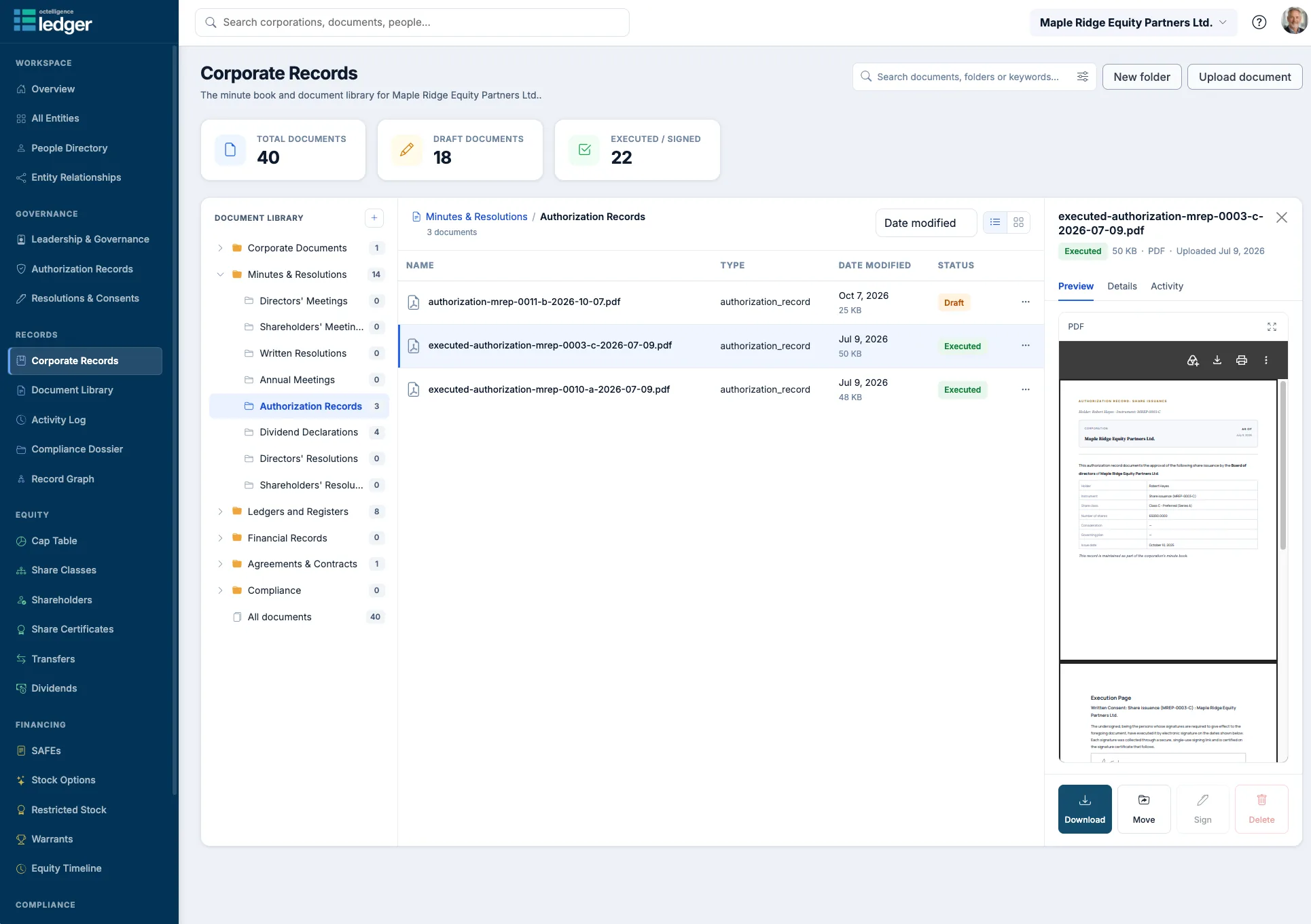
Octelligence keeps the corporate record up to date as the corporation evolves: articles, bylaws, registers, written consents, and share certificates, all in one structured place with a complete activity log.
See Digital Corporate RecordsStructured corporate records, jurisdiction-aware templates, and a complete audit trail.