Minute book requirements in Maryland (MGCL)
Maryland corporations maintain corporate records under Md. Code, Corps. & Ass'ns § 2-111 and § 2-112. The Maryland General Corporation Law is influential (many REITs and large public companies incorporate in Maryland) and has distinctive provisions for charter and bylaw amendments.
| Md. Code, Corps. & Ass'ns § 2-111 | Required corporate records |
|---|---|
| Md. Code, Corps. & Ass'ns § 2-112 | Books and records inspection |
| Md. Code, Corps. & Ass'ns § 2-104 | Charter and bylaws |
| Records location | Principal office in Maryland |
| Inspection rights | 5%+ stockholders have inspection rights |
| Format | Paper or electronic in reproducible form |
- Records under § 2-111: charter, bylaws, minutes, resolutions, share register, accounting records
- Maryland uses 'charter' (not articles) and 'bylaws' as the constating documents
- 5%+ stockholders have inspection rights under § 2-112
- Maryland is the leading US jurisdiction for REIT incorporations
- Records kept at principal office in Maryland
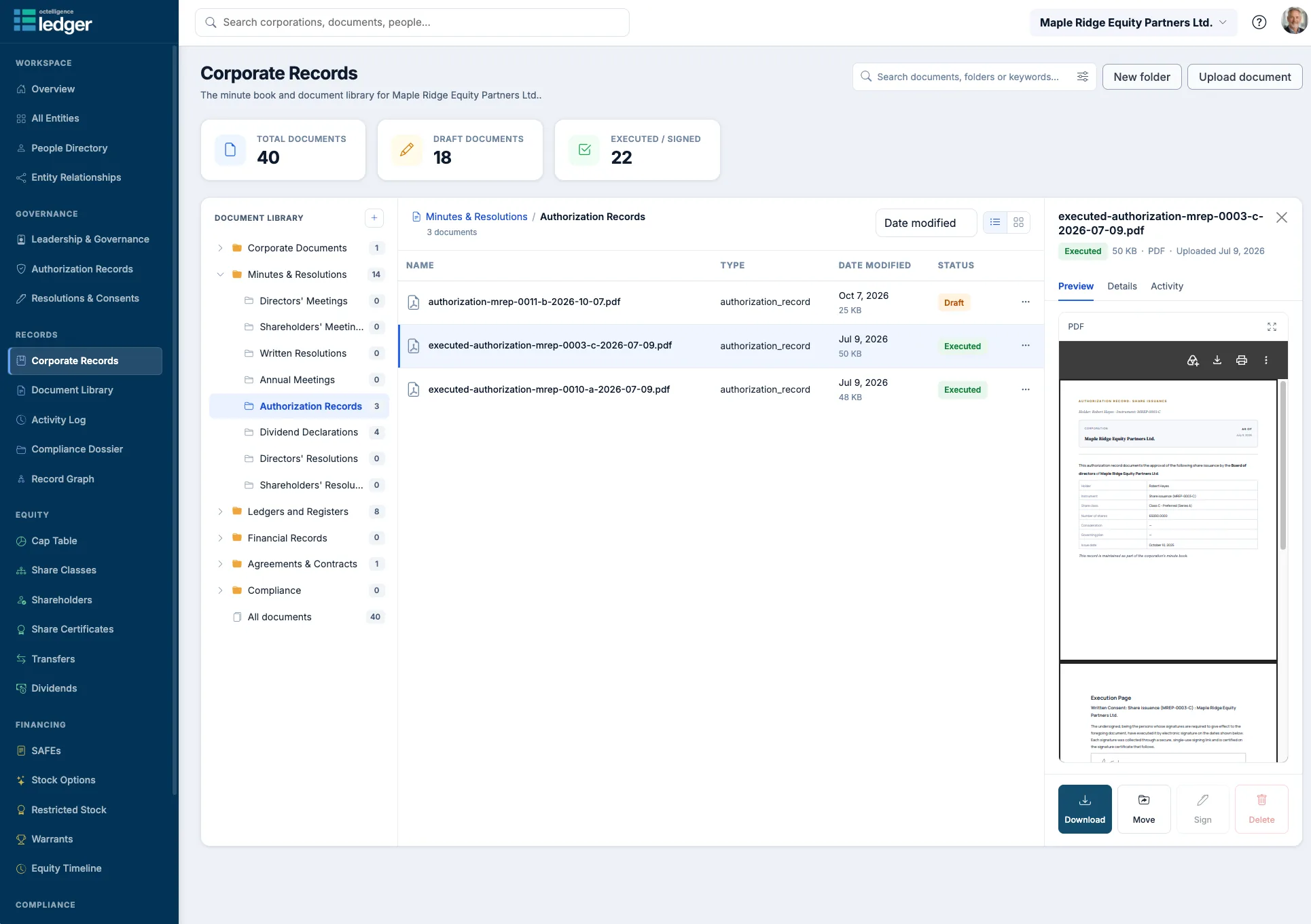
What Md. Code, Corps. & Ass'ns § 2-111 requires
Section 2-111 of the Maryland Corporations and Associations Code requires every Maryland corporation to maintain its charter and bylaws (Maryland uses “charter” rather than “articles of incorporation”), minutes of meetings and resolutions, the share register, and accounting records. Records are kept at the principal office in Maryland.
The 5% inspection threshold under § 2-112
Maryland's inspection regime is restrictive: under § 2-112, only stockholders holding 5% or more of any class of stock for at least 6 months have inspection rights to detailed records. This is one of the more restrictive thresholds in the US and reflects Maryland's pro-corporate regulatory tilt (which is one reason many REITs and large public companies choose Maryland incorporation). Articles of merger, charter, and bylaws are publicly available without restriction.
The REIT connection
Maryland is the leading US jurisdiction for Real Estate Investment Trust (REIT) incorporations: most public REITs in the US are Maryland corporations. Maryland's corporate law includes specific provisions tailored to REITs (the Maryland REIT Law, Title 8 of the Corporations and Associations Code), and the broader Maryland General Corporation Law has been refined to accommodate REIT structures. For non-REIT corporations, Maryland's relevance is more limited, but the charter/bylaw framework affects how routine corporate actions are documented.
What's distinctive about Maryland
Three features distinguish Maryland. First, the terminology: “charter” rather than articles, which affects how corporate-record indexing is organized. Second, the restrictive inspection regime (5% + 6 months) which limits minority-shareholder leverage. Third, the REIT-friendly statutory framework, which has implications even for non-REIT corporations using Maryland-style structures. Counsel working with Maryland corporations should be familiar with the specific charter-amendment procedures, which differ from DGCL § 242 in procedural detail.
Octelligence keeps the corporate record up to date as the corporation evolves: articles, bylaws, registers, written consents, and share certificates, all in one structured place with a complete activity log.
See Digital Corporate RecordsStructured corporate records, jurisdiction-aware templates, and a complete audit trail.