Minute book requirements across 41 jurisdictions
The same artifact under fourteen different statutes. Canadian provinces and federal CBCA call it a minute book. US states call it the corporate records book or corporate book. The UK calls it the statutory company records. What you have to keep, where to keep it, who can inspect, and what happens when you don't, each jurisdiction answers these questions differently.
The minute book is the same idea everywhere, but the rules differ
Every jurisdiction that grants limited liability requires corporations to maintain certain records in exchange. The records prove that the corporation exists, that decisions were authorized, that shares were issued lawfully, and that ownership has been tracked. The bundle of those records is what counsel calls a minute book in Canada and the UK, and a corporate records book in the US. The substance is the same; the statutory packaging differs.
The differences matter when records are reviewed. Diligence counsel, lenders, regulators, and tax authorities apply the standard of the corporation's jurisdiction of incorporation. A Delaware corporation's records are judged against DGCL § 220. An Ontario corporation's records are judged against OBCA s. 140. A UK private limited company's records are judged against the Companies Act 2006. Knowing which standard applies, and which sections of the corporation's records must satisfy it, is the first step in keeping records that survive scrutiny.
Choose your jurisdiction
Each guide covers what to maintain, where to keep it, who can inspect, and what happens if you don't.
Canada (Federal / CBCA)
CBCA View requirements CanadaOntario
OBCA View requirements CanadaBritish Columbia
BCBCA View requirements CanadaAlberta
ABCA View requirements CanadaQuebec
QBCA View requirements CanadaManitoba
MCA View requirements CanadaNew Brunswick
NBBCA View requirements CanadaNewfoundland and Labrador
NLCA View requirements CanadaNova Scotia
NSCA View requirements CanadaPrince Edward Island
PEIBCA View requirements CanadaSaskatchewan
SBCA View requirements United StatesDelaware
DGCL View requirements United StatesCalifornia
Cal. Corp. Code View requirements United StatesNew York
NY BCL View requirements United StatesTexas
TBOC View requirements United StatesFlorida
FBCA View requirements United StatesNevada
NRS Ch. 78 View requirements United StatesWashington
WA BCA View requirements United StatesMassachusetts
M.G.L. c. 156D View requirements United StatesWyoming
WBCA View requirements United StatesColorado
C.R.S. Title 7 View requirements United StatesUtah
URBCA View requirements United StatesIllinois
805 ILCS 5/ View requirements United StatesNew Jersey
NJBCA View requirements United StatesGeorgia
GBCC View requirements United StatesNorth Carolina
NCBCA View requirements United StatesVirginia
VSCA View requirements United StatesArizona
A.R.S. Title 10 View requirements United StatesTennessee
TBCA-TN View requirements United StatesMinnesota
Minn. Stat. § 302A View requirements United StatesOregon
ORS Ch. 60 View requirements United StatesMichigan
MICA View requirements United StatesOhio
OGCL View requirements United StatesPennsylvania
PBCL View requirements United StatesConnecticut
C.G.S. § 33-600 View requirements United StatesMaryland
MGCL View requirements United StatesIndiana
IBCL View requirements United StatesWisconsin
Wis. Stat. Ch. 180 View requirements United StatesMissouri
RSMo Ch. 351 View requirements United StatesSouth Carolina
SCBCA View requirements United KingdomUnited Kingdom
CA 2006 View requirementsCompare requirements across jurisdictions
The same artifact, different rules.
| Jurisdiction | Governing statute | Records location | Inspection rights | Penalty for non-compliance |
|---|---|---|---|---|
| Canada (Federal / CBCA) | CBCA s. 20 | Registered office or designated place in Canada | Shareholders + creditors | Fines up to $200,000 (corp); $5,000 (individual) |
| Ontario | OBCA s. 140 | Registered office or designated place in Ontario | Shareholders + creditors | Statutory offence; fines under s. 258 |
| British Columbia | BCBCA ss. 42-43 | Records office in BC (separate from registered office) | Shareholders + creditors at records office | Fines under s. 421 |
| Alberta | ABCA s. 21 | Registered office or designated place in Alberta | Shareholders + creditors | Statutory offence; fines under ABCA |
| Quebec | QBCA ss. 31-34 | Head office in Quebec | Shareholders during business hours | Court orders, REQ administrative actions |
| Delaware | DGCL § 220, § 219 | Wherever the corporation operates (no statutory location requirement) | Stockholders with 'proper purpose' (§ 220) | Court-ordered production + attorney's fees |
| California | Cal. Corp. Code § 1500 | Principal office in California | Shareholders (5 business days' notice; no proper-purpose requirement) | Court-ordered production + attorney's fees; SOS suspension if filings missed |
| New York | NY BCL § 624 | Any place by or on behalf of the corporation | 6-month shareholders or 5%+ holders, with proper purpose | Court order + attorney's fees |
| Texas | TBOC § 3.151, § 21.218 | Any place | 6-month shareholders or 5%+ holders, proper purpose | Court order; charter forfeiture for filings |
| Florida | FBCA § 607.1601 | Principal office; copies on demand | Tier 1: any shareholder; Tier 2: proper purpose | Administrative dissolution; court orders |
| Nevada | NRS 78.105, NRS 78.257 | Registered office in Nevada (statutory minimums) | 15% threshold or written authorization | Default status; charter revocation |
| Washington | RCW 23B.16.010 | Any location and form | Tier 1: any shareholder; Tier 2: proper purpose | Administrative dissolution; court orders |
| Massachusetts | M.G.L. c. 156D § 16.01 | Any location and form | Tier 1: any shareholder; Tier 2: proper purpose | Administrative dissolution; court orders |
| United Kingdom | Companies Act 2006 | Registered office or SAIL | Members + public for some registers | Strike-off under s. 1003; fines |
What goes wrong when records aren't kept properly
The failure mode is the same across jurisdictions, even when the statutes differ. Records start in good order at incorporation. Over a few years of share issuances, transfers, officer changes, and amendments, fragments move into emails, Dropbox folders, and counsel's drafts. The minute book becomes a binder on a shelf that nobody updates. Then a financing, an audit, or a transaction arrives, and the gap has to be reconstructed under time pressure.
Reconstruction is more expensive than maintenance. Documents drafted years after the fact carry less evidentiary weight than contemporaneous records. Resolutions signed retroactively raise more questions than they answer. In every jurisdiction surveyed below, the cleanest path is to keep the records current as they happen, in a structured system that doesn't depend on any single person remembering to update it.
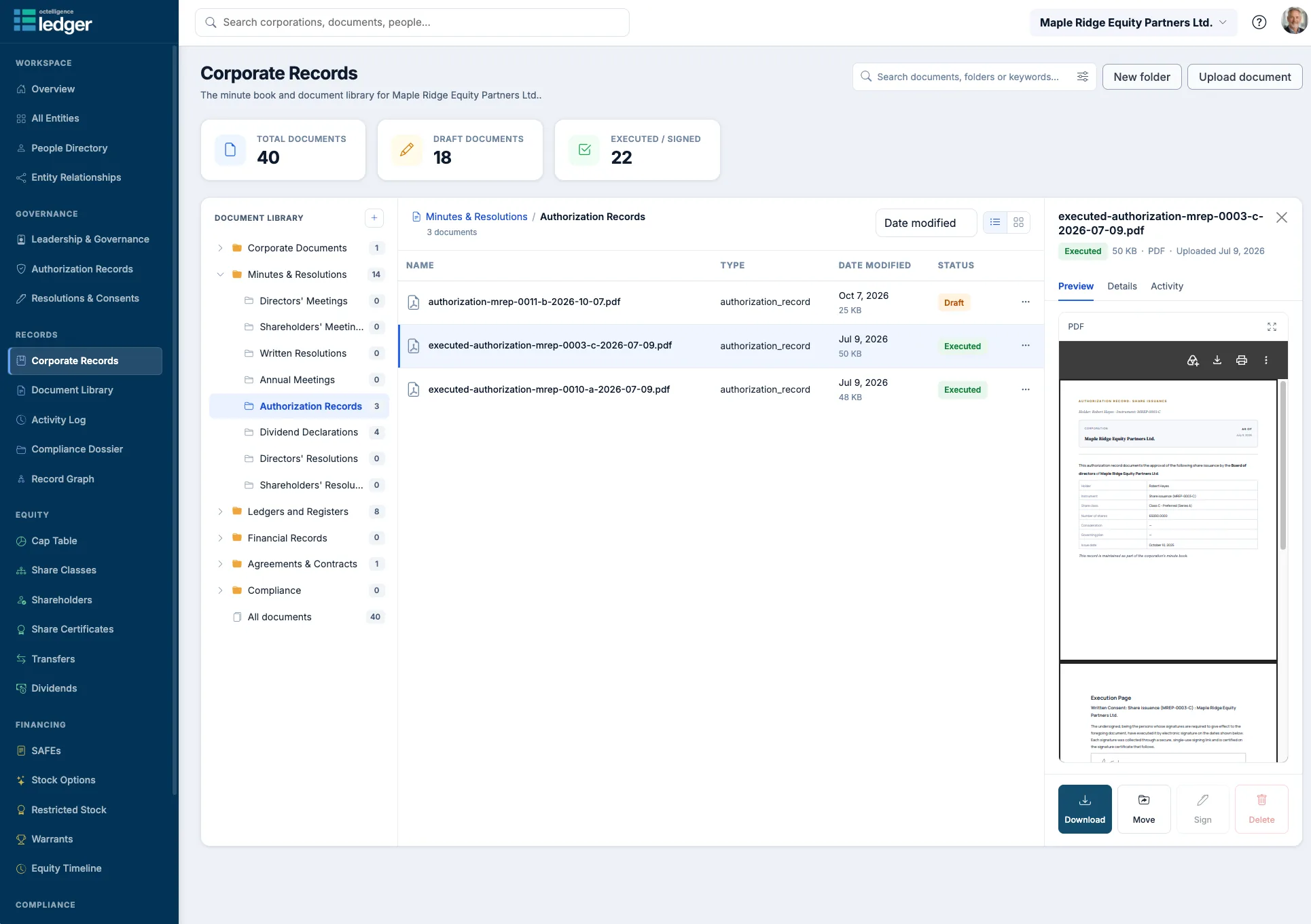
Octelligence ships with a pre-built minute book framework that mirrors the structure each jurisdiction expects: articles, bylaws, registers of directors and shareholders, written resolutions, share certificates, and an activity log. Templates and document wizards adapt to the corporation's jurisdiction so the language and format match what counsel will expect to see.
See Digital Corporate RecordsFrequently asked
Yes. The bundle of articles, bylaws, registers, resolutions, and share certificates that a corporation is required to maintain is called a minute book in Canada and the UK, and a corporate records book (or corporate book) in the US. The substance is identical; the term differs by jurisdiction.
Most jurisdictions require corporations to maintain certain records, even if the statute does not use the term 'minute book'. The CBCA s. 20, the UK Companies Act 2006 Part 8 and Part 21, the OBCA s. 140, and US state corporation statutes (DGCL § 220, NY BCL § 624, Cal. Corp. Code § 1500) all impose recordkeeping obligations. The form of the record can be physical or digital; the obligation to maintain it is unconditional.
Yes, in essentially every modern jurisdiction. The records must be accurate, retrievable, and capable of being reproduced; the medium is not specified. Digital recordkeeping is now the standard practice for new incorporations.
Shareholders, in every jurisdiction. Creditors, in most. The public, in some, the UK PSC register, the Canadian ISC register, and US Corporate Transparency Act beneficial ownership filings are limited public-access components. Specific inspection rights vary; the jurisdiction guides below explain each jurisdiction.
Structured corporate records, jurisdiction-aware templates, and a complete audit trail.