Corporate records requirements for a Delaware corporation
Delaware corporations maintain a stock ledger under DGCL § 219 and produce books and records for inspection under DGCL § 220. The DGCL § 220 inspection right, with its proper-purpose requirement and extensive caselaw, is one of the most-litigated provisions of Delaware corporate law.
| DGCL § 219 | Stock ledger required |
|---|---|
| DGCL § 220 | Inspection of books and records |
| DGCL § 224 | Form of records (paper, electronic, or other) |
| Records location | Principal place of business or registered office |
| Inspection standard | Proper purpose reasonably related to interest as a stockholder |
| Pre-suit demand | Required before § 220 books-and-records action |
- DGCL § 219 requires a stock ledger; § 220 governs inspection of books and records
- DGCL § 220 is among the most-litigated provisions in Delaware corporate law
- Stockholders must show a proper purpose reasonably related to their interest in the corporation
- Pre-suit demand is required; the corporation may demand specifics about purpose and scope
- Delaware permits stock ledgers and other records in any reproducible form under § 224
The stock ledger under DGCL § 219
Section 219 of the Delaware General Corporation Law requires every Delaware corporation to maintain a stock ledger (also called the share ledger or register of stockholders) that records the names and addresses of all stockholders, the number and class of shares held, and the date of issuance. The ledger is the official record of stockholder identity for purposes of voting, dividend distributions, and inspection rights. Delaware permits the ledger to be maintained in any form (paper, electronic, third-party administrator-maintained) under § 224.
Books-and-records inspection under DGCL § 220
Section 220 gives stockholders the right to inspect the corporation's books and records on demand. The stockholder must state a “proper purpose reasonably related to such person's interest as a stockholder.” Common proper purposes include investigating potential mismanagement, valuing shares, communicating with other stockholders, and determining whether to bring a derivative claim. The proper-purpose standard has been the subject of extensive Delaware Chancery Court caselaw, including the seminal City of Westland Police & Fire Retirement System v. Axcelis Technologies decision.
Procedure and pre-suit demand
A § 220 demand must be made in writing under oath, stating the purpose with specificity. The corporation typically has five business days to respond and may demand additional specifics about the scope of records sought. If the corporation refuses, the stockholder can file a books-and-records action in the Court of Chancery, which is among the fastest-moving courts in the country (decisions within weeks or months, rather than years). § 220 actions are often a precursor to derivative litigation: stockholders use the records obtained to plead specific facts in a subsequent fiduciary-duty claim.
What's distinctive about Delaware
Delaware's books-and-records jurisprudence is the most developed in the US. The proper-purpose standard, the “reasonably related” test, the scope-of-records analysis, and the procedural mechanics have all been refined through hundreds of Chancery Court decisions. For Delaware corporations facing stockholder demands, the response strategy is itself a developed practice area. Counsel managing Delaware corporations should understand that any contentious stockholder relationship has the potential to trigger a § 220 demand, and the corporation's response shapes the trajectory of any subsequent dispute. The Court of Chancery's speed and expertise also means that § 220 disputes resolve quickly compared to corporate-records disputes in most other jurisdictions.
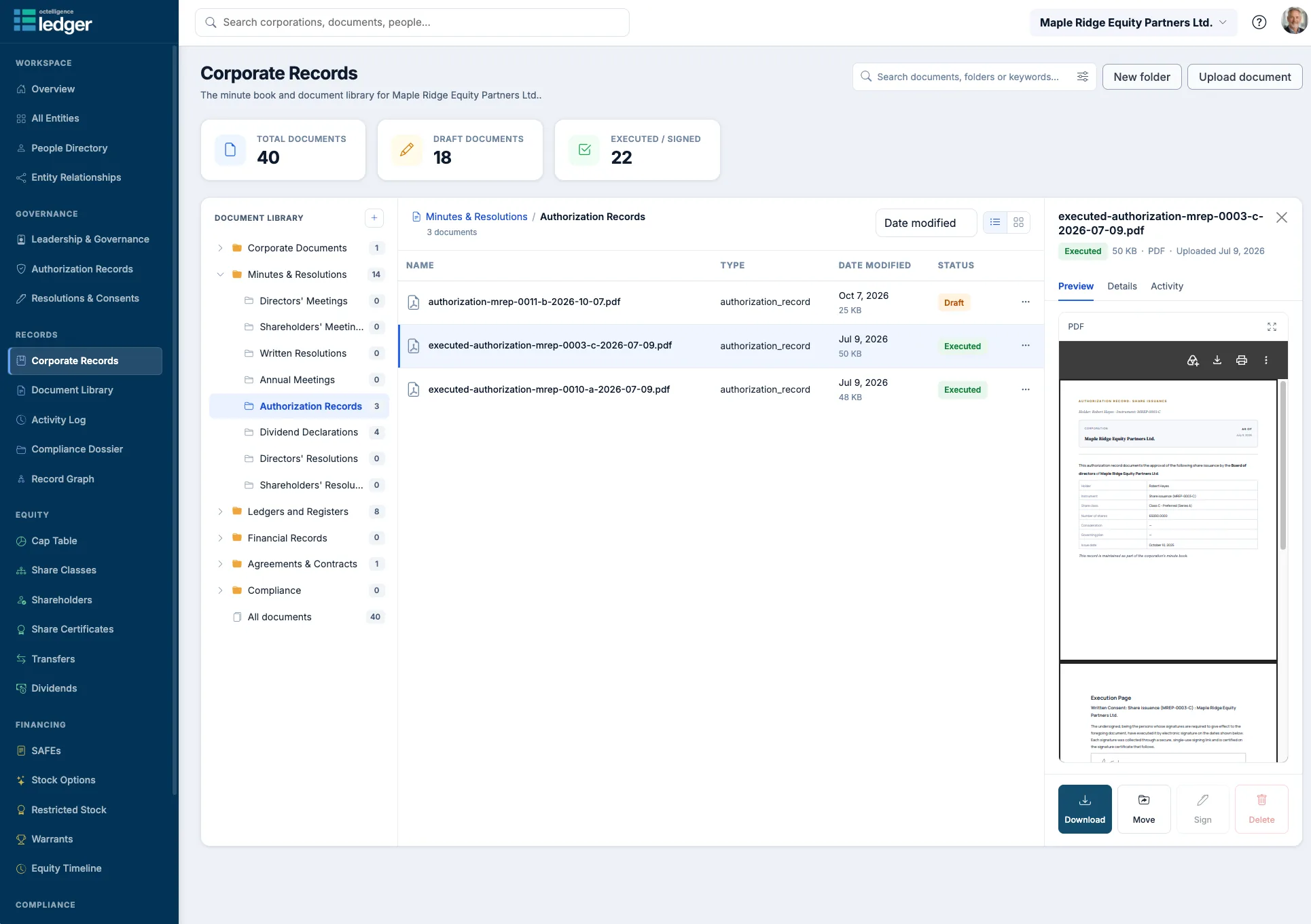
Octelligence keeps the corporate record up to date as the corporation evolves: articles and amendments, bylaws, registers of directors and shareholders, written resolutions, and share certificates, all in one structured place with a complete activity log.
See Digital Corporate RecordsStructured corporate records, jurisdiction-aware templates, and a complete audit trail.