Corporate records requirements for a California corporation
California corporations maintain corporate records under Cal. Corp. Code § 1500-1512. Required records include bylaws, minutes, share register, and accounting books, with one of the broadest shareholder-inspection regimes in the US.
| Cal. Corp. Code § 1500 | Required corporate records |
|---|---|
| Cal. Corp. Code § 1501 | Annual report to shareholders |
| Cal. Corp. Code § 1600 | Inspection rights for shareholders |
| Cal. Corp. Code § 1601 | Inspection of bylaws |
| Records location | Principal executive office or principal California office |
| Inspection rights | 5%+ shareholders have broad inspection rights |
- Records under Cal. Corp. Code § 1500: bylaws, minutes, share register, accounting books and records, financial statements
- Kept at principal executive office or principal California office
- California provides one of the broadest shareholder inspection regimes in the US
- 5% shareholders have absolute inspection rights under § 1600
- Bylaws must be open to inspection by all shareholders under § 1601
What Cal. Corp. Code § 1500 requires
Section 1500 of the California Corporations Code requires every California corporation to maintain adequate and correct books and records of account, minutes of proceedings of shareholders, board, and committees, and the share register (or duplicate share register at a place inside California). Records are kept at the principal executive office or the principal California office. California's bylaws must be open to inspection by all shareholders under § 1601, without limitation.
The broad inspection regime under § 1600
California provides one of the broadest shareholder-inspection regimes in the US. Under § 1600, any shareholder holding 5% or more of any class of stock (or any shareholder with director-nomination rights) has an absolute right to inspect and copy the share register, the accounting books and records, and minutes of board, committee, and shareholder meetings. The corporation cannot demand a stated purpose for these inspections, in contrast to Delaware's DGCL § 220 (which requires a proper purpose showing for many inspections).
Inspection of bylaws under § 1601
Section 1601 requires bylaws to be open to inspection by any shareholder, with no minimum-ownership threshold. This is unusually permissive: most states limit detailed records inspection to shareholders with some minimum stake or proper purpose. California's approach reflects the state's broader policy of shareholder transparency.
What's distinctive about California
California's inspection regime is the most shareholder-friendly in the US. For closely-held corporations with minority shareholders, this can create real friction: a 5%+ minority shareholder can demand inspection of detailed financials, contracts, and board minutes without giving a reason. California also imposes specific record-keeping requirements through Cal. Corp. Code § 1501 (annual report to shareholders), which is more detailed than the federal SEC-style reporting required of public companies. The combination of broad inspection and detailed reporting makes California corporate-records compliance meaningfully more demanding than most states.
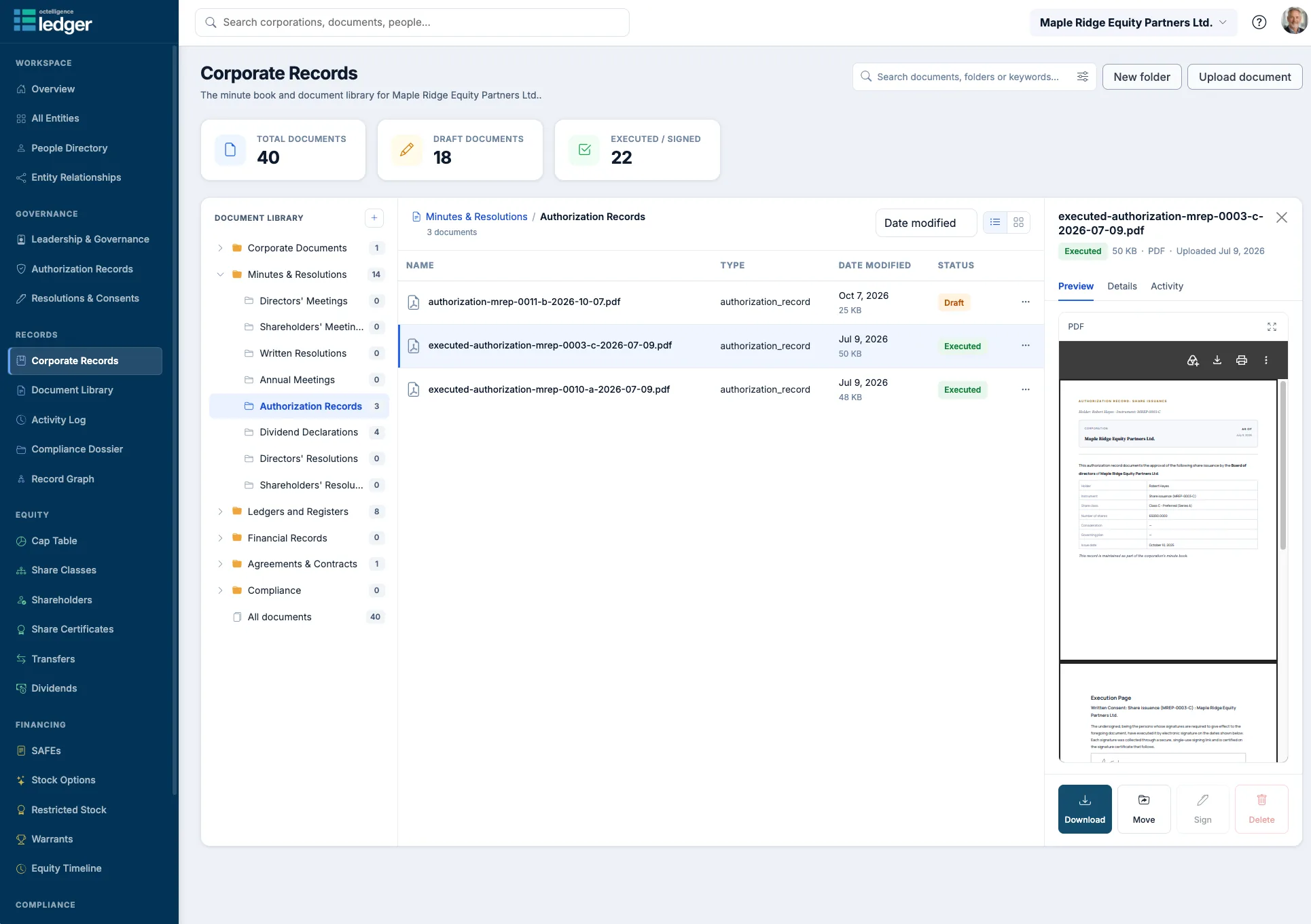
Octelligence keeps the corporate record up to date as the corporation evolves: articles and amendments, bylaws, registers of directors and shareholders, written resolutions, and share certificates, all in one structured place with a complete activity log.
See Digital Corporate RecordsStructured corporate records, jurisdiction-aware templates, and a complete audit trail.