Minute book requirements for an Ontario (OBCA) corporation
Ontario corporations keep their corporate records at the registered office under OBCA s. 140 and s. 144. Required records include the new Forensic Records Register under s. 140.1 (added January 2023), which tracks individuals with significant control.
| OBCA s. 140 | Required corporate records |
|---|---|
| OBCA s. 144 | Right of access |
| OBCA s. 140.1 | Register of individuals with significant control (since January 2023) |
| OBCA s. 141 | Share register |
| Records location | Registered office or designated alternative in Ontario |
| Inspection rights | Shareholders, directors, creditors during business hours |
- Records under OBCA s. 140: articles, bylaws, minutes, resolutions, directors' register, share register, accounting records
- Register of individuals with significant control required under OBCA s. 140.1 (added January 2023)
- Records kept at the registered office or alternative Ontario location designated by directors
- Shareholders, directors, and creditors have inspection rights under OBCA s. 144
- Failure to maintain records is an offence under OBCA s. 258 with significant penalties
What OBCA s. 140 requires
Section 140 of the Business Corporations Act (Ontario) requires every Ontario corporation to maintain articles, bylaws, minutes of meetings and resolutions of shareholders and directors, registers of directors and officers, the share register, and accounting records. Records are kept at the registered office or at another place in Ontario designated by the directors.
The OBCA s. 140.1 ISC register (since January 2023)
Ontario added the Register of Individuals with Significant Control (ISC register) effective January 1, 2023, under OBCA s. 140.1. The register tracks individuals who directly or indirectly own 25% or more of the corporation's voting shares or fair-market-value shares, or who otherwise have significant control. Ontario's ISC register is part of the broader Canadian beneficial-ownership transparency framework. The register is kept at the registered office and is not part of the public corporate file, but it is produced to tax authorities, law enforcement, and certain regulators on request.
Access rights under s. 144
Section 144 gives shareholders, directors, and creditors the right to examine the corporate records during usual business hours. They may take extracts free of charge and obtain copies on payment of a reasonable fee. The Ontario regime closely mirrors the federal CBCA. For private corporations, requests to inspect corporate records often arise in the context of shareholder disputes or due diligence for share transfers.
What's distinctive about Ontario
The 2023 introduction of the ISC register brought Ontario in line with the federal CBCA (which has had an ISC register since 2019) and BC (Transparency Register, since 2020). For corporations operating in multiple provinces, maintaining separate ISC registers under each statute is now standard practice, though the substantive 25%-threshold definition is broadly consistent. Ontario's penalty regime under OBCA s. 258 includes both monetary penalties and potential director liability for material non-compliance, making active ISC register maintenance important.
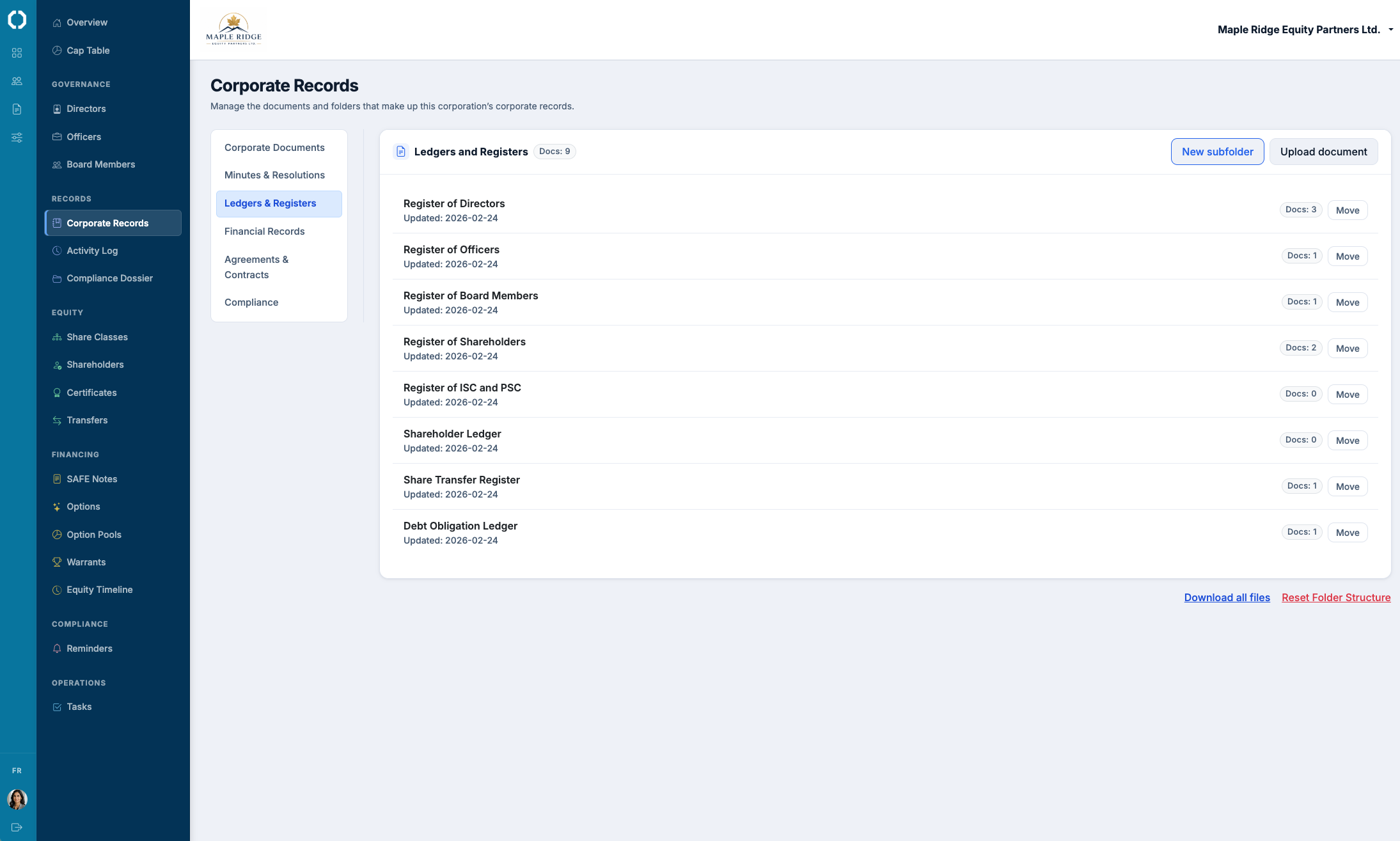
Octelligence keeps the corporate record up to date as the corporation evolves: articles and amendments, bylaws, registers of directors and shareholders, written resolutions, and share certificates, all in one structured place with a complete activity log.
See Digital Corporate RecordsStructured corporate records, jurisdiction-aware templates, and a complete audit trail.