Minute book requirements for a federal Canadian (CBCA) corporation
Federally-incorporated Canadian corporations are governed by the Canada Business Corporations Act. The CBCA is the model statute most provincial corporations Acts are aligned with, and it sets the standard for what records a corporation must keep.
| s. 20 | Required corporate records and where they must be kept |
|---|---|
| s. 21 | Right of access for shareholders and creditors |
| s. 21.1 | Register of individuals with significant control (ISC) |
| s. 50 | Securities register |
| s. 250-251 | Offences and penalties for non-compliance |
- Articles, bylaws, minutes and resolutions, registers of directors, officers, and shareholders, plus the securities register
- Records must be kept at the registered office or another place in Canada designated by the directors
- Shareholders and creditors may examine the records during usual business hours; can take extracts free of charge
- Separate ISC register required under s. 21.1 for individuals with significant control (25%+ ownership or control)
- Failure to maintain records is an offence under s. 250 with fines up to $5,000 for individuals and $200,000 for corporations
What CBCA s. 20 requires
Section 20 of the Canada Business Corporations Act prescribes the records that every federal corporation must maintain. The minute book is the practical bundle that holds them.
- Articles and bylaws, including all amendments and any unanimous shareholder agreement
- Minutes of meetings and resolutions of shareholders and directors
- Register of directors and officers, with names, addresses, occupations, and the dates each individual became and ceased to be a director or officer
- Securities register under s. 50, recording the issued shares, the holders, the certificate numbers, and the dates of issuance and transfer
- ISC register under s. 21.1, identifying individuals with significant control (a 2019 addition to the CBCA, now required of every federal corporation)
- Accounting records, in sufficient detail to disclose the corporation's financial position
Where the records must be kept
The records must be kept at the corporation's registered office or another place in Canada that the directors designate by resolution. Records may be kept in electronic form, provided they can be reproduced on demand. Where records are kept outside the registered office, the corporation must be able to produce them at the registered office within a reasonable time after a request.
The accounting records may be kept outside Canada in some circumstances, but the corporate records under s. 20 must remain accessible from a Canadian location.
Inspection rights under s. 21
Shareholders and creditors of a CBCA corporation, and their personal representatives, are entitled to examine the records under s. 20 free of charge during the usual business hours of the corporation. They may take extracts or, on payment of a reasonable fee, obtain copies.
The right of access is broad. It does not require proof of a 'proper purpose' (as US Delaware corporations require under DGCL § 220); the status of shareholder or creditor is sufficient. Corporations Canada itself has the right to require production of the records for compliance review.
Penalty for non-compliance
Failure to keep the records required by s. 20 is an offence under s. 250. The maximum fine is $5,000 for an individual director, officer, or person responsible, and $200,000 for the corporation. Where the failure is intentional, directors and officers may also be liable. More importantly in practice, a corporation that cannot produce its records during a financing or diligence may simply fail to close, counsel will not certify a transaction the underlying records cannot support.
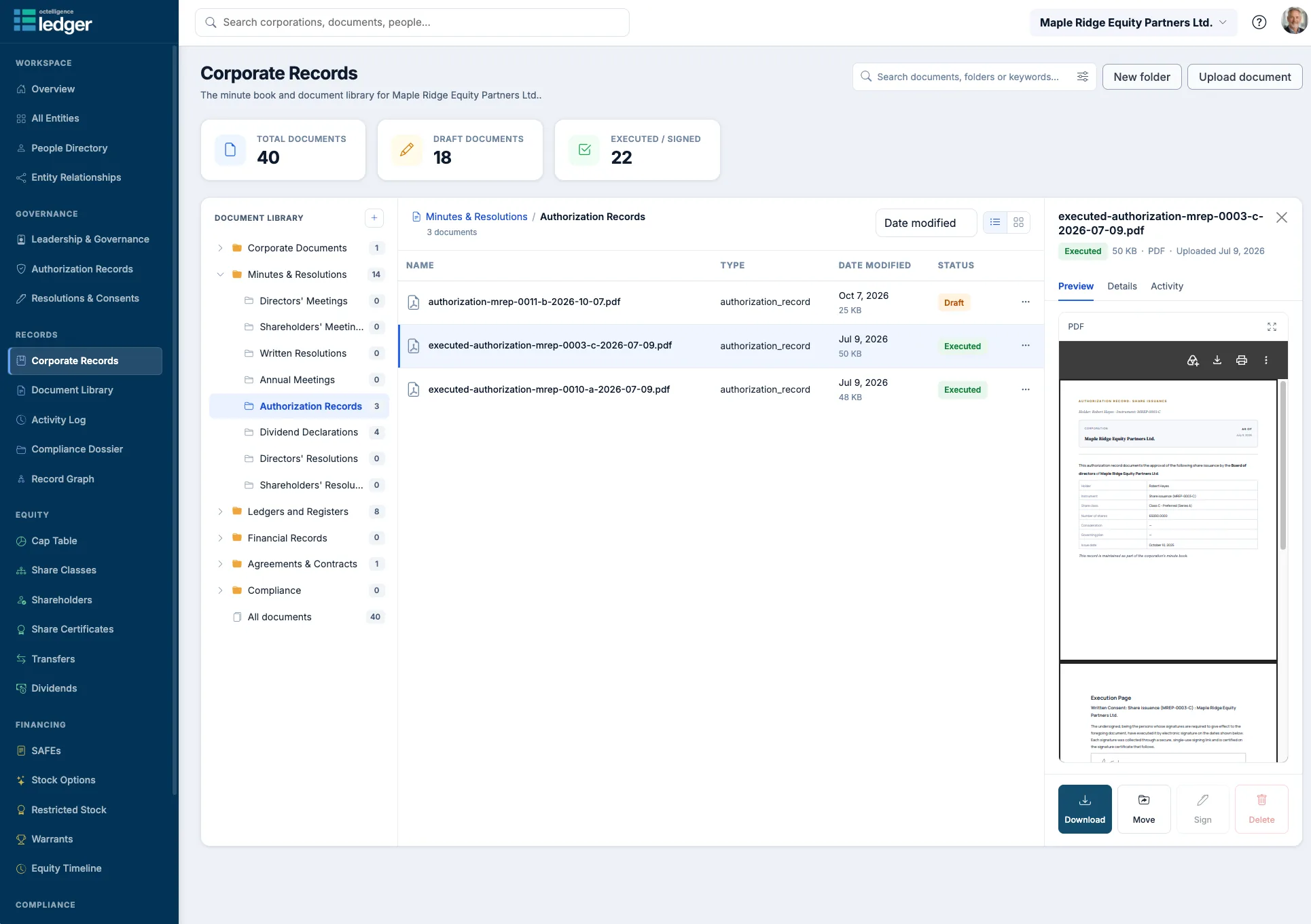
Octelligence keeps the corporate record up to date as the corporation evolves: articles and amendments, bylaws, registers of directors and shareholders, written resolutions, and share certificates, all in one structured place with a complete activity log.
See Digital Corporate RecordsStructured corporate records, jurisdiction-aware templates, and a complete audit trail.