Corporate records requirements for a Nevada corporation
Nevada corporations maintain corporate records under NRS § 78.105 and § 78.257. Nevada has a uniquely high 15% ownership threshold for share register inspection, one of the most restrictive in the US.
| NRS § 78.105 | Required corporate records |
|---|---|
| NRS § 78.257 | Inspection of share register |
| NRS § 78.105(2) | Inspection of other corporate records |
| Records location | Registered office or another Nevada location |
| Share register inspection | 15%+ ownership required (one of US's highest thresholds) |
| Other records inspection | Lower threshold for general corporate records |
- Records under NRS § 78.105: articles, bylaws, minutes, share register, accounting records
- Nevada requires 15% ownership for share register inspection under NRS § 78.257 (one of the highest US thresholds)
- Articles, bylaws, and stockholder list inspectable by any stockholder of record
- Records kept at registered office or another Nevada location
- Nevada's charter-protection focus extends to limiting records-inspection demands
What NRS § 78.105 requires
Section 78.105 of the Nevada Revised Statutes requires every Nevada corporation to maintain articles, bylaws, minutes of meetings and resolutions, the stock ledger (share register), and accounting records. Records are kept at the registered office or another Nevada location designated by the corporation.
The 15% ownership threshold under NRS § 78.257
Nevada's distinctive feature is its 15% ownership threshold for share register (stock ledger) inspection under NRS § 78.257. This is one of the highest thresholds in the US (compare to Delaware's no minimum, California's 5%, Maryland's 5%). The Nevada threshold reflects the state's deliberate policy of insulating corporations from records-driven litigation, which has historically attracted asset-protection structures and holding companies.
Limited inspection vs broad inspection
The 15% threshold applies specifically to the share register. For other records (articles, bylaws, minutes of stockholder meetings), Nevada's threshold is lower or non-existent. Stockholders of record can typically inspect articles, bylaws, and minutes of stockholder meetings without meeting the 15% threshold. The high threshold for the share register is particularly significant because the share register is often the starting point for stockholder activism, derivative-claim preparation, and contested-election analysis.
What's distinctive about Nevada
The 15% share register threshold is Nevada's signature corporate-records feature. Combined with Nevada's no-state-income-tax framework and strong charter-protection provisions, the corporate-records framework is part of a broader Nevada strategy of attracting holding companies and asset-protection structures. For closely-held corporations, the high threshold provides meaningful protection from minority-stockholder records demands. For activist-vulnerable corporations, Nevada's regime contrasts sharply with Delaware's (where stockholders have routine access via DGCL § 220 demands).
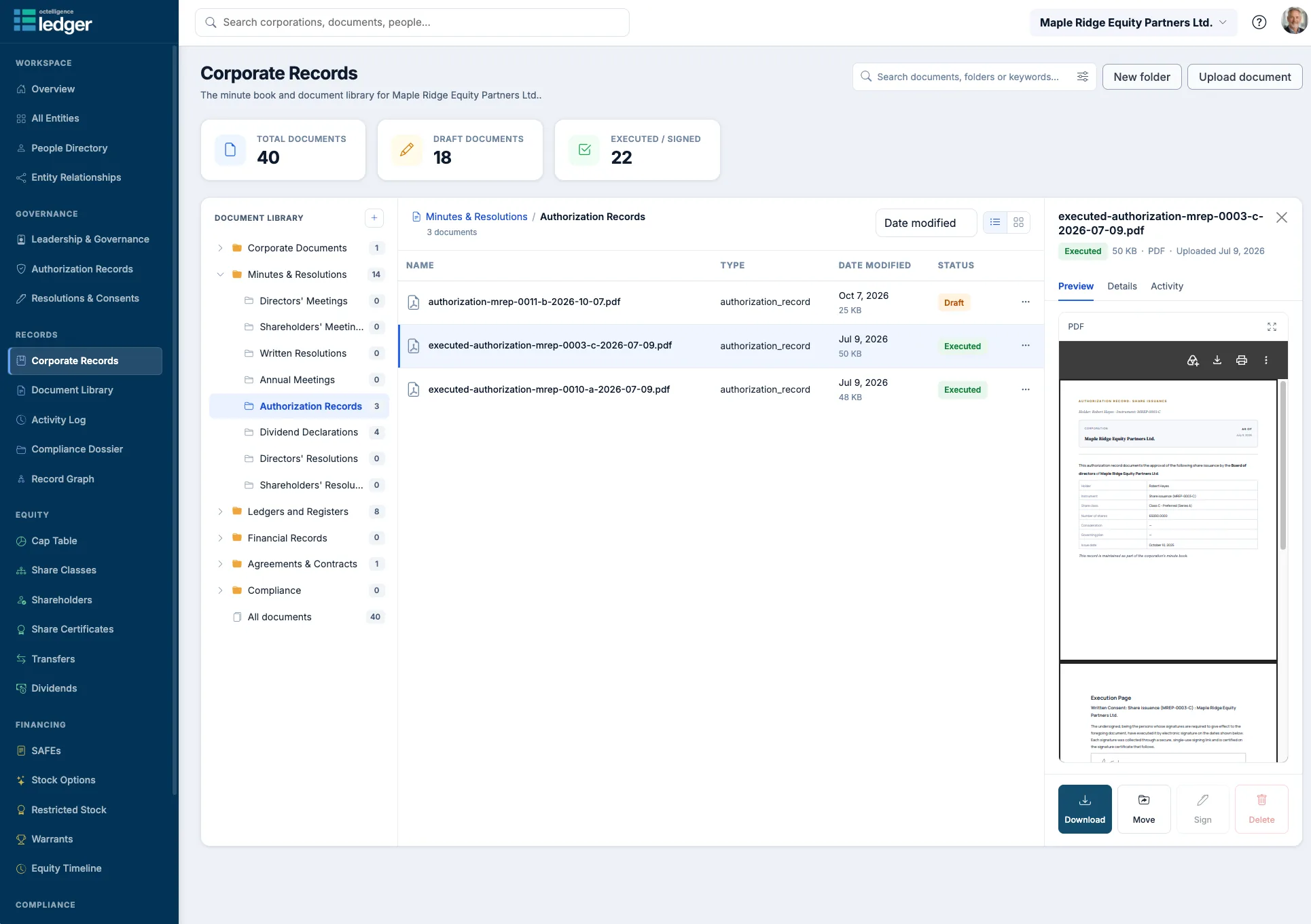
Octelligence keeps the corporate record up to date as the corporation evolves: articles and amendments, bylaws, registers of directors and shareholders, written resolutions, and share certificates, all in one structured place with a complete activity log.
See Digital Corporate RecordsStructured corporate records, jurisdiction-aware templates, and a complete audit trail.