How to maintain a minute book in British Columbia
British Columbia has a distinctive records framework: a separate "records office" (s. 42) distinct from the registered office, where the corporation's records are kept. BC was an early adopter of the transparency register (s. 51.5, effective October 2020). The retention period after dissolution is 10 years, longer than the CBCA's 6 years.
| Statutory records | Records office (separate from registered office) |
|---|---|
| Inspection right | Broad inspection rights for shareholders, creditors, and certain other persons |
| Retention period | 10 years after dissolution under BCBCA |
| BCBCA s. 42 | Records office; records to be kept |
| BCBCA s. 46 | Inspection of records |
| BCBCA s. 51.5 | Transparency register since October 2020 |
| BCBCA s. 111 | Central securities register |
| BCBCA s. 160 | Form of records |
| BCBCA s. 364 | Retention after dissolution |
- BCBCA s. 42 requires a separate "records office" distinct from the registered office
- BCBCA s. 46 broad inspection rights
- BCBCA s. 51.5 transparency register since October 1, 2020 (one of the earliest in Canada)
- 10-year retention after dissolution under BCBCA s. 364 (longer than CBCA's 6 years)
- No par-value shares; central securities register under s. 111
The records office concept under BCBCA s. 42
BC is distinctive in requiring a separate "records office", distinct from the registered office, where the corporation's records are kept. The records office must be in BC and may be the same place as the registered office or different. The records office is where shareholders, creditors, and other inspecting parties go to inspect records. The bifurcation of registered office (for legal notices) and records office (for record-keeping) is unique to BC among Canadian provinces.
Records inventory under s. 42
Records to be kept at the records office: articles, notice of articles (BC's distinctive two-document structure), bylaws, USA, shareholder meeting minutes and resolutions, central securities register (s. 111), transparency register (s. 51.5), board meeting minutes and resolutions, accounting records, and supporting documents.
Inspection rights under s. 46
BCBCA s. 46 grants broad inspection rights to shareholders, creditors, and (in some circumstances) other interested persons. The inspection right is similar to CBCA s. 21: broad, no proper-purpose requirement. Inspection is at the records office during business hours.
Transparency register under s. 51.5 (since October 2020)
BCBCA s. 51.5, effective October 1, 2020, requires every BC private corporation to maintain a transparency register of "significant individuals" (the BC term for beneficial owners of 25%+ shares or voting rights, plus persons with indirect control through arrangements). The transparency register is internal but may be made available to certain government bodies on request. BC was one of the earliest Canadian provinces to enact transparency-register requirements.
10-year retention after dissolution under s. 364
BCBCA s. 364 requires the corporation's records to be retained for 10 years after dissolution. This is the longest statutory retention period among the priority jurisdictions (CBCA is 6 years; most US states rely on common-law/IRS rules). The 10-year period reflects BC's protective approach.
Procedure
The minute book maintenance routine as it applies in British Columbia, in seven steps:
Establish a records office in BC under s. 42
At incorporation, establish a records office in BC. This may be the same location as the registered office or a separate location. The records office must be in BC.Maintain the records inventory at the records office
Records inventory: articles, notice of articles, bylaws, USA, shareholder minutes and resolutions, central securities register (s. 111), transparency register (s. 51.5), board minutes.Maintain the central securities register and transparency register together
Central securities register lists securityholders. Transparency register lists significant individuals. Update both on ownership changes.Record corporate actions on the date of the action
Standard MBCA/CBCA pattern.Respond to s. 46 inspection demands at the records office
Inspection at the records office during business hours. Broad inspection right; no proper-purpose requirement.Maintain the transparency register under s. 51.5 since October 2020
Update the transparency register within statutory windows. Information may be made available to certain government bodies on request.Retain records 10 years after dissolution under s. 364
Longer than CBCA's 6 years. Retention obligation falls on directors and officers at dissolution; counsel often the custodian.
Common mistakes
Common BCBCA failure points in maintaining corporate records:
- Not establishing or maintaining a separate records office under s. 42
- Not maintaining the s. 51.5 transparency register since October 2020
- Confusing the records office with the registered office (BC uniquely separates them)
- Not retaining records for the 10-year post-dissolution period (longer than CBCA)
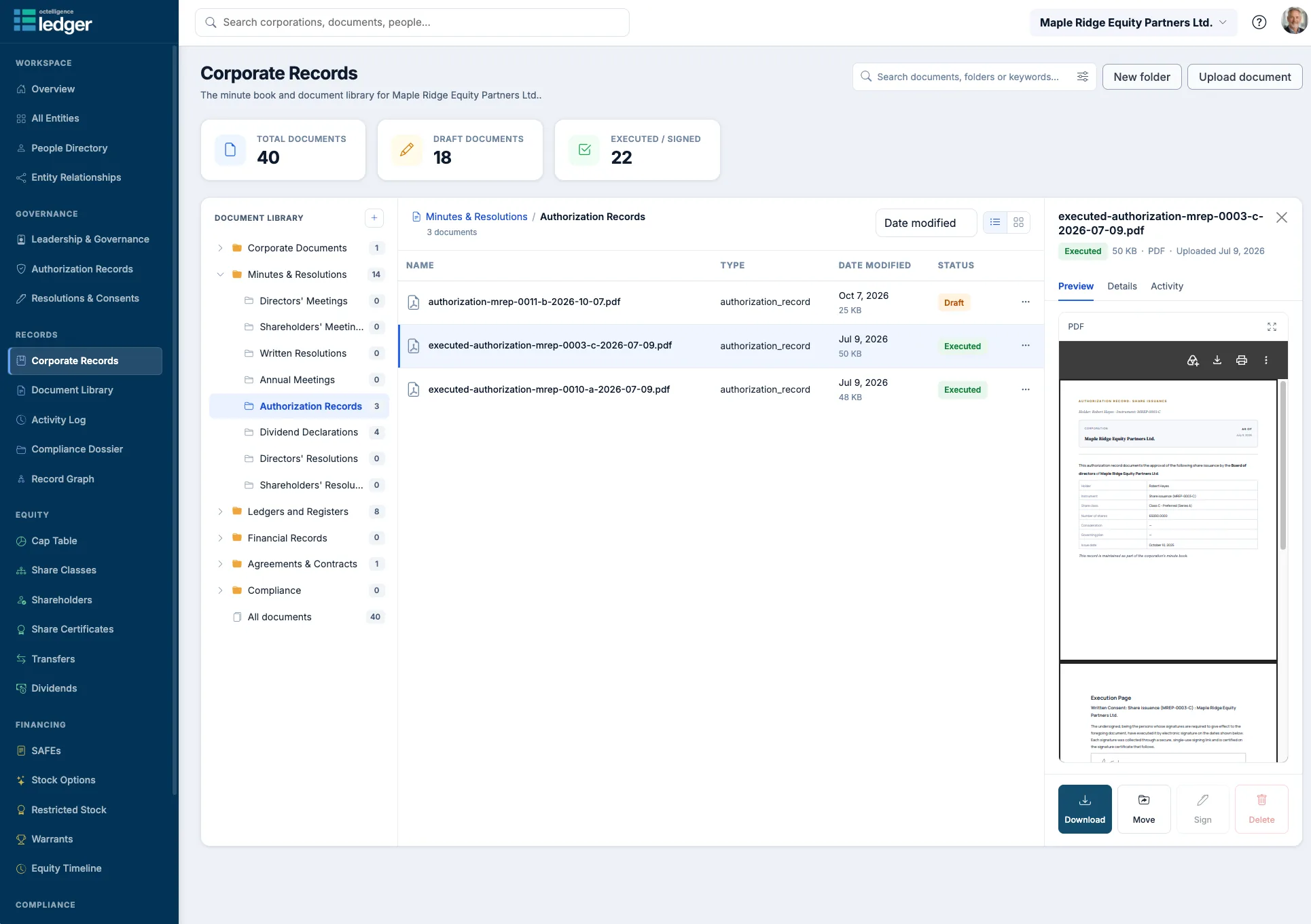
Octelligence keeps the minute book, the share register, the certificates, and the cap table in one record. Every resolution, meeting, issuance, and transfer is dated, indexed, and linked to its supporting documents. The BCBCA inspection right, the retention period, and the beneficial-ownership register requirement are jurisdiction-aware. Diligence can reproduce the corporate record at any past date.
See Digital Corporate RecordsCommon questions in British Columbia
Octelligence keeps the minute book, the share register, and the cap table reconciled together with full BCBCA awareness of inspection rights and retention periods.