How to issue shares in British Columbia corporations
BCBCA governs British Columbia-incorporated corporations. BC has historically been a popular incorporation jurisdiction for private corporations due to its flexibility on no-par-value shares, no director-residency requirement, and a transparency register that is more recent than the federal CBCA equivalent.
| BCBCA s. 64 | Issuance of shares |
|---|---|
| BCBCA s. 71 | Consideration for shares |
| BCBCA s. 75 | Share certificates and uncertificated shares |
| BCBCA s. 111 | Central securities register |
| BCBCA s. 119 | Inspection by shareholders |
| BCBCA s. 51.5 | Transparency register |
- Authorized by the board under BCBCA s. 64; consideration under s. 71
- BC has no par-value requirement; all shares are no-par-value by default
- Future services not permitted as consideration (s. 71(2))
- Central securities register under s. 111; transparency register under s. 51.5 (since October 2020)
- NI 45-106 exemption (passport regime); Form 45-106F1 filed with the BC Securities Commission
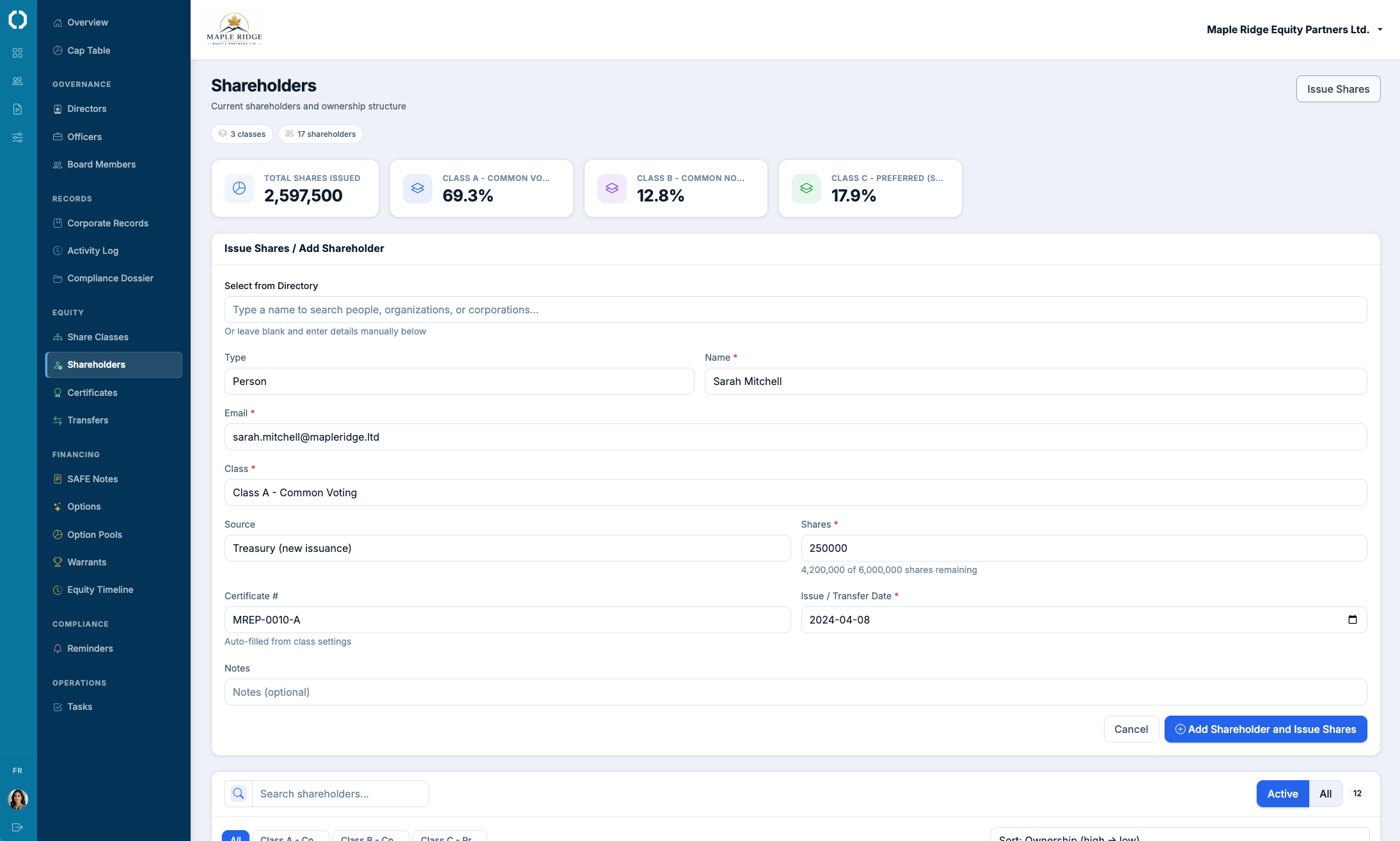
Board authorization under BCBCA s. 64
Stock issuance is authorized by the directors under BCBCA s. 64. The directors determine consideration under s. 71. BC follows the Canadian pattern: future services and promissory notes are not permitted as consideration (s. 71(2)). Past services, money, and property are permitted.
No par-value shares
British Columbia was one of the early Canadian jurisdictions to abolish par-value shares. Under BCBCA, all shares are no-par-value by default. The articles do not state a par value; instead, the share structure simply identifies share classes and rights. This simplifies share issuance: there is no minimum consideration requirement tied to par.
Stated capital and the BCBCA framework
BCBCA does not use the term stated capital as the CBCA and OBCA do. Instead, BCBCA tracks capital for accounting purposes through the issuance and consideration records. The substantive effect is similar: consideration received is recorded in a capital account that supports dividend and redemption tests under ss. 70 and 79.
Central securities register under s. 111 and transparency register under s. 51.5
BCBCA s. 111 requires every BC corporation to maintain a central securities register listing every shareholder with their address, number of securities, and other particulars. BCBCA s. 51.5, effective October 1, 2020, additionally requires every BC private corporation to maintain a transparency register of significant individuals (the BC version of an ISC/PSC register). The transparency register is internal but may be made available to certain government bodies on request.
Securities-law compliance: NI 45-106 in BC
BC participates in the National Instrument 45-106 passport regime. Common exemptions used in BC private placements: accredited investor (§ 2.3), private issuer (§ 2.4), family/friends/business associates (§ 2.5), and the offering memorandum exemption. Form 45-106F1 is filed with the BC Securities Commission within 10 days of distribution closing.
Common mistakes
Common BCBCA failure points in share issuance:
- Issuing shares for future services or promissory notes (prohibited under BCBCA s. 71(2))
- Not maintaining the BCBCA s. 51.5 transparency register since October 2020
- Failing to extra-provincially register a BC corporation operating in other provinces
- Treating BCBCA as if it had a par-value framework (it does not)
Octelligence handles BCBCA specifics in the share register, certificates, board resolutions, and beneficial-ownership filings: jurisdiction-aware templates, statute citations on each record, and the right reconciliation cadence for the corporation.
See Digital Corporate RecordsCommon questions in British Columbia
Octelligence handles BCBCA-specific share issuance: register, certificates, resolutions, and beneficial-ownership records aligned with statute.