How to issue shares in California corporations
California is a primary state of operations for many US startups even when incorporated elsewhere. California-incorporated corporations operate under the California Corporations Code, which is more shareholder-protective than the DGCL and broader in inspection rights.
| CCC § 405 | Issuance of shares |
|---|---|
| CCC § 408 | Consideration for shares |
| CCC § 409 | Par value; reduction below par |
| CCC § 416 | Stock certificates; uncertificated shares |
| CCC § 1500 | Books and records; share register |
| CCC § 25102 | Securities-law exemptions (Section 25102(f)) |
- Authorized by the board under CCC § 405; California also permits future services as consideration (§ 408)
- Stock certificates default under § 416 unless the corporation elects uncertificated
- Share register required under CCC § 1500, with broad inspection rights without proper-purpose requirement
- State securities filing under Section 25102(f) for limited offerings, plus federal Form D where applicable
- Stronger minority-shareholder protections under § 309 (director fiduciary duties) than DGCL
Board authorization under CCC § 405
Stock issuance is authorized by the board of directors under California Corporations Code § 405. The board determines the consideration. Unlike DGCL, California permits future services as consideration under § 408 (the corporation must value the future services in the resolution). The board acts by meeting or by unanimous written consent under § 307(b).
Consideration: cash, property, services, including future services
California permits consideration to include money, services rendered, services to be rendered, debts and securities, and other property. Future services are an important difference from Delaware: California founder grants can be supported by future services commitment with a recital of the value of those services. Consideration must equal at least the par value where stated.
Share register under CCC § 1500
California Corporations Code § 1500 requires every corporation to keep adequate and correct books and records, including a share register. The inspection right under § 1601 is broad: any shareholder of 5% or more, or any holder of voting trust shares, may inspect for any purpose related to their interest as a shareholder. There is no proper-purpose requirement equivalent to DGCL § 220.
Stock certificates default under § 416
California Corporations Code § 416 requires share certificates unless the corporation's articles or bylaws expressly authorize uncertificated shares. The certificate must contain the corporation's name, the holder's name, the class and number of shares, signatures of authorized officers, and any required legends. Many California-incorporated corporations issue uncertificated shares after amending the bylaws to permit them.
Section 25102(f) and federal compliance
California's blue-sky law (Corporate Securities Law of 1968) requires qualification of securities offerings unless exempt. Section 25102(f) is the most common exemption for private offerings to accredited investors; a notice filing on Form 25102(f) is required within 15 calendar days of the first sale. Federal Form D applies separately under SEC Regulation D. NSMIA pre-empts state qualification for Rule 506 offerings but not the notice filing.
Common mistakes
Common California-specific failure points in share issuance:
- Treating Delaware practice as California practice (e.g. defaulting to uncertificated shares without bylaw authorization)
- Missing the Section 25102(f) notice filing within 15 days of the first sale
- Failing to assess § 2115 long-arm exposure for Delaware-incorporated corporations operating in California
- Inadequate consideration recitals for founder grants relying on future services
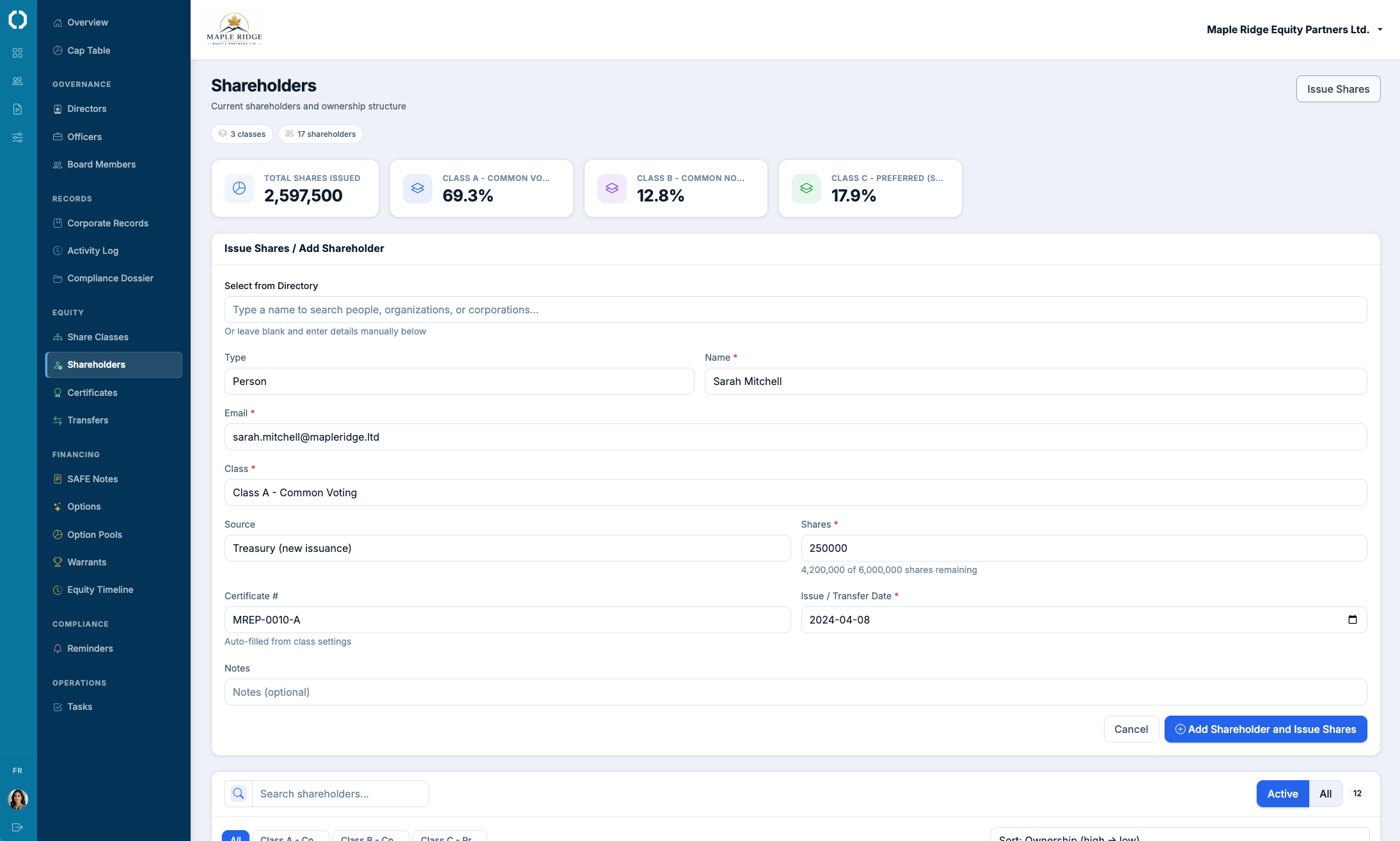
Octelligence handles CCC specifics in the share register, certificates, board resolutions, and beneficial-ownership filings: jurisdiction-aware templates, statute citations on each record, and the right reconciliation cadence for the corporation.
See Digital Corporate RecordsCommon questions in California
Octelligence handles CCC-specific share issuance: register, certificates, resolutions, and beneficial-ownership records aligned with statute.