How to maintain a minute book in Canada (CBCA)
The CBCA's records regime is distinctive in two ways relative to US states: very broad inspection rights under s. 21 (any person on reasonable notice, no proper-purpose requirement), and an Individuals with Significant Control (ISC) register requirement under s. 21.1 since June 2019. Records must be kept at the registered office (or another location authorized by the directors).
| Statutory records | Corporate records (registered office) |
|---|---|
| Inspection right | Broad: any person on reasonable notice (no proper-purpose requirement) |
| Retention period | 6 years after dissolution under CBCA s. 226 |
| CBCA s. 20 | Corporate records: location and contents |
| CBCA s. 21 | Inspection rights (broad, no proper-purpose required) |
| CBCA s. 21.1 | Individuals with Significant Control (ISC) register |
| CBCA s. 22 | Form of records |
| CBCA s. 226 | Retention of records (6 years post-dissolution) |
| CBCA s. 50 | Securities register |
- CBCA s. 20 prescribes records inventory and location (registered office or director-authorized location)
- CBCA s. 21 inspection right is broad: ANY person may inspect on reasonable notice (no proper-purpose requirement)
- CBCA s. 21.1 ISC register since June 2019: individuals with 25%+ significant control
- 6-year retention after dissolution under CBCA s. 226
- Records may be in any form provided convertible to written form within reasonable time (s. 22)
Records inventory and location under CBCA s. 20
CBCA s. 20 requires every CBCA corporation to maintain at its registered office (or another location in Canada designated by the directors): the articles, the bylaws and amendments, unanimous shareholder agreements, minutes of shareholder meetings and shareholder resolutions, copies of all notices required to be filed, and a securities register maintained in accordance with s. 50. Subsidiary records (board minutes, board resolutions, accounting records) are also required.
Broad inspection rights under CBCA s. 21: no proper-purpose requirement
CBCA s. 21 grants inspection rights to ANY person on reasonable notice. There is no proper-purpose requirement like Delaware's § 220. There is no minimum-holding threshold like Nevada's 15%. Section 21(3) extends inspection rights to creditors as well as shareholders. This is one of the broadest inspection regimes in common-law corporate jurisdictions. The corporation may charge reasonable fees for copying but cannot refuse inspection on purpose grounds.
Individuals with Significant Control register under s. 21.1
CBCA s. 21.1, effective June 13, 2019, requires every CBCA private corporation to maintain a register of Individuals with Significant Control (ISCs): individuals with direct or indirect ownership or control of 25% or more of the shares (by voting rights or fair-market-value), plus individuals with control through arrangements. The ISC register is internal but a portion is filed with Corporations Canada under recent amendments (effective January 2024). Information includes name, address, jurisdiction of tax residence, control percentage, and dates of becoming/ceasing to be an ISC.
Form of records under s. 22
CBCA s. 22 permits records to be in any form provided the records can be converted to a written form within a reasonable time. Digital records are explicitly permitted. The records may be replicated at multiple locations including outside Canada provided they remain accessible from the registered office.
6-year retention after dissolution under s. 226
CBCA s. 226 requires the corporation to retain its records for 6 years after dissolution. This is one of the longer statutory retention requirements among common-law jurisdictions and reflects the CBCA's protective approach to creditor and shareholder interests post-dissolution. The retention obligation falls on the directors and officers at the time of dissolution; counsel may also be the custodian.
Procedure
The minute book maintenance routine as it applies in Canada (CBCA), in seven steps:
Establish records at the registered office under CBCA s. 20
At incorporation, establish records at the registered office or at another location in Canada authorized by the directors. The inventory: articles, bylaws, USA, shareholder minutes and resolutions, securities register (s. 50), and supporting documents. The ISC register (s. 21.1) is established alongside the securities register.Maintain the securities register and ISC register together
The securities register (s. 50) lists every securityholder. The ISC register (s. 21.1) lists individuals with significant control. The two registers are related but distinct: the ISC register tracks beneficial ownership at the 25% threshold and includes individuals controlling through arrangements. Update both on every ownership change.Record corporate actions on the date of the action
Board actions and shareholder actions are recorded on the date they occur.Respond to CBCA s. 21 broad inspection demands
On a s. 21 inspection demand: confirm the demand is in writing and on reasonable notice. Do NOT demand proper-purpose justification (CBCA does not require it). Produce responsive records within a reasonable time. The inspection right extends to creditors as well as shareholders.Maintain the ISC register under s. 21.1 and file with Corporations Canada
The ISC register is updated within 15 days of becoming aware of any change. As of January 2024 amendments, a portion of the ISC information is also filed with Corporations Canada and made partially public. The corporation must take reasonable steps to identify ISCs and to verify the information.File the annual return under CBCA s. 263
The CBCA annual return is filed within 60 days of the anniversary date. The annual return is a separate public filing from internal records.Retain records for 6 years after dissolution under s. 226
If the corporation dissolves, the directors and officers (or counsel as designated) must retain the records for 6 years after the dissolution. This is a longer retention period than most US jurisdictions and reflects the CBCA's protective approach.
Common mistakes
Common CBCA failure points in maintaining the corporate records book:
- Refusing s. 21 inspection on proper-purpose grounds (CBCA does not require proper purpose; the inspection right is broad)
- Not maintaining the s. 21.1 ISC register since June 2019
- Failing to file ISC information with Corporations Canada since January 2024 amendments
- Not preserving records for the 6-year post-dissolution period under s. 226
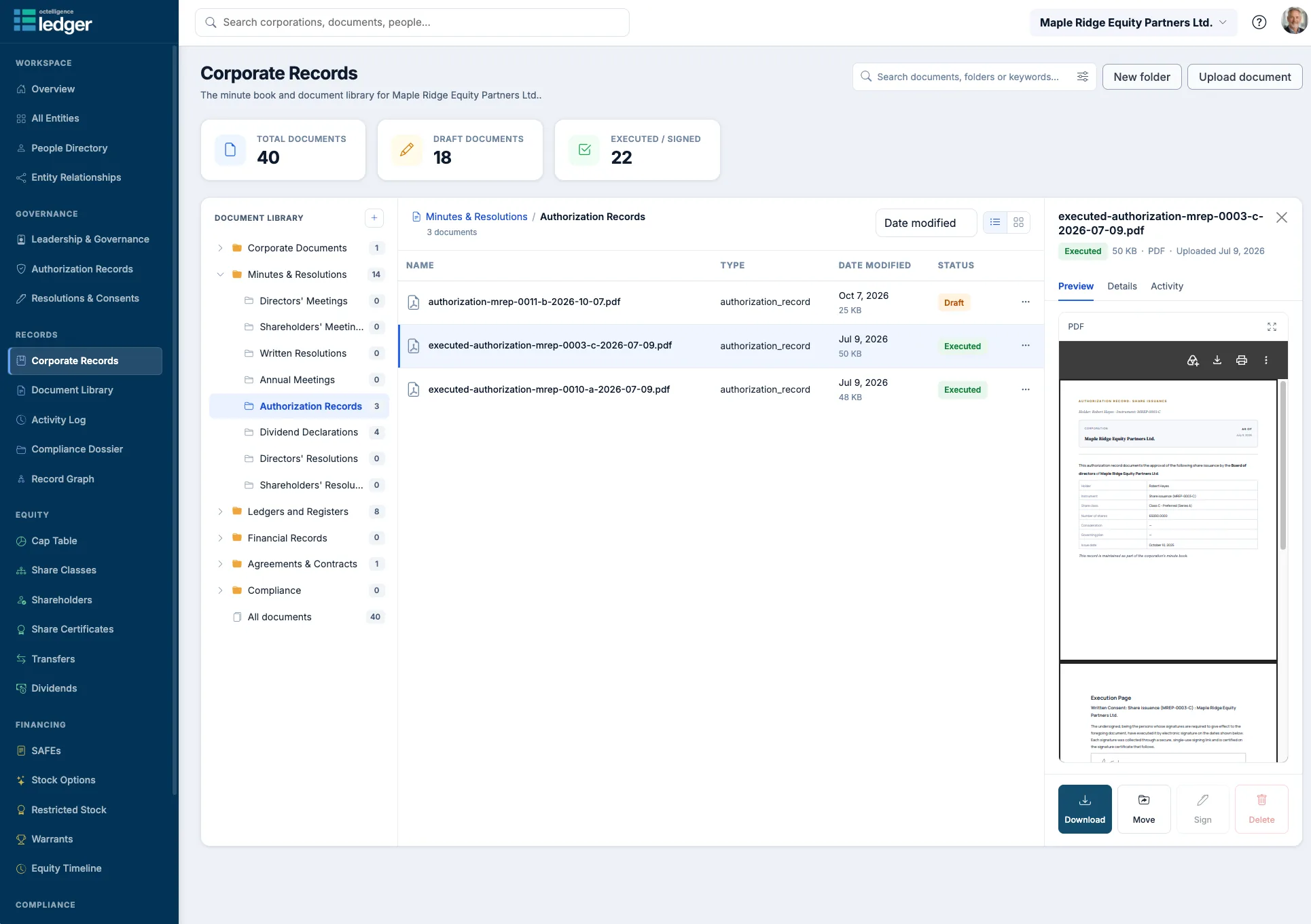
Octelligence keeps the minute book, the share register, the certificates, and the cap table in one record. Every resolution, meeting, issuance, and transfer is dated, indexed, and linked to its supporting documents. The CBCA inspection right, the retention period, and the beneficial-ownership register requirement are jurisdiction-aware. Diligence can reproduce the corporate record at any past date.
See Digital Corporate RecordsCommon questions in Canada (CBCA)
Octelligence keeps the minute book, the share register, and the cap table reconciled together with full CBCA awareness of inspection rights and retention periods.