How to issue shares in Canada (CBCA) corporations
CBCA is the federal Canadian corporate-law statute, governing federally-incorporated Canadian corporations. CBCA share issuance is more formal than US practice: shares must be issued for consideration not less than the fair equivalent of the money the corporation would have received if the share had been issued for money.
| CBCA s. 25 | Issuance of shares |
|---|---|
| CBCA s. 26 | Stated capital account |
| CBCA s. 27 | Other forms of consideration |
| CBCA s. 49 | Stock certificates and uncertificated shares |
| CBCA s. 50 | Securities register |
| CBCA s. 21.1 | Individuals with Significant Control register |
- Authorized by the board under CBCA s. 25; broad consideration permitted under s. 27
- No future services permitted (s. 25(3)): consideration must be money or property or past services
- Stated capital account must be maintained for each class (s. 26)
- Securities register required under s. 50; ISC register under s. 21.1
- NI 45-106 exemption (typically accredited investor) and Form 45-106F1 filing for distributions
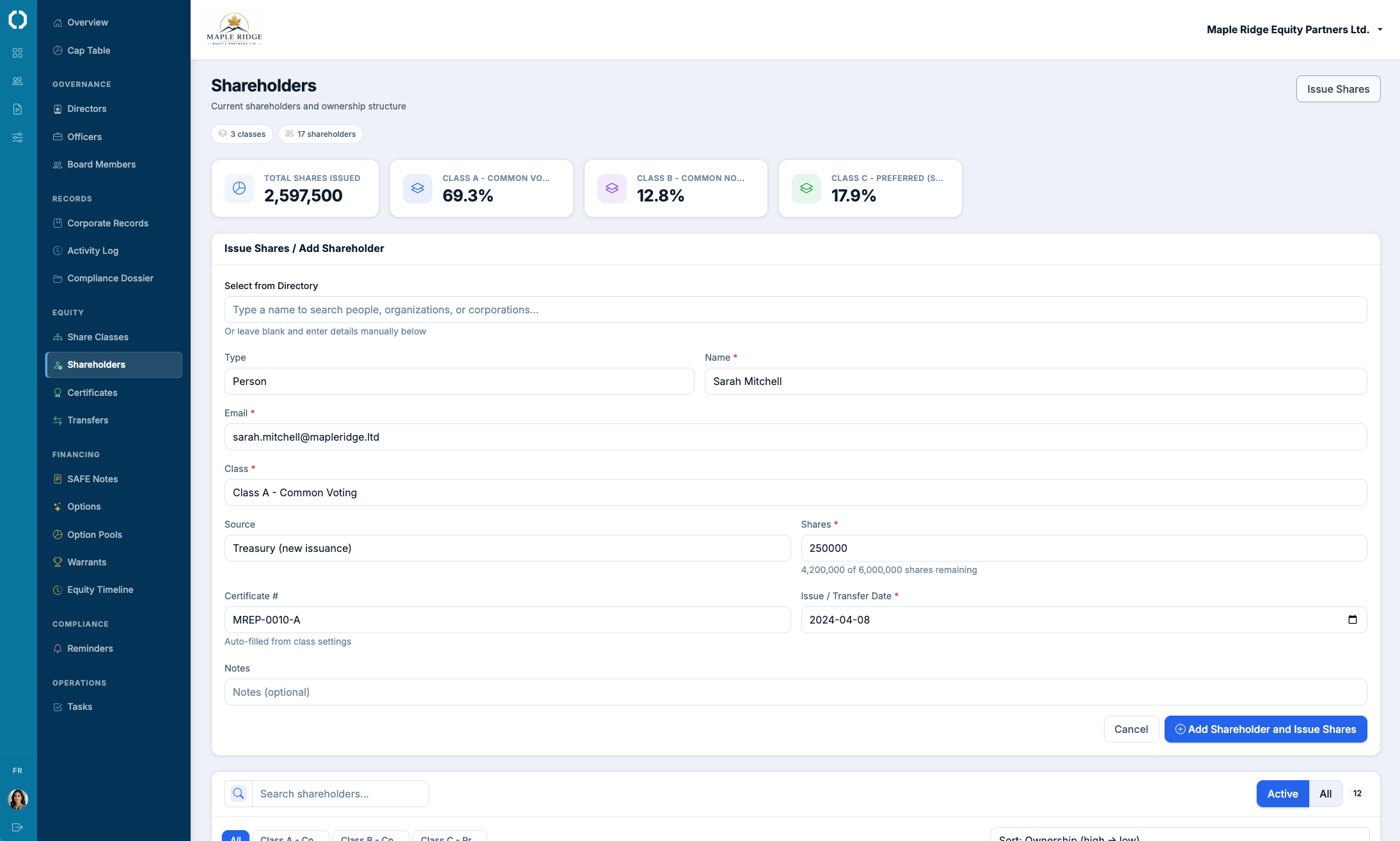
Board authorization under CBCA s. 25
Stock issuance is authorized by the directors under CBCA s. 25. Shares may not be issued until they are fully paid; consideration must be money or property or past services performed for the corporation. Future services and promissory notes are not permitted (this is a key difference from many US states). The directors determine consideration value, and their determination is conclusive absent fraud.
No future services or notes (s. 25(3))
CBCA s. 25(3) prohibits issuance for future services or promissory notes. This is the principal difference between CBCA share issuance and Delaware or MBCA-state issuance. CBCA founder grants must rely on past services (work already done) or cash consideration (commonly a nominal amount). The stricter rule reflects the Canadian protective approach to creditor and minority-shareholder interests.
Stated capital account under s. 26
CBCA s. 26 requires the corporation to maintain a separate stated capital account for each class and series of shares. The stated capital is increased by the consideration received for issuances. Stated capital matters for tax (it represents the paid-up capital for ITA s. 84 deemed-dividend calculations) and for corporate-law solvency tests on dividends and redemptions. US states either lack the concept (Delaware uses capital surplus) or treat it less formally.
Securities register under s. 50
CBCA s. 50 requires every CBCA corporation to maintain a securities register listing every security holder with their name, address, number of securities, and other particulars. The register is the controlling record of shareholders. CBCA s. 21 grants broad inspection rights: any person may inspect on reasonable notice (no proper-purpose requirement like Delaware). Section 21.1 requires a separate Individuals with Significant Control (ISC) register listing beneficial owners of 25%+.
Securities-law compliance: NI 45-106
Distributions to Canadian investors are governed by National Instrument 45-106. The most common exemptions: accredited investor (§ 2.3), private issuer (§ 2.4), family/friends/business associates (§ 2.5), and the $150,000 minimum-investment exemption (§ 2.10). Form 45-106F1 (report of exempt distribution) is filed within 10 days of the distribution closing. The CBCA's stricter issuance rules complement Canadian securities law's prospectus regime.
Common mistakes
Common CBCA failure points in share issuance:
- Issuing shares for future services or promissory notes (prohibited under CBCA s. 25(3))
- Failing to maintain the s. 50 securities register or s. 21.1 ISC register
- Not filing Form 45-106F1 within 10 days of an exempt distribution
- Not maintaining a separate stated capital account per class under s. 26
Octelligence handles CBCA specifics in the share register, certificates, board resolutions, and beneficial-ownership filings: jurisdiction-aware templates, statute citations on each record, and the right reconciliation cadence for the corporation.
See Digital Corporate RecordsCommon questions in Canada (CBCA)
Octelligence handles CBCA-specific share issuance: register, certificates, resolutions, and beneficial-ownership records aligned with statute.