Share certificate requirements for a British Columbia (BCBCA) corporation
BCBCA s. 57 governs share certificates in British Columbia, with the BC particularity that uncertificated shares are the default unless directors resolve otherwise. The required content and signing rules are similar to the CBCA.
| BCBCA s. 57 | Issuance of share certificates |
|---|---|
| BCBCA s. 57(2) | Form and content of share certificates |
| BCBCA s. 58 | Signing of share certificates |
| BCBCA s. 64 | Lost share certificates |
| BCBCA s. 51 | Central securities register |
- BC defaults to uncertificated shares, directors must specifically resolve to issue paper certificates
- Section 57(2) requires the corporation name, shareholder name, class and number of shares, and rights attached
- Section 58 requires signing by two directors or officers, or one director plus one officer; facsimile permitted where transfer agent appointed
- Section 64 governs replacement of lost certificates on satisfactory evidence and indemnity
- Restrictions on transfer must be noted on certificate or in the corporation's articles
BC's uncertificated-by-default approach
British Columbia is unusual among Canadian provinces in defaulting to uncertificated shares. Under BCBCA s. 57(1), the directors may decide to issue paper certificates, but absent that decision, the corporation records share ownership in the central securities register under s. 51 without issuing certificates. The shareholder receives notice of the issuance and a statement of rights but no certificate.
Many BC corporations, particularly tech corporations and others using digital recordkeeping, never issue paper certificates. The BCBCA's default position makes this the path of least resistance, where other Canadian jurisdictions still presume certificated issuance unless the corporation deliberately opts out.
Required content under s. 57(2)
Where the directors do resolve to issue share certificates, the certificate must state:
- The name of the corporation
- The name of the registered shareholder
- The number and class of shares represented, with any series designation
- If applicable, a statement of any restriction on transfer
- A statement of the rights, privileges, restrictions, and conditions attaching to the shares, or a notation that this information can be obtained from the corporation
Signing under s. 58
BC share certificates must be signed by two directors or officers, or by one director and one officer of the corporation. Where the corporation has appointed a transfer agent (typically only public companies do), facsimile signatures of the directors or officers are permitted in combination with the transfer agent's manual signature.
Private BC corporations almost always issue paper or digital certificates with two ink signatures from the directors. Where the corporation has only one director (BCBCA permits a single-director corporation), the single director's signature plus an officer's signature satisfies the requirement.
Lost certificates and replacement (s. 64)
Where a certificate is lost, stolen, or destroyed, the corporation may issue a replacement under s. 64 on satisfactory evidence of the loss, an indemnity bond against future claims, and payment of a reasonable fee. The replacement carries a new certificate number; the original is marked cancelled in the central securities register.
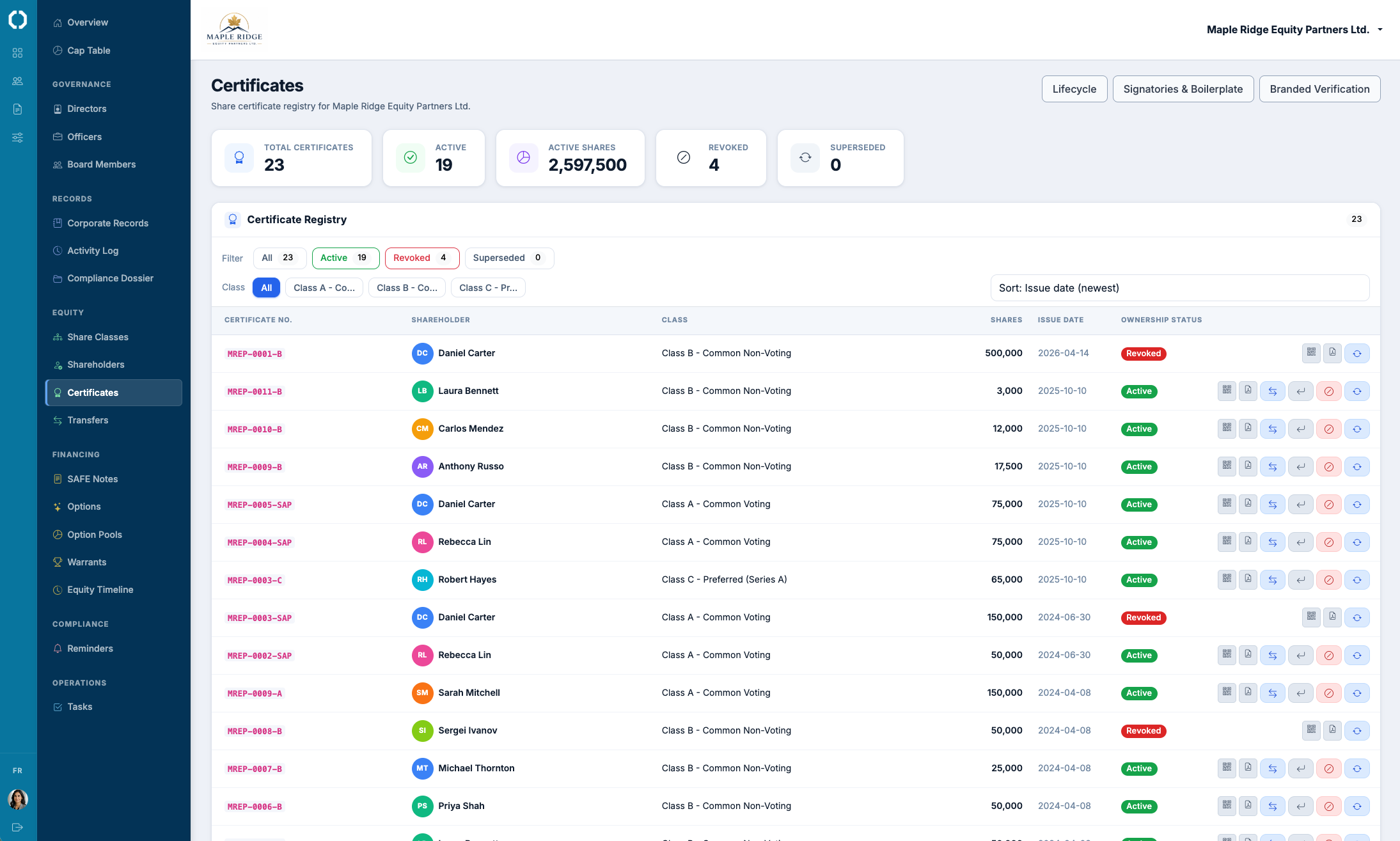
Octelligence issues share certificates with QR codes that resolve to a public verification page. Cancellations and reissuances flow through the same workflow as issuance, so the certificate, the register, and the cap table stay aligned.
See Digital Corporate RecordsQR-verified share certificates, public verification pages, and a register that always agrees with the certificate in hand.