Share certificate requirements for an Ontario (OBCA) corporation
OBCA s. 56 governs share certificates issued by Ontario corporations. The required content and signing rules track the federal CBCA closely, with Ontario-specific provisions on registers and securities-law compliance.
| OBCA s. 56 | Form and content of share certificates |
|---|---|
| OBCA s. 56(4) | Required content |
| OBCA s. 56(6) | Signing requirements |
| OBCA s. 56(9) | Statement of restrictions |
| OBCA s. 54 | Uncertificated shares |
- Section 56(4) requires the corporation name, shareholder name, class and number of shares, and applicable conditions
- Two signatures by directors or officers; facsimile permitted where corporation has a registrar or transfer agent
- Restrictions on transfer must be conspicuously noted on the certificate (s. 56(9))
- Section 54 permits issuance of uncertificated shares, increasingly the default for private corporations
- Securities-law restrictions (OSC requirements) apply to certificates issued in private placements
Required content under OBCA s. 56(4)
Section 56(4) specifies what an OBCA share certificate must state:
- The name of the corporation
- That the corporation is governed by the Ontario Business Corporations Act
- The name of the shareholder
- The number and class of shares represented, and any series designation
- The par value of the shares, or that they are without par value
- Where there is more than one class of shares, a statement of the rights, privileges, restrictions, and conditions attaching to each class (or that the statement can be obtained from the corporation on request)
Signing and restrictions
Section 56(6) requires the certificate to be signed by a director or officer, or by a registrar, transfer agent, branch transfer agent, or trustee. Where the corporation has a registrar or transfer agent, facsimile signatures may be used. Private Ontario corporations typically use two ink signatures by the president and secretary.
Section 56(9) requires that any restriction on transfer be conspicuously stated on the certificate. Ontario private corporations frequently have transfer restrictions in their articles or in a unanimous shareholder agreement, these must be referenced on the certificate to be enforceable against third-party transferees.
Uncertificated shares under s. 54
Like the CBCA, the OBCA permits uncertificated shares. The corporation records the ownership in the securities register; the shareholder receives a written notice of issuance and a statement of rights. Uncertificated issuance is common in modern Ontario practice, particularly for technology corporations and others using digital recordkeeping.
Securities-law overlay
Beyond the OBCA's certificate requirements, securities law applies to certificates issued in private placements or restricted distributions. Certificates issued under National Instrument 45-106 prospectus exemptions typically carry a four-month hold legend (or longer, depending on the exemption) referencing the restrictions on resale. This legend appears in addition to the OBCA-required content and is enforceable against transferees on the face of the certificate.
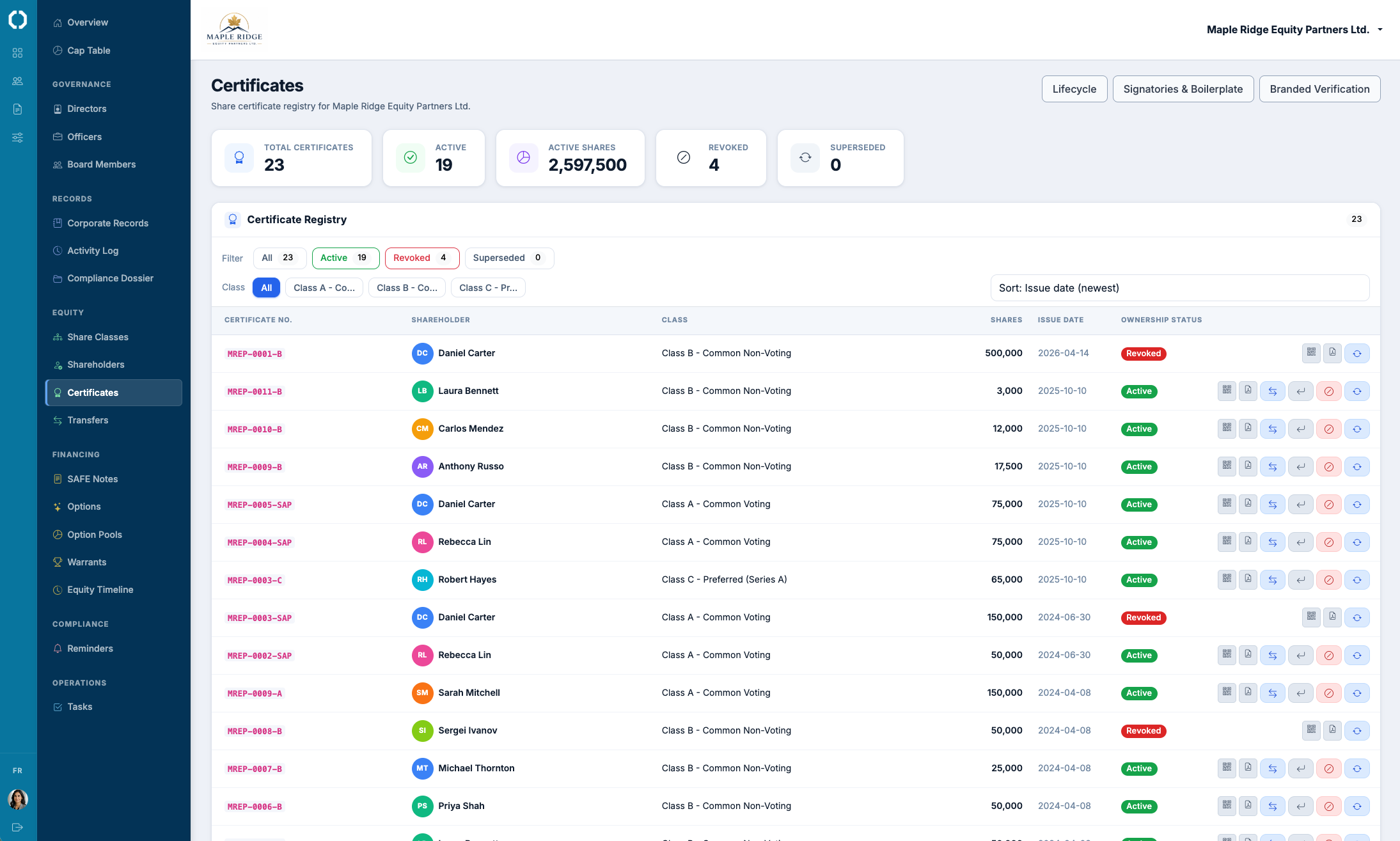
Octelligence issues share certificates with QR codes that resolve to a public verification page. Cancellations and reissuances flow through the same workflow as issuance, so the certificate, the register, and the cap table stay aligned.
See Digital Corporate RecordsQR-verified share certificates, public verification pages, and a register that always agrees with the certificate in hand.