Share certificate requirements for a federal Canadian (CBCA) corporation
CBCA s. 49 sets out the formal requirements for share certificates issued by a Canadian federal corporation, including the prescribed content, signing requirements, and the option to issue uncertificated shares.
| s. 49(1) | Right of shareholder to share certificate or non-transferable security |
|---|---|
| s. 49(7) | Required content of share certificates |
| s. 49(9) | Signatures on share certificates |
| s. 49(11) | Restrictions and legends |
| s. 49(13) | Uncertificated shares permitted |
- Section 49(7) prescribes the content: corporation name, statement of governance under the CBCA, shareholder name, class and number of shares
- Two signatures required from directors or officers (s. 49(9)); facsimile signatures permitted for issued shares of registered corporations
- Restrictions on transfer must be conspicuously stated on the certificate (s. 49(11))
- Section 49(13) permits uncertificated shares, the corporation records ownership in the securities register without issuing a certificate
- Lost or destroyed certificates may be replaced under s. 49(15) on satisfactory evidence and indemnity
Required content under CBCA s. 49(7)
Section 49(7) of the CBCA specifies what every share certificate must show:
- The name of the corporation as it appears on the certificate of incorporation
- A statement that the corporation is governed by the Canada Business Corporations Act
- The name of the shareholder entitled to the shares evidenced by the certificate
- The number and class of shares represented by the certificate, and any series designation
- If applicable, a statement that there is no nominal or par value, or the par value of the shares
- The conditions attached to the shares (or a statement that conditions can be obtained on request) where the corporation has more than one class of shares
Section 49(11) requires that any restriction on transfer be conspicuously noted on the certificate, most commonly, the standard 'no restriction or hold' language for unrestricted shares, or specific transfer restrictions where unanimous shareholder agreements apply.
Signing requirements (s. 49(9))
A CBCA share certificate must be signed by at least one of: a director of the corporation, an officer of the corporation, a registrar or transfer agent (or branch agent), or a trustee for the corporation. In practice, certificates are signed by two officers, typically the president and the corporate secretary, though one signature satisfies the statute.
For shares of corporations whose securities are publicly traded, facsimile signatures are permitted, recognizing that high-volume issuance cannot be hand-signed. Private corporations generally use original ink or digital signatures with cryptographic verification.
Uncertificated shares under s. 49(13)
The CBCA expressly permits a corporation to issue uncertificated shares. Where shares are uncertificated, the corporation records ownership in the securities register under s. 50 without issuing a paper or digital certificate. The shareholder receives written notice of issuance and a statement of the rights attached to the shares, but no certificate.
Uncertificated issuance is increasingly common in private CBCA corporations, particularly those using digital recordkeeping. The choice between certificated and uncertificated shares is typically set in the bylaws and can vary by share class.
Replacing lost certificates (s. 49(15))
Where a share certificate is lost, stolen, or destroyed, s. 49(15) permits the corporation to issue a new certificate to replace it on receipt of:
- An affidavit or other evidence satisfactory to the directors that the certificate has been lost, stolen, or destroyed
- An indemnity bond or other security against any claim arising from the replacement
- Payment of any reasonable fee charged by the corporation
The replacement certificate carries a new certificate number; the original is cancelled in the securities register.
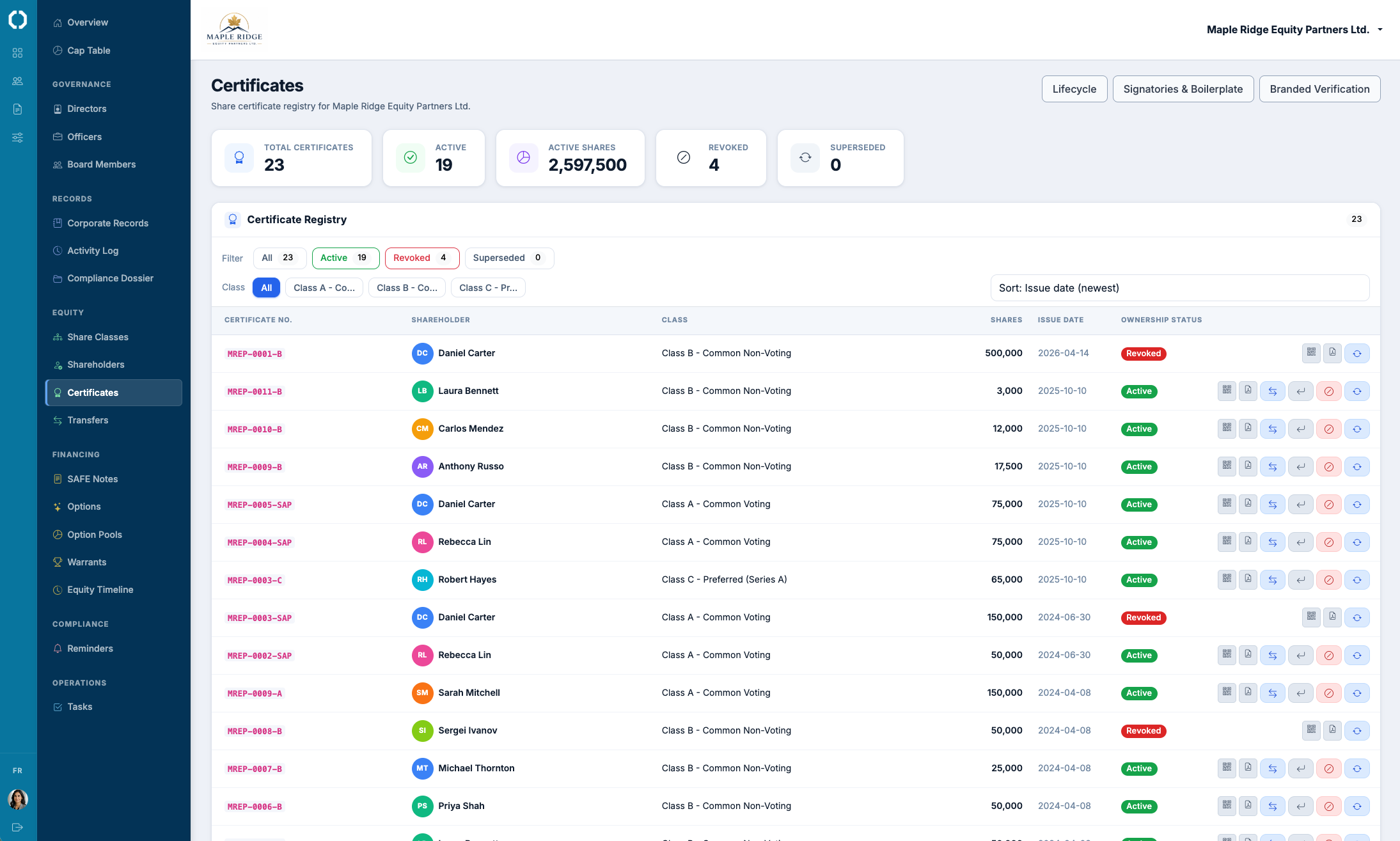
Octelligence issues share certificates with QR codes that resolve to a public verification page. Cancellations and reissuances flow through the same workflow as issuance, so the certificate, the register, and the cap table stay aligned.
See Digital Corporate RecordsQR-verified share certificates, public verification pages, and a register that always agrees with the certificate in hand.