Share certificate requirements across 41 jurisdictions
Share certificates (Canada and UK) and stock certificates (US) are the formal documents evidencing share ownership in a corporation. What must appear on them, whether they're mandatory at all, and how they're cancelled and reissued, each jurisdiction answers differently.
Same document, different names and rules
A corporation issues a share certificate (or stock certificate, in US terminology) to evidence that a specific shareholder owns a specific number of shares of a specific class. The certificate is not the share itself, the underlying ownership lives in the corporation's register, but it is the most visible and portable piece of evidence that ownership exists.
What goes on the face of the certificate, who must sign it, whether it must be issued at all, and how it is transferred or cancelled differs by jurisdiction. Most modern jurisdictions now permit uncertificated shares: the corporation may record ownership in its register without issuing physical certificates. Where certificates are issued, they remain governed by detailed statutory rules. This page surveys those rules across 41 jurisdictions.
Choose your jurisdiction
Each guide covers what to maintain, where to keep it, who can inspect, and what happens if you don't.
Canada (Federal / CBCA)
CBCA View requirements CanadaOntario
OBCA View requirements CanadaBritish Columbia
BCBCA View requirements CanadaAlberta
ABCA View requirements CanadaQuebec
QBCA View requirements CanadaManitoba
MCA View requirements CanadaNew Brunswick
NBBCA View requirements CanadaNewfoundland and Labrador
NLCA View requirements CanadaNova Scotia
NSCA View requirements CanadaPrince Edward Island
PEIBCA View requirements CanadaSaskatchewan
SBCA View requirements United StatesDelaware
DGCL View requirements United StatesCalifornia
Cal. Corp. Code View requirements United StatesNew York
NY BCL View requirements United StatesTexas
TBOC View requirements United StatesFlorida
FBCA View requirements United StatesNevada
NRS Ch. 78 View requirements United StatesWashington
WA BCA View requirements United StatesMassachusetts
M.G.L. c. 156D View requirements United StatesWyoming
WBCA View requirements United StatesColorado
C.R.S. Title 7 View requirements United StatesUtah
URBCA View requirements United StatesIllinois
805 ILCS 5/ View requirements United StatesNew Jersey
NJBCA View requirements United StatesGeorgia
GBCC View requirements United StatesNorth Carolina
NCBCA View requirements United StatesVirginia
VSCA View requirements United StatesArizona
A.R.S. Title 10 View requirements United StatesTennessee
TBCA-TN View requirements United StatesMinnesota
Minn. Stat. § 302A View requirements United StatesOregon
ORS Ch. 60 View requirements United StatesMichigan
MICA View requirements United StatesOhio
OGCL View requirements United StatesPennsylvania
PBCL View requirements United StatesConnecticut
C.G.S. § 33-600 View requirements United StatesMaryland
MGCL View requirements United StatesIndiana
IBCL View requirements United StatesWisconsin
Wis. Stat. Ch. 180 View requirements United StatesMissouri
RSMo Ch. 351 View requirements United StatesSouth Carolina
SCBCA View requirements United KingdomUnited Kingdom
CA 2006 View requirementsCompare requirements across jurisdictions
The same artifact, different rules.
| Jurisdiction | Governing statute | Required to issue? | Signing authority | Uncertificated permitted? |
|---|---|---|---|---|
| Canada (Federal / CBCA) | CBCA s. 49 | Optional (s. 49(13), uncertificated permitted) | One signature minimum (director, officer, agent) | Yes (s. 49(13)) |
| Ontario | OBCA s. 56 | Optional (s. 54, uncertificated permitted) | Director/officer or agent | Yes (s. 54) |
| British Columbia | BCBCA s. 57 | No, uncertificated by default | Two directors/officers (or 1+1) | Yes (and default) |
| Alberta | ABCA s. 49 | Optional (s. 49(13)) | One signature minimum | Yes (s. 49(13)) |
| Quebec | QBCA art. 67-72 | Right exists; uncertificated permitted | Two signatures (directors/officers) | Yes (art. 70) |
| Delaware | DGCL § 158 | No, uncertificated permitted | Two officers (specific combinations under § 158) | Yes (§ 158, fully) |
| California | Cal. Corp. Code § 416 | Generally yes (uncertificated narrowly permitted) | Two officers (specific combinations) | Limited |
| New York | NY BCL § 508 | Optional (uncertificated permitted) | Two officers (specific combinations) | Yes (§ 508(c)) |
| Texas | TBOC § 3.202 | Optional (uncertificated permitted) | One officer minimum | Yes |
| Florida | FBCA § 607.0625 | Optional (uncertificated permitted under § 607.0626) | Two officers; facsimile permitted | Yes (§ 607.0626) |
| Nevada | NRS 78.235 | Optional (uncertificated permitted) | Two officers (president/VP + secretary/asst./treasurer) | Yes |
| Washington | RCW 23B.06.250 | Optional (uncertificated under .260) | Two officers (facsimile permitted) | Yes |
| Massachusetts | M.G.L. c. 156D § 6.25 | Optional (uncertificated under § 6.26) | Two officers | Yes (§ 6.26) |
| United Kingdom | CA 2006 s. 768-769 | Yes, within 2 months (s. 769) | Seal, or 2 directors / 1 director + secretary | Yes (CREST for public; articles for private) |
The shift to digital certificates
Across every jurisdiction surveyed below, the statutory rules were written for paper certificates handed to shareholders in person, often with embossed seals and signatures of officers in ink. Most statutes have been updated to permit electronic certificates, uncertificated shares, or both. The result is that modern private corporations have three choices: paper certificates (still legal, increasingly impractical), digital certificates with verification (the modern default), or uncertificated shares (recording ownership in the register only, no certificate issued).
The legal effect is the same in each case. What changes is the operational complexity of issuance, the ease of verification by buyers in diligence, and the resistance to fraud. Digital certificates with QR-based verification combine the comfort of a physical-looking document with the auditability of a digital record.
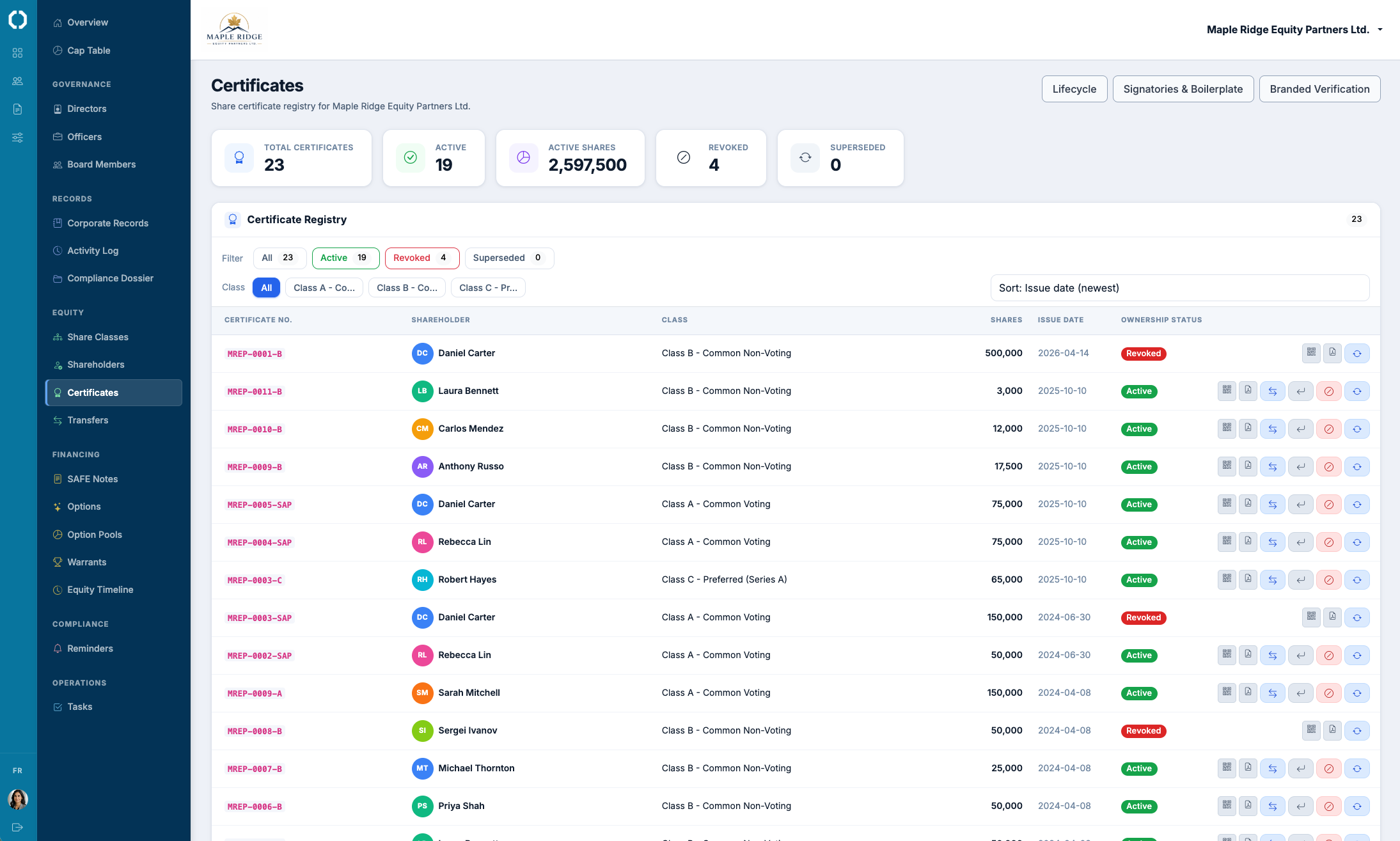
Octelligence issues QR-verified share certificates tied to the live share register. Every certificate carries a public verification page; cancellations and reissuances flow through the same workflow, so the certificate, the register, and the cap table never drift apart. Revoke-and-reissue is supported across every jurisdiction we operate in, and Intelligence adds bulk certificate PDFs.
See Share CertificatesFrequently asked
Yes, Canada and the UK use 'share certificate'; the US uses 'stock certificate'. The legal substance is identical: a document issued by a corporation evidencing ownership of a specific number of shares of a specific class. The Canadian, US, and UK statutes governing them differ in formal requirements but share the same core function.
In most modern jurisdictions, no. Corporations may issue uncertificated shares (recording ownership in the register without issuing certificates) or digital certificates. Delaware (DGCL § 158), California, the CBCA, and the UK Companies Act 2006 all expressly permit uncertificated shares. Whether to issue certificates is a corporate decision, usually set in the bylaws.
Statutory requirements vary by jurisdiction, but common fields include: certificate number, corporation name and jurisdiction of incorporation, name of the shareholder, class and number of shares, par value (or no-par-value statement), date of issuance, and signatures of authorized officers. Restricted shares typically also carry a restrictive legend. See the jurisdiction guides below for jurisdiction-specific requirements.
The mechanics differ slightly by jurisdiction but follow a common pattern: the transferor signs over the certificate (typically with an endorsement or separate stock power), the corporation cancels the old certificate, issues a new certificate to the transferee, and updates the share register to record the transfer. Many jurisdictions require board approval for private-company transfers; others impose securities-law compliance obligations.
QR-verified share certificates, public verification pages, and a register that always agrees with the certificate in hand.