Share certificate requirements for a Massachusetts corporation
M.G.L. c. 156D §§ 6.25-6.27 govern share certificates in Massachusetts. The MBCA-based statute uses familiar section numbering and permits both certificated and uncertificated shares.
| M.G.L. c. 156D § 6.25 | Form and content of share certificates |
|---|---|
| M.G.L. c. 156D § 6.26 | Shares without certificates |
| M.G.L. c. 156D § 6.27 | Restriction on transfer of shares and other securities |
| M.G.L. c. 156D § 6.28 | Expense of issuance of shares |
- Massachusetts adopted MBCA in 2003, share certificate provisions mirror Washington, Florida
- Required content: corporation name (organized in Massachusetts), holder name, class and number of shares, par value
- Two officer signatures; facsimile permitted; corporate seal optional
- Section 6.26 permits uncertificated shares with written notice to the holder
- Transfer restrictions under § 6.27 require conspicuous notation for enforcement against transferees
Content under M.G.L. c. 156D § 6.25
A Massachusetts share certificate must state:
- The name of the issuing corporation
- That the corporation is organized under Massachusetts law
- The name of the person to whom the certificate is issued
- The number and class of shares represented and the designation of the series
- The par value, or that the shares are without par value
- The relative rights, preferences, and limitations of the class (or a statement that they are available on request)
The certificate must be signed by two officers, typically the president and the secretary. Facsimile signatures are permitted, and the corporate seal may be affixed but is not required.
Uncertificated shares (§ 6.26)
Massachusetts § 6.26 permits the corporation to issue uncertificated shares. As with Washington and other MBCA states, the corporation must send the holder a written notice within a reasonable time after issuance, describing the holder, the shares, any restrictions, and the rights of the class.
Massachusetts corporations using digital recordkeeping commonly issue uncertificated shares from inception. The biotech and tech corporations in the Boston/Cambridge area are particularly likely to operate this way.
Transfer restrictions (§ 6.27)
Section 6.27 follows the standard MBCA approach to transfer restrictions: enforceable against transferees with notice; notice established by conspicuous notation on the certificate or by written notice for uncertificated shares. Common legend categories appear: securities-law restrictions, buy-sell agreements, vesting/repurchase rights from equity incentive plans, and shareholder agreement restrictions.
Terminology note
Massachusetts uses 'articles of organization' rather than 'articles of incorporation' (a terminology quirk preserved when Massachusetts adopted the MBCA in 2003). Share certificates issued by a Massachusetts corporation reference the corporation as organized under Chapter 156D, but the substantive certificate content follows MBCA standards.
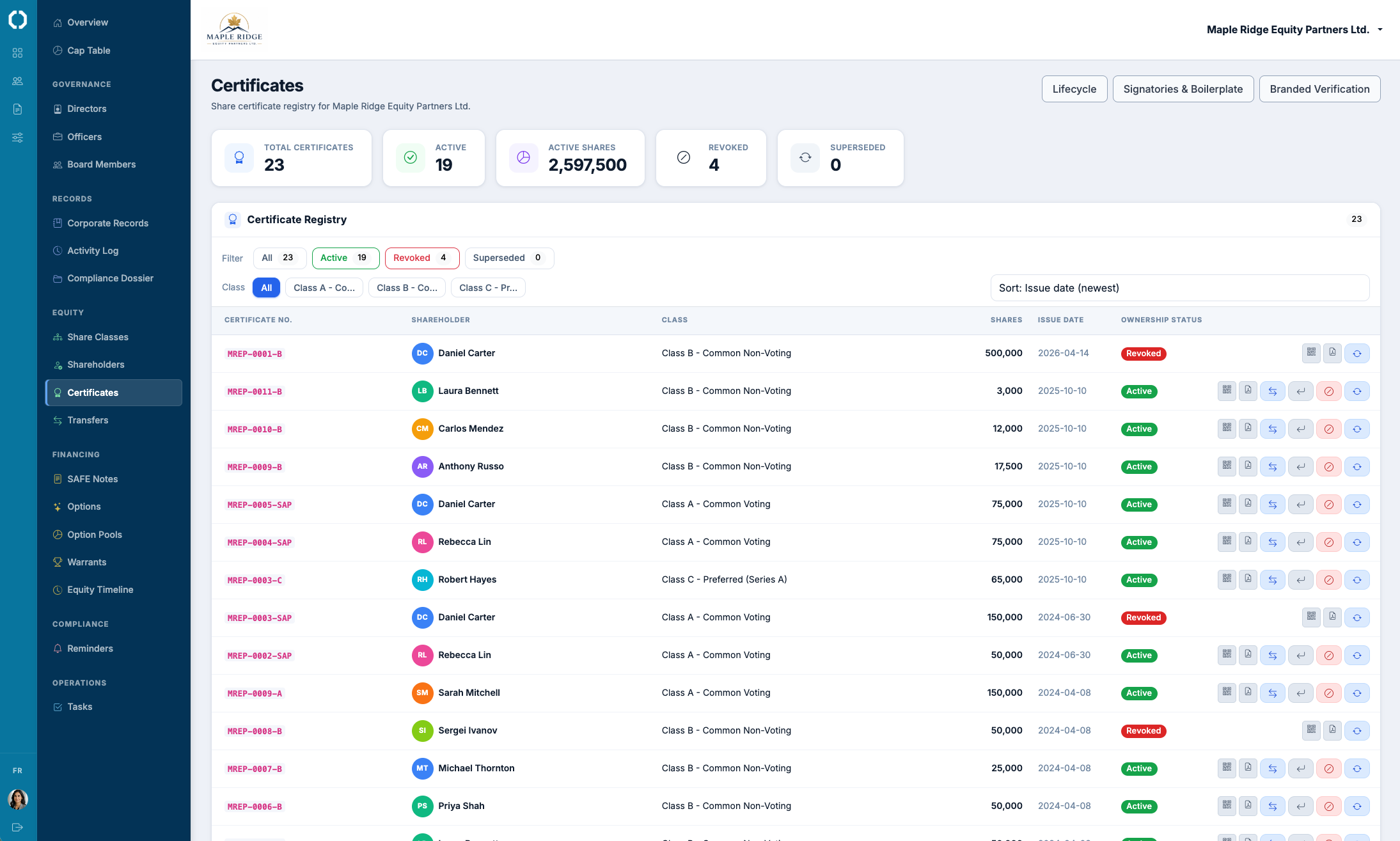
Octelligence issues share certificates with QR codes that resolve to a public verification page. Cancellations and reissuances flow through the same workflow as issuance, so the certificate, the register, and the cap table stay aligned.
See Digital Corporate RecordsQR-verified share certificates, public verification pages, and a register that always agrees with the certificate in hand.