Stock certificate requirements for a California corporation
California Corporations Code §§ 416-419 governs stock certificates. California's provisions are more prescriptive than Delaware's, with specific content requirements and notice obligations for restricted shares.
| Cal. Corp. Code § 416 | Share certificates; signature; legend; content |
|---|---|
| Cal. Corp. Code § 417 | Statement of facts on certificate |
| Cal. Corp. Code § 418 | Statement of rights of holders; legends |
| Cal. Corp. Code § 419 | Replacement of certificates |
| Cal. Corp. Code § 25102 | Securities-law exemptions and legend requirements |
- California requires share certificates by default, uncertificated shares permitted only in limited circumstances
- Section 416(a) requires two officer signatures: chairperson/president/VP and CFO/secretary/assistant
- Detailed legend requirements under § 418 for restricted shares, classes with multiple rights, and securities-law exemptions
- Section 417 requires a complete statement of voting rights, preferences, and restrictions to be on the certificate or available on request
- Replacement under § 419 follows the standard pattern: satisfactory proof of loss + indemnity
California's prescriptive approach to certificates
California corporations issuing shares must generally issue stock certificates under § 416. The statute permits uncertificated shares but only in narrow circumstances and is more restrictive than Delaware's § 158. As a practical matter, California private corporations commonly issue physical or digital share certificates rather than rely on uncertificated issuance.
Content under §§ 416-417
A California stock certificate must state:
- The name of the corporation and the state of incorporation
- The name of the registered shareholder
- The class and number of shares represented
- The par value of the shares, or that they are without par value
- A statement of the voting rights, dividend rights, redemption rights, and other rights of the class, or, alternatively, a statement that the corporation will furnish a copy of these rights to the shareholder on request without charge (§ 417)
Restricted-share legends under § 418
California § 418 is one of the most detailed legend requirements in any US jurisdiction. The statute requires conspicuous legend notations for:
- Securities-law restrictions, typically the standard Rule 144 or § 25102(f) hold-period legends
- Transfer restrictions imposed by a buy-sell agreement, voting agreement, or other contract
- Preference and conversion rights if the certificate represents preferred stock and the rights are not stated in full on the certificate
- Rights to additional series where the certificate represents shares of one series and the corporation has authorized but unissued additional series
The legend requirements are strict; failure to include a required legend can prevent enforcement of the underlying restriction against transferees.
Signing under § 416
California § 416(a) requires two officer signatures on every stock certificate. The combinations are similar to Delaware's: chairperson or president plus CFO or secretary or assistant. Facsimile signatures are permitted. The certificate may also carry the corporate seal but this is not required.
California private corporations frequently issue digital certificates with PDF generation and electronic signing by the CEO and secretary. The two-signature requirement is satisfied as long as both signatures appear, regardless of medium.
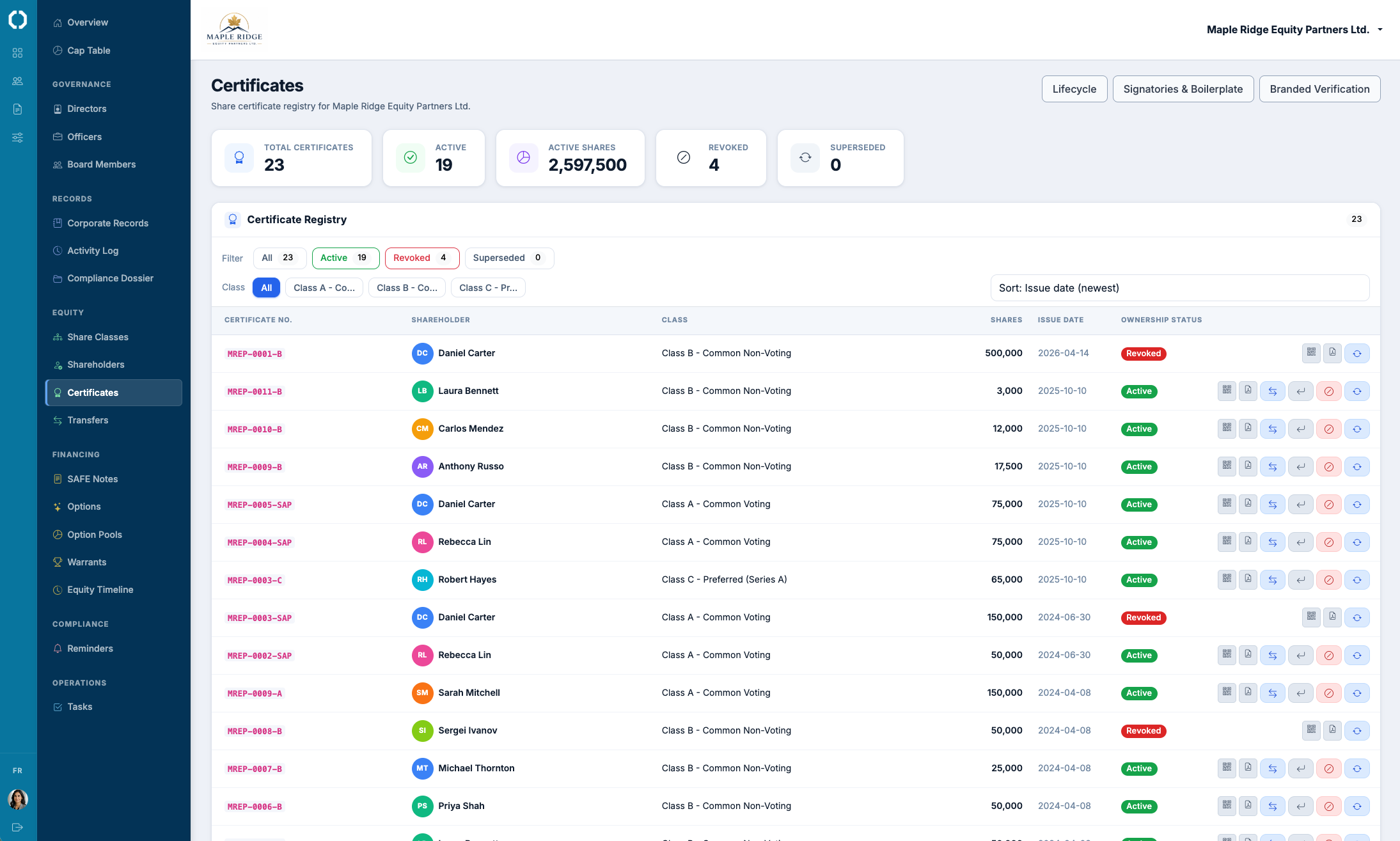
Octelligence issues share certificates with QR codes that resolve to a public verification page. Cancellations and reissuances flow through the same workflow as issuance, so the certificate, the register, and the cap table stay aligned.
See Digital Corporate RecordsQR-verified share certificates, public verification pages, and a register that always agrees with the certificate in hand.