Share certificate requirements for a UK private limited company
UK Companies Act 2006 s. 768 makes the share certificate prima facie evidence of title to the shares. UK private companies must issue certificates within two months of allotment under s. 769, unless a contrary provision applies.
| CA 2006 s. 768 | Share certificate as evidence of title |
|---|---|
| CA 2006 s. 769 | Duty of company to issue share certificates |
| CA 2006 s. 776 | Duty to issue certificates on transfer |
| CA 2006 s. 779 | Issue of certificates on conversion |
| Uncertificated Securities Regulations 2001 | Uncertificated shares (CREST) |
- UK companies must issue certificates within two months of allotment or transfer (s. 769) unless the shares are uncertificated (in CREST) or the articles provide otherwise
- Section 768 establishes the certificate as prima facie evidence of the holder's title to the shares
- Required content: company name, registration number, holder name, class and number of shares, applicable restrictions
- Execution: under the corporate seal or, if articles permit, signed by two directors or a director plus the company secretary
- Uncertificated shares are permitted for publicly traded shares held in CREST; private companies may have uncertificated regimes via articles
Two-month issuance duty (s. 769)
Section 769 of the Companies Act 2006 imposes an affirmative duty on a UK company to deliver share certificates to allottees and transferees within two months of:
- An allotment of shares (issuance to a new shareholder), OR
- A registered transfer of shares
This duty is unique to the UK among the jurisdictions surveyed here. Most other jurisdictions either permit immediate uncertificated issuance or do not impose a fixed deadline for certificate delivery. The two-month rule means UK companies cannot indefinitely delay certificate issuance, failure to deliver within the period is an offence by the company and every officer who is in default, with daily fines.
Certificate as prima facie evidence (s. 768)
Section 768 makes the share certificate, with the company's common seal (or under the alternative execution methods) affixed, prima facie evidence of the holder's title to the shares. This is a stronger evidentiary position than most other jurisdictions afford: in the UK, possession of a properly issued certificate creates a presumption of ownership that the company must rebut.
The presumption is not conclusive, the register of members under s. 113 remains the authoritative record where it conflicts with a certificate, but s. 768 makes UK share certificates particularly valuable documents to issue and to receive.
Required content and execution
UK share certificates conventionally state:
- The company's name and registered number
- The name of the holder
- The number and class of shares held
- The certificate number
- The date of issuance
- Any restrictions on transfer (typically referencing the articles or a shareholders' agreement)
Execution is by the company seal (still permitted under s. 44) or, more commonly today, by signature of two directors or one director plus the company secretary. Many UK companies have abolished the use of the common seal in their articles and rely solely on the signature methods. The 2006 Act expressly permits this.
Uncertificated shares: CREST
The UK has had a sophisticated uncertificated-shares regime since the Uncertificated Securities Regulations 2001, anchored by CREST (the UK's central securities depository operated by Euroclear UK & International). Publicly traded UK shares are typically held in uncertificated form within CREST; share certificates are not issued for these shares.
Private UK companies may, by their articles, adopt uncertificated-share regimes. In practice, most private UK companies still issue paper or digital share certificates because the CREST infrastructure is geared to public-company use. Private uncertificated-share systems exist but are less common than in the US.
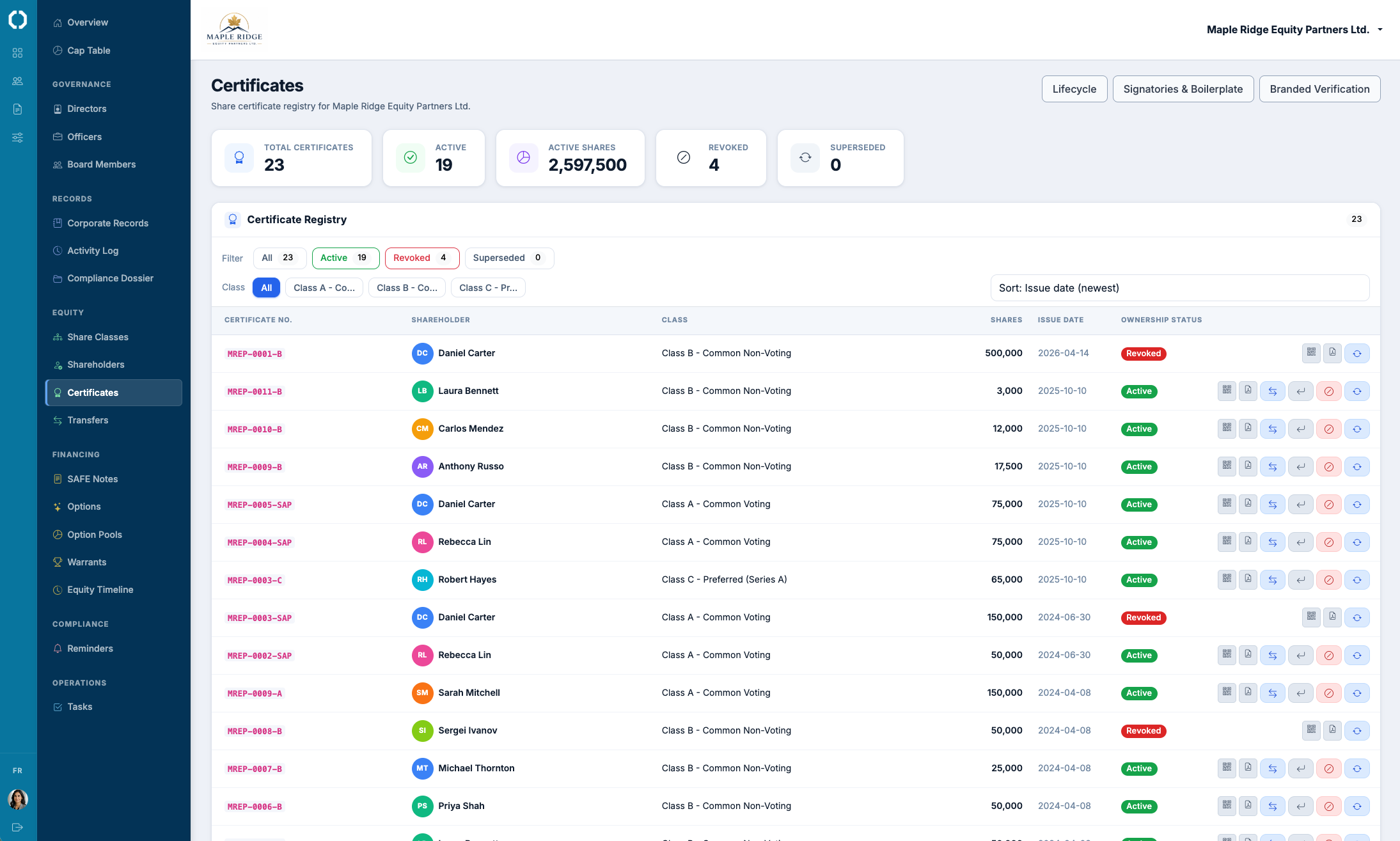
Octelligence issues share certificates with QR codes that resolve to a public verification page. Cancellations and reissuances flow through the same workflow as issuance, so the certificate, the register, and the cap table stay aligned.
See Digital Corporate RecordsQR-verified share certificates, public verification pages, and a register that always agrees with the certificate in hand.