Stock certificate requirements in North Carolina (NCBCA)
What a North Carolina corporation must know about stock certificate requirements under North Carolina Business Corporation Act, N.C.G.S. § 55-1-01 et seq.: statute citations, mechanics, and inspection rights.
| N.C.G.S. § 55-6-25 | Share certificates |
|---|---|
| N.C.G.S. § 55-6-26 | Uncertificated shares |
| N.C.G.S. § 55-6-27 | Transfer restrictions |
| N.C.G.S. § 55-6-28 | Lost or destroyed certificates |
- Must show corporation name, holder name, number and class of shares, and signing officers
- Signed by authorized officers (typically president and secretary); facsimile signatures permitted
- Restrictive notations required when shares are subject to transfer restrictions
- Uncertificated shares permitted under the MBCA framework; widely used in modern startups
- Transfer requires endorsement and surrender of the old certificate (or registry entry for uncertificated shares)
What the NCBCA requires
N.C.G.S. § 55-6-25 prescribes stock certificate content. NC follows the MBCA framework.
- Corporation name (in full)
- Statement that the corporation is incorporated under the applicable state law
- Name of the person to whom the certificate is issued
- Number and class or series of shares
- Signatures of authorized officers
Restrictive notations
When shares are subject to transfer restrictions (shareholders agreements, options, or other restrictions), the certificate must bear a restrictive notation. Without it, the restriction may be unenforceable against a good-faith purchaser without notice. This is uniform across MBCA-tradition states.
Uncertificated shares
Most MBCA-tradition states permit corporations to issue shares without physical certificates. In that case, the stock ledger is the proof of ownership. This option is increasingly common, especially for venture-backed and tech-focused corporations.
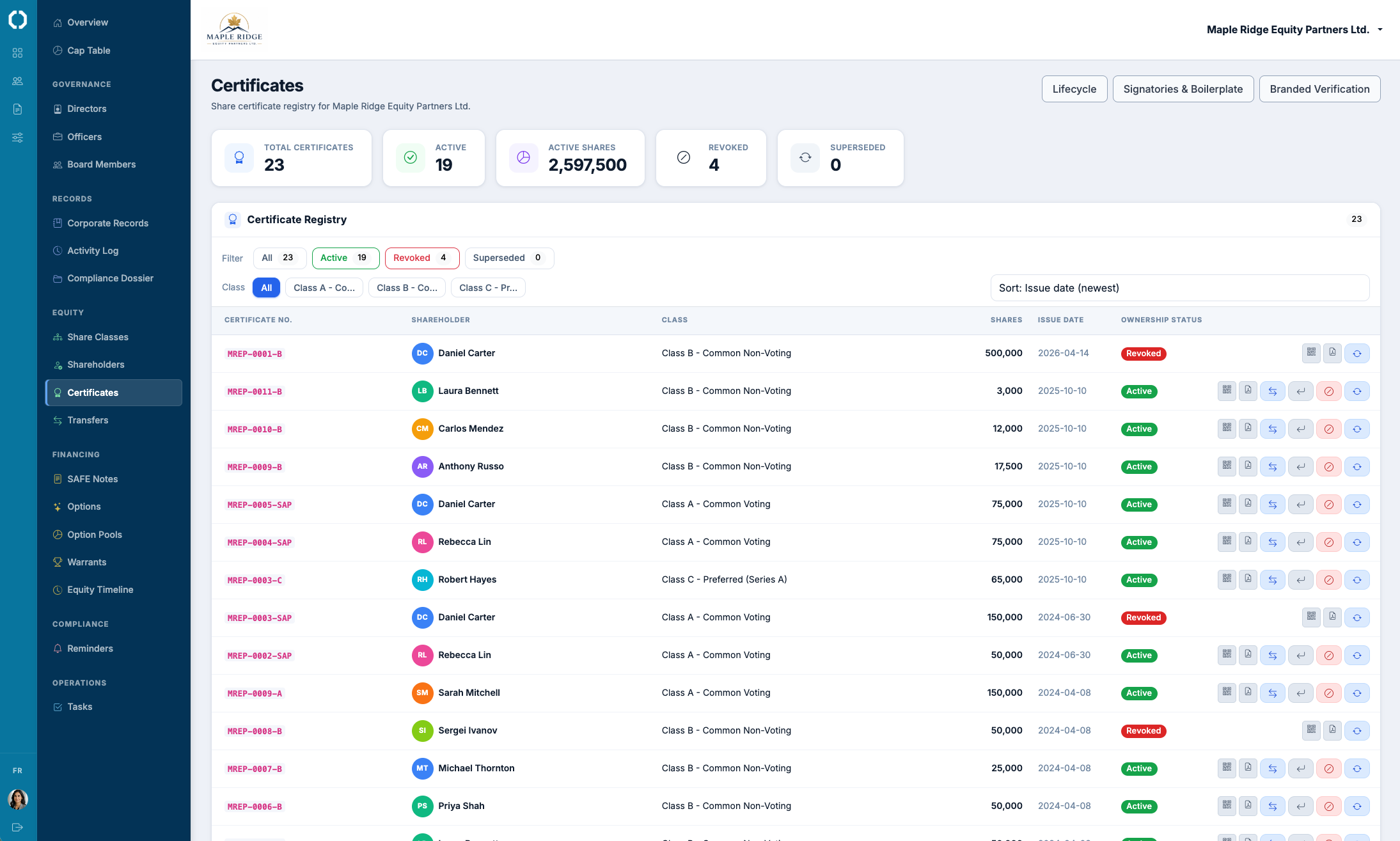
Octelligence issues stock certificates that comply with the applicable state corporation code. Each certificate carries a QR-verifiable hash and is linked to the issuance in the stock ledger, with full history of cancellations and reissues.
See Digital Corporate RecordsStatutory-compliant content, QR verification, full transfer audit trail.